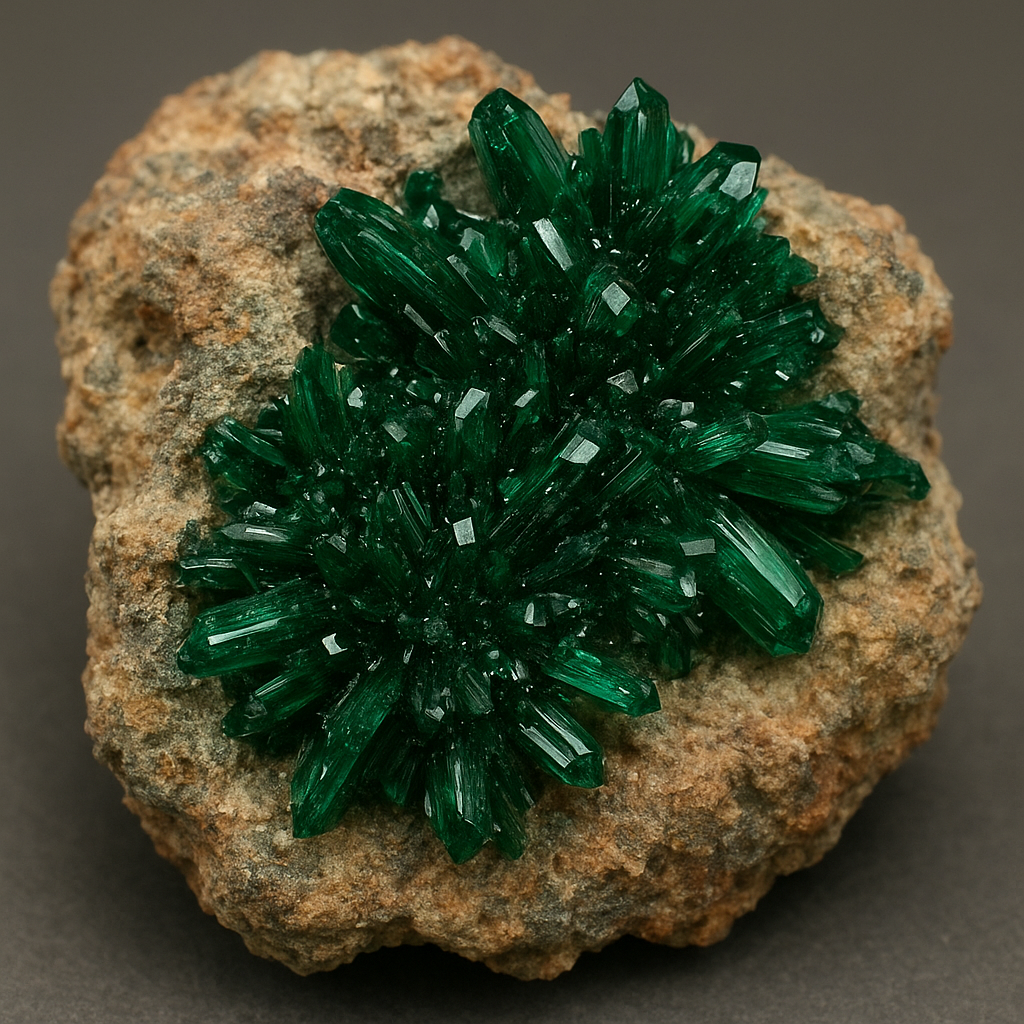
Atacamite is a striking green mineral that captures the attention of geologists, mineral collectors and conservators alike. Beyond its vivid color, this mineral records environmental histories, signals the presence of chloride-rich fluids, and complicates the preservation of archaeological metalwork. In the following sections I will describe what atacamite is, how and where it forms, its practical and cultural significance, and some intriguing scientific and conservation-related stories connected to it.
What is atacamite?
Atacamite is a copper chloride hydroxide mineral with the ideal chemical formula Cu2Cl(OH)3. It typically forms as green to dark green prismatic or acicular crystals and crusts. As a secondary mineral, atacamite develops when copper-bearing materials react with chloride-bearing solutions under specific environmental conditions. The mineral commonly displays a vitreous to subadamantine luster and a relatively low hardness in the Mohs scale, which makes it easy to recognize in hand specimen when combined with its color and habit.
Mineralogically, atacamite belongs to a group of chemically identical but structurally distinct phases — often referred to as polymorphs — that include forms such as paratacamite and botallackite. Although they share the same chemical components, each polymorph has a different internal arrangement of atoms, which leads to differences in crystal system, stability range and appearance. Identifying the precise polymorph often requires analytical methods like X-ray diffraction (XRD) or Raman spectroscopy rather than simple visual inspection.
Where atacamite occurs
Atacamite is named after the Atacama Desert region of northern Chile, where it was first described. Its occurrence is, however, global wherever conditions favor the concentration of chloride and the oxidation or alteration of copper. The mineral is most commonly found in:
- Oxidized zones of copper deposits, where groundwater or surface waters transport chloride and react with primary copper minerals.
- Coastal environments and sea caves affected by marine aerosols and spray, where salt-laden air accelerates chloride-driven alteration.
- Arid and semi-arid climates, where evaporation concentrates salts and promotes the crystallization of secondary minerals.
- Archaeological and historic copper or bronze artifacts exposed to chloride contamination, particularly in burial or marine contexts.
Famous localities and regions that have produced noteworthy atacamite specimens include Chile (the type region), parts of the southwestern United States, Mexico, Spain, the United Kingdom (notably Cornwall), Namibia and Australia. Important specimen localities often share a combination of copper-rich primary minerals and access to chloride sources — whether from saline groundwater, sea spray or anthropogenic salts.
Associated minerals
- Malachite and azurite — other secondary copper carbonates often found nearby when carbonate chemistry dominates.
- Brochantite and chalcanthite — additional copper sulfate or chloride phases that can co-occur during oxidative alteration.
- Cuprite and tenorite — primary or early-formed copper oxides that can be transformed into chlorinated hydroxides.
- Native copper and various sulfides — which may be the original copper sources.
How atacamite forms: chemistry and environments
The formation of atacamite typically requires three basic ingredients: a source of copper, a source of chloride, and environmental conditions that permit oxidation and precipitation of a hydroxide. Groundwater, marine spray, or evaporite deposits often supply chloride; oxidation of primary copper sulfides or exposure of metallic copper provides the copper; and variable humidity or evaporation drives the precipitation of the mineral.
In geologic settings, atacamite often appears in the oxidized envelope above sulfide deposits when saline solutions percolate through rock and react with exposed copper minerals. The transformation is influenced by local pH, availability of dissolved oxygen, temperature and the concentration of chloride. In archaeological contexts, atacamite can form when buried copper alloys interact with chloride-bearing soils or when marine-recovered objects are inadequately desalinated. In these cases, copper chlorides can form first and then hydrolyze to produce atacamite and related phases.
A commonly cited sequence in an archaeological corrosion scenario begins with the formation of copper(I) chloride (nantokite, CuCl) as chloride attacks the metal. With water and oxygen, hydrolysis and oxidation can then transform CuCl into copper chloride hydroxides such as atacamite. This chain of reactions is central to the problem conservators call corrosion or, in the context of bronzes and archaeological copper, the damaging process known as “bronze disease.”
Identification methods and physical properties
While color and habit are useful first clues, identifying atacamite reliably usually requires instrumental analysis:
- X-ray diffraction (XRD) to determine crystallographic structure — essential to distinguish between atacamite and its polymorphs.
- Raman spectroscopy and Fourier-transform infrared spectroscopy (FTIR) for non-destructive mineral identification on artifacts and specimens.
- Scanning electron microscopy with energy-dispersive X-ray spectroscopy (SEM-EDS) for morphological detail and semi-quantitative chemical composition, particularly to detect chlorine content.
- Optical microscopy under polarized light can be informative for transparent to translucent microcrystals.
General physical characteristics of atacamite include a bright green color range, a relatively low Mohs hardness (often about 3 to 4), and a specific gravity that reflects its copper content. It frequently appears as acicular crystals, fibrous aggregates, or earthy crusts, and it readily forms thin encrustations on surfaces where chloride-laden solutions evaporate.
Uses, implications and cultural significance
Atacamite is not a material of large-scale industrial use, but it carries several important roles and meanings across disciplines:
- Collectors prize well-formed crystals for their color and habit; fine specimens can be quite sought after in the mineral trade.
- In art history and conservation, atacamite provides clues about the provenance and environmental exposure of artifacts and paintings. Traces of copper chloride hydroxides reveal past interactions with saline environments or specific pigment recipes.
- As an indicator mineral in economic geology, the presence of atacamite can signal the oxidation of a nearby copper deposit and point to geochemical conditions favorable for exploration.
- Researchers study synthetic and natural copper chloride hydroxides for potential applications in catalysis, photocatalysis and antimicrobial coatings, though atacamite itself remains primarily of academic and conservation interest.
Historically, copper-based greens have been used as pigments in various cultures. While other copper minerals and compounds (such as malachite or copper acetates) are more frequently cited as pigments, chlorinated copper hydroxides including atacamite and its polymorphs have also been found in the patinas and surface layers of historical objects and artworks, adding layers of complexity to conservation treatments.
Atacamite in conservation: a challenge for caretakers
When atacamite appears on archaeological metalwork or museum objects, it is often a symptom rather than a neutral ornament. The presence of chlorides can portend ongoing deterioration: under fluctuating humidity, chlorides can migrate and react, leading to repeated cycles of salt crystallization, hydration and expansion that mechanically disrupt surfaces. Conservators therefore pay particular attention to copper chloride minerals because their stability is closely tied to the local microenvironment.
Standard approaches in the conservation community typically emphasize control of relative humidity, careful desalination of artefacts recovered from marine environments, and the use of corrosion inhibitors (for example, benzotriazole for copper alloys) where appropriate. Sophisticated analytical monitoring — including chloride mapping and microchemical tests — helps guide treatment choices. The goal is often to stabilize the object and prevent further formation of harmful chlorinated phases, rather than to remove all traces of historic patinas which may have aesthetic or informative value.
Practical examples in conservation
- Marine-recovered bronzes often require repeated desalination baths; failure to remove chlorides can allow atacamite to form after display or storage.
- Coins and small metal finds from saline soils are routinely screened for copper chlorides before stabilization and curation.
- Metal objects displayed in coastal museums may need aggressive climate control and barrier methods to avoid salt-laden corrosion cycles.
Related minerals and polymorphism
The chemical family represented by Cu2Cl(OH)3 shows a diversity of structural arrangements. The most commonly discussed members are atacamite, paratacamite and botallackite. Although their chemistry is essentially equivalent, differences in symmetry and bonding lead to different crystal habits and relative stabilities. These polymorphs may form under subtly different conditions of temperature, pH, chloride concentration and rate of precipitation.
Because polymorphism matters for stability and for the way the mineral interacts with its environment, distinguishing among these phases is important for geochemists and conservators. For example, one polymorph might be more stable under a given humidity regime, affecting long-term preservation strategies for cultural heritage objects that host such compounds.
Scientific interest and modern research directions
Although atacamite itself is not produced at industrial scale for major applications, researchers have explored copper chloride hydroxides for various scientific and technological reasons:
- Photoactive and catalytic properties: copper-containing minerals and synthetic analogues are of interest for redox and light-driven chemical processes.
- Antimicrobial surfaces: copper and certain copper compounds have well-known antimicrobial behavior; scientists examine a range of copper phases for surface applications.
- Model systems for corrosion studies: atacamite and related phases serve as model products for studying chloride-driven corrosion mechanisms on cultural heritage objects and modern materials alike.
These research avenues often use synthetic materials that mimic the composition or structure of atacamite, allowing controlled experiments that inform both basic science and applied fields such as materials science and conservation technology.
Interesting occurrences and stories
The mineral’s eponymous connection to the Atacama Desert is more than historical trivia: the desert’s hyperarid climate concentrates salts and preserves delicate mineral assemblages, making it a laboratory for studying evaporite-related mineralization. In another arena, the discovery of atacamite and related chlorides on recovered shipwreck bronzes has provided dramatic, sometimes heartbreaking examples of how rapidly chloride-driven deterioration can proceed when artifacts are not treated appropriately.
Collectors and museums occasionally encounter surprising finds — for example, bright green atacamite crusts on otherwise unremarkable fragments, or microscopic growths in encrusted archaeological contexts that reveal hidden chemical pathways. For mineralogists, the interplay of structure, environment and chemistry in the atacamite group illustrates the broader principle that simple chemical formulas can lead to a rich variety of natural forms.
Note on terminology:
The vocabulary surrounding copper chlorides and hydroxides can be confusing because many related names exist (nantokite, atacamite, paratacamite, botallackite, clinoatacamite, etc.), and because compositions may vary with substitution and hydration. Precise analytical work is often required to untangle these names in real-world samples.
How to study atacamite in the field and the lab
For field geologists and collectors, careful observation and documentation are first steps: record the mineral’s habit, color, texture, and the geological or archaeological context. For conservators and scientists, the follow-up often includes:
- Non-destructive surface analyses (portable XRF, Raman spectroscopy).
- Sampling for laboratory XRD to confirm crystallography.
- SEM-EDS for morphology and elemental mapping to confirm chlorine and copper distribution.
- Environmental monitoring to assess whether observed atacamite is stable under present storage or display conditions.
Because atacamite formation is intimately tied to environmental conditions, long-term handling strategies are as important as the initial identification. Documentation and preventive measures can be decisive in preserving both scientific information and cultural value.
Final observations
The story of atacamite spans natural geochemical processes, the challenges of preserving human artifacts, and niche scientific inquiry. As a mineral, it is a vivid reminder that color and chemistry often encode dynamic histories of water, salt and time. Whether admired as a collector’s specimen, used as a clue by a field geologist, or treated carefully by a conservator saving a piece of human heritage from disintegration, atacamite continues to occupy a compelling intersection of science, culture and conservation.