
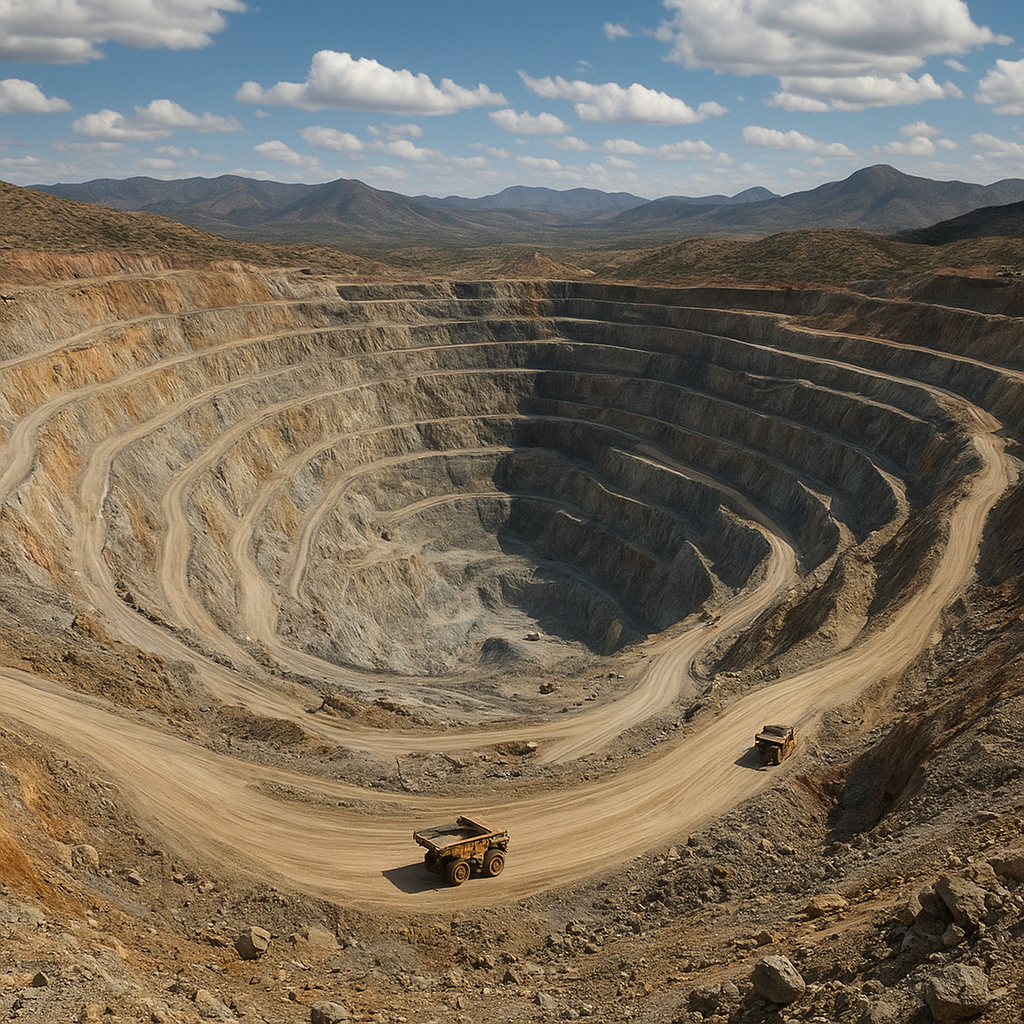
The Penasquito mine is one of Mexico’s most important modern mineral operations, notable for its polymetallic output and regional significance. Located in the north-central state of Zacatecas, the operation produces a mix of precious and base metals that contribute to both company revenues and local economies. This article examines where Penasquito sits on the map, what is extracted there, how the mine operates, its economic footprint, environmental and social aspects, and several noteworthy technical and historical details that make Penasquito a compelling case study in contemporary mining.
Location and geological setting
Penasquito lies in the municipality of Mazapil in the state of Mexico (Zacatecas), a region long known for its mineral wealth. The deposit is situated on the Mexican Plateau, north of the city of Zacatecas, in a landscape of semi-arid plains and rolling hills. Accessibility is relatively good by Mexican standards: the site is served by roads that connect to regional highways and to the nearest service centers for supplies, labor, and logistics.
Geologically, Penasquito is a classic example of a large, polymetallic carbonate-replacement and skarn-related system. The mineralization occurs as disseminated and massive sulfide bodies replacing carbonate host rocks, with a complex assemblage of sulfide and oxide minerals. The deposit hosts economically valuable concentrations of Gold, Silver, Zinc, and lead, with copper and other metals present as by-products in varying amounts. The spatial distribution of metals within the deposit reflects hydrothermal fluid pathways and multiple mineralizing events that affected the carbonate platform rocks during regional tectonic activity.
History, ownership and development
Penasquito was advanced through exploration and permitting by a major mining company and entered commercial production in the early 2010s. The operation was developed by Goldcorp and later became part of Newmont’s portfolio following corporate consolidation in the precious metals sector. Today the mine operates as a part of the broader assets managed by Newmont, aligning Penasquito with one of the world’s largest gold producers and benefiting from corporate-level technical, finance, and sustainability frameworks.
Exploration to production timeline
- Exploration phases identified a large footprint of polymetallic mineralization with good continuity.
- Feasibility studies and permitting in the late 2000s supported development of a large-scale open-pit mine.
- Construction and commissioning proceeded quickly, allowing commercial operations to start around 2010.
- The mine has since moved through phases of pit expansion, optimization of processing, and resource reconciliation as part of routine mine life management.
Mining methods and processing
Penasquito is primarily an open-pit mining operation, designed to extract large tonnages of ore with varying grades of precious and base metals. Open-pit methods allow for efficient removal of overburden and ore, with benching, drilling, blasting, and haulage to primary crushers conducted on a large scale. The mine’s design emphasizes high throughput to maximize recovery of the low-to-medium grade but high-tonnage mineralization characteristic of the deposit.
Processing and recovery
The processing facilities at Penasquito are tailored to recover both precious and base metals. A combination of crushing, grinding, and flotation circuits is typically used to concentrate sulfide minerals. Precious metals such as Gold and Silver are recovered through downstream processes that may include leaching or specialized recovery circuits depending on ore characteristics. Zinc and lead are recovered as concentrates via flotation and then shipped to smelters or refineries for final processing. Operational flexibility is important because mineralogy varies within the deposit and processing must adapt to changing feed.
Logistics and infrastructure
- On-site infrastructure includes crushing, grinding, flotation, reagent storage, and tailings facilities.
- Power and water supply are critical: water is managed carefully in a semi-arid region, and energy supply is coordinated with grid and, in some cases, on-site generation.
- Transport routes connect Penasquito to national rail and road networks for concentrate shipments and supply deliveries.
Resources, production and economic importance
Penasquito is valued for its combination of metals rather than a single standout commodity. The mine’s resource base has historically included significant ounces of Gold and Silver plus large tonnages of Zinc and lead, giving it flexibility across commodity cycles. Because the operation produces a mix of precious and base metals, it can offset volatility in one commodity with gains in another, smoothing revenue streams.
Economic role at local and national levels
The economic contribution of Penasquito extends across several dimensions:
- Employment: The mine provides direct jobs in mining, processing, engineering, and administration, as well as indirect employment through contractors and service providers.
- Supplier networks: Local and regional businesses supply goods and services, stimulating the provincial economy.
- Government revenue: Taxes, royalties, and duties from mine operations contribute to municipal, state, and federal budgets.
- Export value: Concentrates produced at Penasquito form part of Mexico’s mineral export portfolio, supporting foreign exchange earnings and trade balances.
On a corporate level, Penasquito has been an important asset within Newmont’s global portfolio, contributing to overall production and supporting capital allocation decisions across the company’s other projects.
Environmental management and social engagement
Large-scale mining in semi-arid regions requires careful environmental stewardship. Penasquito’s environmental strategy focuses on minimizing water consumption, managing tailings and waste rock, limiting dust and emissions, and planning for eventual closure and reclamation. A combination of engineering controls, monitoring programs, and adaptive management practices is used to mitigate environmental impacts.
Key environmental measures
- Tailings management: Tailings facilities are designed with multiple barriers and monitoring to reduce risks of seepage or failure.
- Water management: Recycling, efficient processing circuits, and responsible consumption practices reduce freshwater withdrawals in a water-stressed region.
- Progressive reclamation: Disturbed areas are progressively rehabilitated where feasible, reducing the long-term footprint of operations.
Social license is equally critical. Community engagement programs aim to establish and maintain constructive relationships with nearby towns and indigenous or rural populations. Initiatives commonly include community development projects, employment and training programs, procurement opportunities for local businesses, and transparent communication about operational plans and environmental monitoring results. The mine must also manage expectations about the finite nature of mining jobs and the importance of legacy planning for life after mine closure.
Challenges, opportunities and future outlook
Like any large mining operation, Penasquito faces a range of operational and strategic challenges as well as opportunities:
- Commodity prices: Fluctuations in gold, silver, and zinc prices directly affect profitability and investment decisions.
- Resource variability: Geological complexity requires ongoing exploration and detailed geological modeling to optimize recoverable reserves and plan pit expansions.
- Regulatory and permitting environment: Compliance with evolving environmental and social regulations influences operational flexibility and cost structures.
- Technological adoption: Opportunities exist to increase efficiency and reduce environmental impact through improved processing technologies, automation, and digital mine tools.
Corporate consolidation and ongoing exploration in the region also open options for resource conversion and potential extensions of mine life. Sustained investment in exploration on satellite deposits or deeper zones could provide additional ore feeds, while improvements in metallurgical recoveries could enhance margins and lower unit costs.
Interesting technical and historical aspects
Penasquito offers several noteworthy technical and historical features that make it stand out:
- Polymetallic nature: The combination of precious and base metals in a single large deposit is relatively uncommon at the scale seen at Penasquito, enabling diversified revenue streams.
- Geotechnical scale: The open pit has been engineered to accommodate high production rates and complex bench designs while managing slope stability in variable rock masses.
- Processing flexibility: The processing plant was designed to adapt to changing ore types and metallurgical characteristics, transitioning between flotation, leaching, or combined circuits as required.
- Supply chain integration: Given the polymetallic output, the mine’s logistics and marketing operations must coordinate with multiple purchasers and smelters for different concentrate streams.
- Regional precedent: Penasquito’s development reinforced Zacatecas’s reputation as a mining-friendly region, encouraging further exploration and investment in the state.
Technical staffing, innovation and safety
A modern operation such as Penasquito depends heavily on technical expertise across geology, engineering, metallurgy, environmental sciences, and social disciplines. The mine has invested in training and technical transfer to build local capacity, complementing expatriate and corporate specialists. On the innovation front, advances in geometallurgy, real-time monitoring, and process control can yield productivity gains and reduce environmental footprints.
Safety is a central pillar of the operational culture: measures encompass slope management, dust suppression, equipment maintenance, and workforce training. Minimizing incidents and maintaining operational continuity are essential for both human welfare and economic performance.
Concluding observations
Penasquito exemplifies how a single large deposit can have layered impacts: it is a significant producer of precious and base metals, a source of regional jobs and government revenue, and a focus for technical innovation and environmental stewardship in a challenging semi-arid setting. Its polymetallic character, open-pit scale, and integration into a global mining company’s portfolio make the mine an instructive example of modern mining economics and practice. As commodity markets evolve, as new technologies mature, and as stakeholders increasingly demand stronger environmental and social performance, Penasquito will continue to be a test case for balancing resource extraction with sustainable regional development and responsible mining practices.

