Arfvedsonite is a striking and scientifically valuable dark amphibole that attracts the attention of mineral collectors, petrologists, and lapidaries alike. Its combination of deep color, complex chemistry and occurrence in unusual alkaline rocks makes it both an attractive specimen and an informative probe into magmatic processes. This article explores the nature of arfvedsonite, where it forms, how it is identified and studied, its uses, and several intriguing aspects that connect mineralogy, geology and cultural history.
What is arfvedsonite?
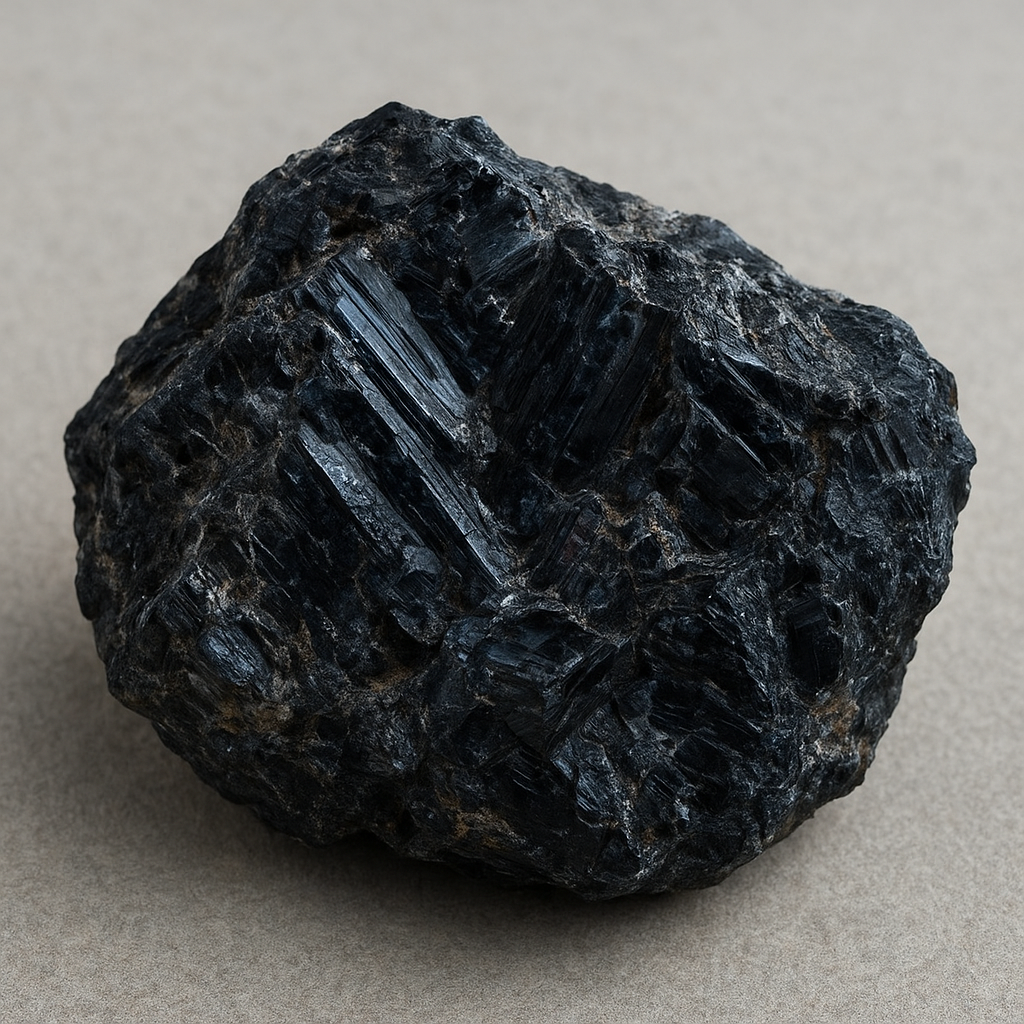
Arfvedsonite belongs to the large amphibole family of silicate minerals. It is a predominantly sodium– and iron-rich member of the sodium amphibole subgroup, commonly recognized by its dark green to black color and prismatic crystals. In hand sample it usually appears opaque to subtranslucent, and under the hand lens it may show strong pleochroism—changing color when viewed from different directions—typical of iron-rich amphiboles. Because amphiboles form a broad series with many compositional variations, arfvedsonite is best understood as part of a continuum rather than a single fixed endmember; substitutions by magnesium, titanium and other cations are common.
Chemical character and crystal habit
The chemistry of arfvedsonite is complex: its crystal lattice accommodates significant amounts of iron in multiple oxidation states and substantial sodium in the larger cation sites. This combination produces a dense, iron-rich amphibole with characteristic optical and physical properties that set it apart from more common calcic amphiboles. Morphologically, arfvedsonite typically forms elongated, prismatic crystals or radiating aggregates. In rare cases it occurs in fibrous habits; such fibrous amphiboles should be handled with caution because asbestiform amphiboles of other species are known health hazards.
Occurrence and notable localities
Arfvedsonite is most characteristic of alkaline, silica-undersaturated igneous environments. It commonly crystallizes in peralkaline granites, nepheline syenites, phonolites, and agpaitic pegmatites—settings where alkalis (sodium and potassium) are abundant and silica is relatively scarce. These environments favor the stabilization of sodium-dominant amphiboles over their calcium-dominant counterparts.
- Alkaline intrusive complexes: Nepheline syenites and related pegmatitic veins are classic hosts. Arfvedsonite often appears as an accessory or primary mineral in these rock types, associated with feldspathoids and alkali feldspars.
- Peralkaline volcanic rocks: In some continental rift and intraplate volcanic provinces, arfvedsonite can occur in late-stage alkaline lavas and dikes where magmas evolve to high sodium/low silica compositions.
- Metasomatic and skarn-like zones: In certain contact or hydrothermal environments where alkaline fluids interact with surrounding rocks, arfvedsonite may form as a product of metasomatic alteration.
Notable localities for high-quality arfvedsonite specimens include alkaline complexes in Canada (e.g., Mont Saint-Hilaire and other carbonatite-alkaline provinces), Greenland’s agpaitic complexes, and several Scandinavian alkaline massifs. Smaller but scientifically important occurrences are recorded in Russia, the United States (notably in Nevada and parts of the western US alkaline provinces), and parts of Africa and Asia where peralkaline magmatism has produced distinctive suites of minerals.
Physical and optical properties useful for identification
Arfvedsonite displays a suite of diagnostic properties that make it recognizable both in the field and under the microscope:
- Color: typically very dark green to black; thin fragments may show deep brownish-green hues.
- Streak: usually dark gray to black.
- Cleavage: two prominent cleavages intersecting at angles characteristic of amphiboles (approximately 56° and 124°), producing good cleavage planes for cleavage fragments.
- Hardness: moderate, typically around 5−6 on the Mohs scale.
- Specific gravity: relatively high due to iron content, often between about 3.2 and 3.6 depending on composition.
- Optical properties: strong pleochroism (color variations in polarized light), high relief, and distinct absorption features in thin section that reflect its iron-rich nature.
Laboratory methods such as X-ray diffraction (XRD), electron microprobe analysis (EMPA), and optical petrography provide definitive identification. Spectroscopic techniques—infrared, Raman, and Mössbauer spectroscopy—are particularly valuable for assessing iron oxidation states and structural OH content, both of which are important to classify amphiboles precisely.
Uses and applications
Arfvedsonite is not widely used industrially, but it has several important applications in science, collecting and, occasionally, lapidary arts:
- Petrogenetic indicator: In igneous petrology, the presence of arfvedsonite signals an alkali-rich and often silica-undersaturated magmatic environment. Its composition—especially the proportions of Fe2+/Fe3+ and substitution by Mg or Ti—can be used to infer conditions of crystallization such as oxygen fugacity, magma temperature and the evolution of late-stage magmatic fluids.
- Geochemical tracer: Because arfvedsonite incorporates sodium and iron in distinctive ways, trace-element studies and isotopic analyses of arfvedsonite can help reconstruct magma sources and differentiation processes, particularly in peralkaline complexes.
- Collecting and display: High-quality arfvedsonite specimens are prized by mineral collectors for their dark, lustrous prismatic crystals and their association with unusual and colorful companion minerals. Specimens from famous alkaline complexes can be both aesthetic and scientifically informative.
- Lapidary use: On rare occasions, translucent arfvedsonite has been fashioned into cabochons or small ornamental pieces. Its cleavage and variable transparency make it a challenging gem material, so such use is limited and mostly of interest to niche collectors and artisans.
- Educational and research specimen: Universities and museums use arfvedsonite to teach mineralogy, crystallography and igneous petrology because it exemplifies the effects of chemical environment on mineral stability.
Associated minerals and geological context
Arfvedsonite typically occurs alongside a distinctive suite of minerals that reflect its alkaline, silica-poor host environment. Common associates include nepheline, sodalite, aegirine, alkali feldspar, and other sodium-rich silicates. In agpaitic pegmatites and peralkaline granites, it may be found with rare minerals such as eudialyte, rinkite-group minerals, and various complex zirconium and rare-earth element (REE) bearing species.
The presence of arfvedsonite in a rock often correlates with late-stage hydrothermal or magmatic fluids that are enriched in alkalis and volatile components. These fluids drive the growth of exotic mineral assemblages and can concentrate REE and other incompatible elements, making arfvedsonite-bearing suites of interest in economic geology and mineral exploration.
Scientific studies and analytical approaches
Modern studies of arfvedsonite span crystallography, spectroscopy, thermodynamics and geochemistry. Researchers use a combination of techniques to understand its structure and formation:
- X-ray diffraction (XRD): Determines the crystal structure and distinguishes arfvedsonite from closely related amphibole species.
- Electron microprobe (EMPA): Measures major and minor element concentrations, allowing precise classification within amphibole nomenclature.
- Mössbauer and X-ray absorption spectroscopy: Provide detailed information on iron oxidation states and site distributions, which are critical to interpreting formation conditions and magnetic properties.
- Raman and infrared spectroscopy: Reveal vibrational modes associated with the silicate framework and OH groups, useful for identifying structural variants and assessing hydrogen content.
- Experimental petrology: Laboratory studies that recreate high-temperature, high-pressure conditions help constrain the stability fields of arfvedsonite and related minerals, shedding light on the temperature, pressure and chemical environment of crystallization.
Collecting, hazards and care of specimens
Collectors prize arfvedsonite for its crystal form and association with rare alkaline minerals. When collecting and handling specimens, several practical considerations apply:
- Because many amphiboles, as a group, can form fibrous, asbestiform varieties, any material that appears fibrous should be approached with caution. While arfvedsonite is not commonly mined as asbestos, appropriate handling precautions (gloves, dust control, avoiding inhalation of dust) are sensible when preparing or trimming specimens.
- Polishing and lapidary work should avoid generating fine dust; wet cutting and polishing methods reduce airborne particles.
- Specimens may be sensitive to strong acids or bases used in cleaning; many collectors use gentle mechanical cleaning or mild detergents to preserve surface luster and associated delicate minerals.
- Because cleavage planes can cause splitting, store arfvedsonite specimens with padding and avoid dropping or striking.
Historical and etymological notes
The mineral’s name honors the Swedish chemist Johan August Arfwedson, best known for discovering the element lithium in the early 19th century. The naming recognizes his contributions to chemistry, and it reflects a period when many new minerals were being described and named to commemorate notable scientists. Historical collections from classical alkaline localities include some of the earliest described arfvedsonite specimens, and museum collections continue to preserve specimens that illustrate the mineral’s variability and associations.
Interesting aspects and broader connections
Several features make arfvedsonite especially interesting beyond its basic mineralogical description:
- Indicator of specialized magmatic chemistry: Arfvedsonite’s stability in peralkaline systems links it to magmas with unusual elemental budgets, including enrichment in alkalis and volatiles. Such magmas are important for understanding continental rifting, intraplate volcanism and the generation of rare-element mineralization.
- Sensitivity to redox conditions: The iron oxidation state in arfvedsonite responds to oxygen fugacity during crystallization. Thus, measurements of Fe2+/Fe3+ in the mineral provide constraints on the oxidation conditions of the host magma or hydrothermal fluids.
- Solid-solution behavior: As amphiboles readily incorporate diverse cations, arfvedsonite participates in solid-solution series with related amphiboles. Studying these compositional variations helps mineralogists map chemical zoning in crystals and interpret magmatic evolution.
- Aesthetic and scientific duality: Some arfvedsonite specimens combine visual appeal with scientific information—prismatic crystals whose growth zoning records changing melt compositions, or those associated with rare accessory minerals that tell a story about late-stage magmatic processes.
Practical tips for rockhounds and students
If you are interested in finding or studying arfvedsonite, consider these practical suggestions:
- Explore alkaline igneous complexes and nepheline syenite outcrops; published geological maps and museum collections can point you to promising localities.
- Learn to recognize the characteristic amphibole cleavage and pleochroism in thin section or under a hand lens—these optical clues are often decisive.
- When in doubt, seek laboratory confirmation via XRD or microprobe analysis; many amphiboles are visually similar but chemically distinct.
- Handle specimens and dust-producing activities with care, using wet methods and personal protective equipment where appropriate.