
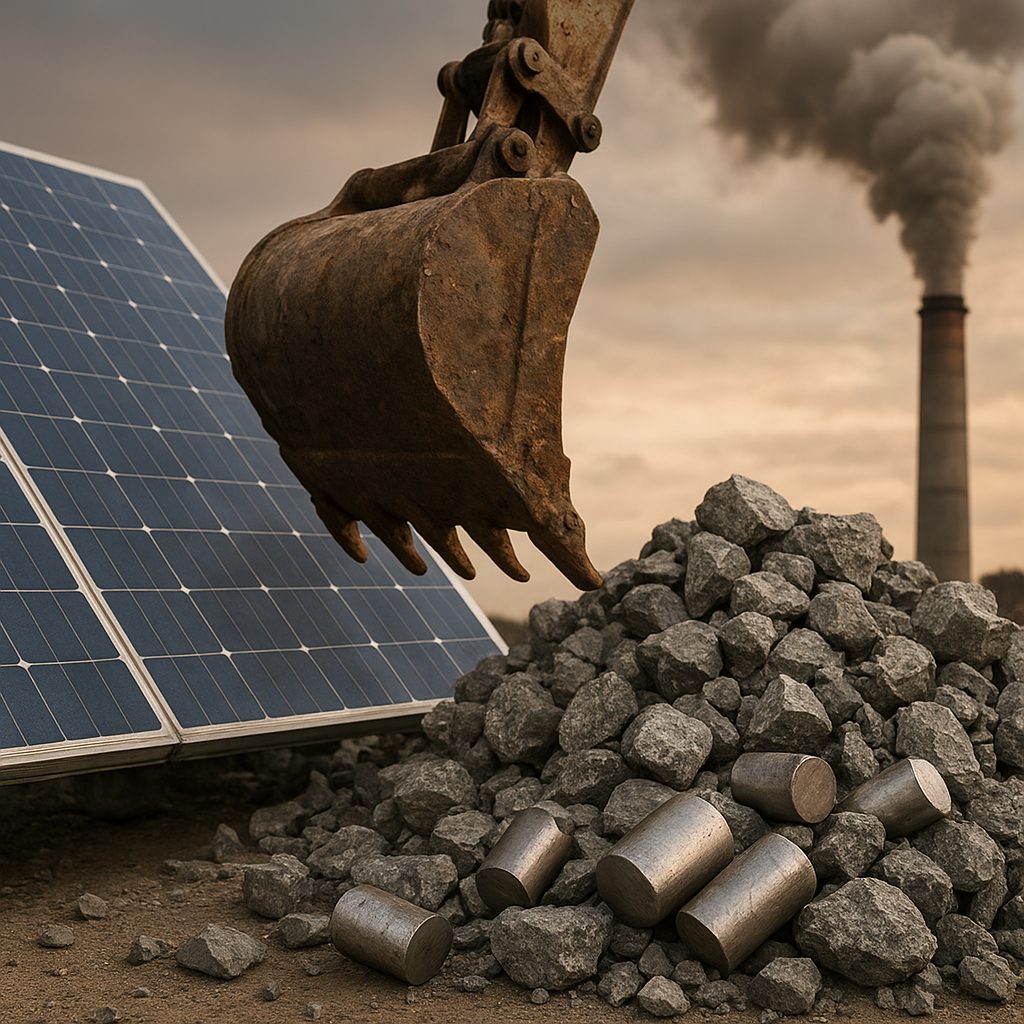
The global push to decarbonize energy systems is rewriting industrial priorities and consumption patterns. As countries accelerate the shift away from fossil fuels toward low-carbon alternatives, demand for a narrower set of materials needed for clean technologies is soaring. This article examines how the energy transition intensifies pressure on supplies of rare metals, why current market and policy responses are often insufficient, and what technological, economic and governance strategies can reduce the risk of long-term shortages.
Demand shock: electrification, storage and the race for critical minerals
At the heart of the shortage dynamics lies a classic demand shock. The global roll-out of solar, wind, grid-scale batteries and electric vehicles generates concentrated demand for specific elements. For example, lithium-ion batteries require substantial amounts of lithium, cobalt and nickel. Permanent magnets used in many wind turbines and electric motors rely on rare-earth elements like neodymium and dysprosium. Photovoltaic manufacturing consumes silver and specialty silicon. The result is rapid growth in consumption of a relatively small basket of commodities while overall metal markets remain modest in scale compared to oil or steel.
This is not simply growth in aggregate metal use. The transition changes compositions: replacing internal combustion engines with electric drivetrains multiplies demand for battery- and motor-related metals per vehicle. Adding large-scale energy storage to balance variable renewables further multiplies demand. Moreover, recycling loops are immature relative to the speed of deployment, so a high share of material must come from primary extraction for decades.
Projected demand trajectories
- Battery systems: forecasts suggest multi-fold increases in lithium and nickel consumption within a decade, with cobalt demand concentrated in specific chemistries.
- Permanent magnets: wind and EV motor growth increases need for neodymium and dysprosium beyond historical mining outputs.
- Electronics and infrastructure: copper, silver and specialty alloys face additional pressure as grids and digital systems expand.
When demand accelerates faster than mines can be permitted, financed and brought online, prices spike, investment cycles lengthen and shortages become a real possibility.
Supply constraints: geology, investment cycles and geopolitical concentration
Supply does not respond instantly to price signals. Mining and refining industries are capital intensive and subject to long lead times. Securing a new mine can take a decade or more from discovery to full production because of exploration, permitting, community agreements and infrastructure. Processing and refining capacity—often the real bottleneck for many critical minerals—is also highly concentrated and slow to expand.
Geopolitics compounds these structural issues. A small number of countries dominate production and processing for several key metals. For instance, cobalt extraction has been heavily concentrated in the Democratic Republic of Congo, while refined lithium chemicals and rare-earth processing are concentrated in China. Such concentration increases systemic risk: export controls, trade disputes or domestic policy changes can sharply affect global flows. Investors and governments increasingly fear single-source dependencies for materials deemed essential to national energy and security strategies.
Environmental and social limits on expansion
- Local opposition and environmental permitting can delay or block projects, especially in biodiversity-sensitive or water-stressed regions.
- Social license to operate is not guaranteed; mining can spark community conflict and reputational risks for companies and host states.
- Water scarcity, land rights and waste disposal constraints limit where and how fast mines can scale.
These non-market factors slow supply growth just when demand needs rapid adjustment, creating temporary and sometimes protracted shortfalls.
Market dynamics and price feedbacks
Price signals matter but are imperfect. A rapid price increase can spur exploration and higher production in the long term, but speculation, supply chain frictions and limited short-run substitutability for certain metals make markets volatile. For buyers—carmakers, wind turbine manufacturers, battery makers—volatile input costs complicate planning and may slow deployment unless manufacturers hedge or redesign products.
Substitutability varies: some elements can be partly replaced with engineering or chemistry changes, but these shifts often require R&D, retooling and recontracting that take time and money. For example, cobalt intensity in batteries has fallen through chemistry shifts (NMC to NCA to LFP), but each chemistry brings trade-offs in energy density, performance and raw-material footprints. Such transitions can reduce vulnerability to one metal while raising exposure to another.
Role of strategic stockpiles and trade policy
- Some governments consider strategic reserves to smooth supply shocks for critical materials, but stockpiling is expensive and politically contentious.
- Export controls and tariffs can temporarily secure domestic supply at the expense of global market efficiency, provoking retaliatory measures and longer-term fragmentation.
- Regional industrial policies that support domestic refining and recycling can insulate producers but require large public investments.
Technological responses: design, recycling and alternative chemistries
Industry and researchers are actively pursuing technical solutions to reduce dependency on scarce elements. Improving material efficiency, designing batteries with lower critical-metal content, and developing substitute technologies can mitigate pressure. For example, lithium-iron-phosphate (LFP) batteries reduce or eliminate cobalt and nickel, while solid-state chemistries promise energy-density gains that may change raw-material mixes.
Scaling recycling is crucial but challenging. Current recycling rates for many battery and electronics materials remain low because of collection difficulties, dispersed stocks, and complex product designs. Building efficient circular supply chains demands investment in reverse logistics, standardized product design for disassembly, and novel hydrometallurgical or direct recycling processes that recover metals economically and with low environmental impact.
Innovation pathways
- Material substitution: redesign motors and magnets to use less or different rare-earth content.
- Process innovation: develop lower-impact extraction and refining techniques to reduce environmental footprint and speed permitting acceptance.
- Product architecture: modular batteries and standardized components to simplify end-of-life recovery.
These responses take time to diffuse and depend on supportive policy, capital availability and coordination across industries.
Policy options and international cooperation
Addressing shortages demands policy action across several domains. Demand-side measures include incentivizing design for circularity, setting recycling targets, and supporting R&D in alternative chemistries. Supply-side policies encompass streamlined but rigorous permitting, transparent licensing processes, and incentives for responsible mining and domestic processing capacity.
International cooperation is especially important: global supply chains mean no single country can secure all necessary materials alone without imposing costs on others. Multilateral frameworks for critical minerals can promote diversification of sourcing, shared stockpiles, data transparency and joint investments in refining and recycling facilities. Trade agreements and coordinated standards on environmental and labor practices can help avoid a race to the bottom while keeping supply lines open.
Risks of fragmented approaches
- Competing national policies without coordination can fragment markets, raise costs and slow the overall transition.
- Protectionist measures may secure short-term domestic supply but lengthen the timeline for expanding global production capacity.
- Lack of transparency in extraction chains increases the chance of human-rights and environmental abuses that undermine social acceptance and lead to reputational risks for clean-technology industries.
Coherent policy mixes should balance near-term security with long-term sustainability and equity.
Environmental justice and social implications of scaling extraction
Mining for critical minerals is not an abstract back-end of the energy transition; it has tangible local impacts. Communities living near prospective mines often face trade-offs between jobs and environmental degradation. There are documented risks of water contamination, habitat loss and disruption of traditional livelihoods. Careful governance—free, prior and informed consent, benefit-sharing mechanisms and strict environmental standards—must accompany expansion to avoid social conflict that can stop projects and intensify shortages.
Supply strategies that ignore social dimensions are brittle. Building resilient and ethical supply chains requires integrating community voices, transparent impact assessments and mechanisms to ensure local development benefits from resource projects.
Business strategies: diversification, vertical integration and long-term contracting
Firms racing to secure materials have adopted several approaches. Downstream manufacturers sign long-term offtake agreements with miners to guarantee supply and price stability. Others pursue vertical integration—investing in or acquiring mining and refining assets—to control critical steps of the value chain. Still other companies enter consortiums to fund shared processing facilities or invest in recycling ventures to capture secondary sources of supply.
While these strategies can smooth supply and reduce price volatility for individual firms, they can also lead to concentrated control over resources and raise barriers for smaller players and developing-country producers. Policy needs to ensure competitive markets and avoid creating monopolistic bottlenecks that would reproduce scarcity in another form.
Conclusion: navigating a constrained transition
The energy transition is both a technological revolution and a materials story. As demand for clean technologies grows, so does reliance on a limited set of metals and minerals whose supply is constrained by geology, investment lag, processing bottlenecks and social-environmental limits. Addressing these challenges requires a portfolio of actions: accelerating recycling and circular design, diversifying and responsibly expanding mining and refining capacity, investing in alternative chemistries, and fostering international cooperation to manage strategic risks. Business strategies like long-term contracting and vertical integration can help some actors manage exposure, but public policy and global coordination are indispensable to ensure that the shift to low-carbon energy does not simply trade one set of resource dependencies for another.
