
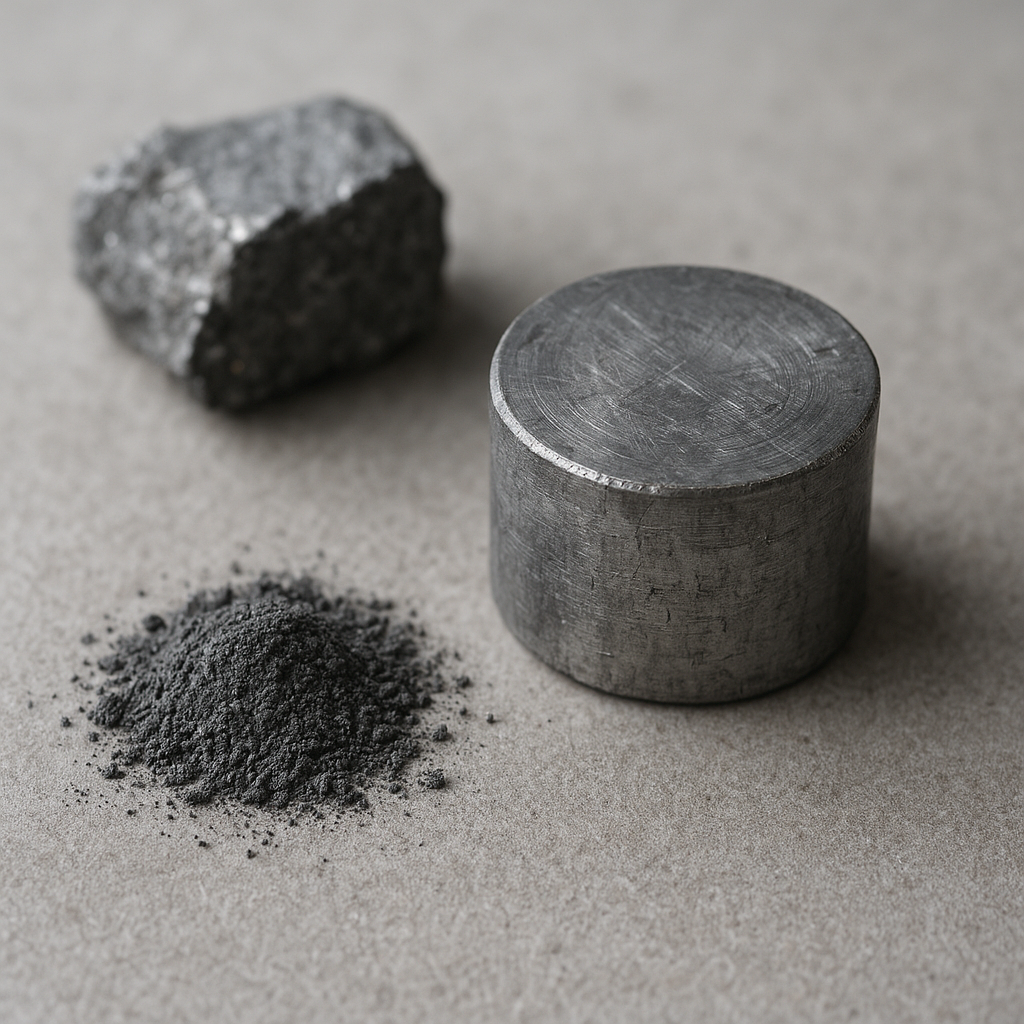
Molybdenum is a transition metal with a unique combination of physical, chemical and biological properties that have shaped its role across industry, science and agriculture. From deep within the Earth’s crust to high-tech laboratories and hospitals, this element plays pivotal roles that are sometimes invisible but often indispensable. This article explores where molybdenum is found in nature, how it is extracted and processed, its many applications, and some of the most intriguing developments and challenges connected to it.
Properties and Natural Occurrence
Molybdenum, atomic number 42, is known for a very high melting point and notable strength at elevated temperatures. Its metallic form is silvery-gray, dense and hard. The element crystallizes in a body-centered cubic structure at room temperature and demonstrates excellent thermal and electrical conductivity for a refractory metal. A few physical constants help explain its wide use: the melting point is around 2623 °C and the boiling point approaches 4639 °C; density is about 10.28 g/cm³. These properties make it valuable wherever materials must withstand high-temperature environments or severe mechanical stress.
In nature, molybdenum rarely occurs as a free metal. The most common ore is molybdenite, molybdenum disulfide (MoS2), which is the starting point for most commercial production. Other minerals include wulfenite (lead molybdate) and powellite (calcium molybdate), but these are far less important as ore sources. Molybdenum is broadly distributed in trace amounts throughout the Earth’s crust (estimated crustal abundance around 1–2 parts per million), soils and seawater. Concentrated deposits are found in porphyry-type ore systems often associated with copper mineralization.
Major producers of molybdenum and molybdenum concentrates include China, the United States, Chile, Peru and Canada. Historically important mining centers include the Climax and Henderson mines in Colorado (USA) and the numerous porphyry copper–molybdenum mines in Chile and Mexico. Because many molybdenum reserves are co-located with copper deposits, production often follows the economics of copper mining as well.
Extraction, Processing and Refinement
The path from ore to usable molybdenum involves several stages. For molybdenite concentrates, a common sequence is:
- Crushing and grinding of ore followed by flotation to produce a molybdenite concentrate;
- Roasting of molybdenite to convert MoS2 to molybdenum trioxide (MoO3), releasing sulfur dioxide, which is captured for sulfuric acid production;
- Conversion of MoO3 into intermediates such as ammonium molybdate for catalysts or chemical uses;
- Reduction of MoO3 to produce metallic molybdenum powder, typically using hydrogen or carbon;
- Powder consolidation and sintering to produce ferro-molybdenum or pure molybdenum metal products used in alloys and components.
When recovered from complex ores or secondary sources, hydrometallurgical techniques such as leaching and solvent extraction are used. The production chain integrates chemical processing steps tailored to the intended end-use—whether alloying additions for steel, catalyst precursors, or specialty compounds like molybdenum disulfide for lubricants.
Primary Industrial Applications
One of the most significant facts about molybdenum in commerce is that a large majority of mined molybdenum enters the steelmaking industry. As an alloying element, molybdenum dramatically improves mechanical properties and corrosion resistance, even when used in small percentages.
- Alloying in steels and cast irons: Addition of molybdenum increases strength, hardenability, creep resistance and toughness at elevated temperatures. It is a key component in stainless steels (especially the 300 and 400 series variants tailored for corrosion resistance), high-strength low-alloy (HSLA) steels and alloy steels for power generation and petroleum equipment.
- Catalysts: Molybdenum oxides and sulfides are central to heterogeneous catalysts used in the petroleum industry, notably hydrodesulfurization (HDS) catalysts. These catalysts remove sulfur from fuels, enabling lower-emission fuels and protecting downstream catalysts. Molybdenum is often used in combination with cobalt or nickel on alumina supports.
- Lubricants and MoS2: Molybdenum disulfide serves as an excellent dry lubricant due to its layered crystal structure, which provides low friction even under high pressure and at elevated temperatures. It is used in greases, coatings and composite materials.
- High-temperature structural components: Molybdenum and its alloys (and also molybdenum-based superalloys) are used in turbines, aerospace components, rocket engines and industrial furnaces where resistance to deformation at high temperature is required.
- Electronics and lighting: Molybdenum’s thermal stability and conductivity make it useful for electrical contacts, thin-film transistor backings, and the base materials of incandescent lamp filaments and certain vacuum tubes.
Ferro-molybdenum is the most common commercial product used for alloying; it provides a convenient way to add controlled amounts of molybdenum to steel melts.
Biological Role, Health and Agriculture
Although required only in trace amounts, molybdenum is essential for nearly all forms of life. In plants, animals and microorganisms, molybdenum is present in the active sites of enzymes that catalyze key redox reactions. Examples include nitrogenase (in certain bacteria that fix atmospheric nitrogen), nitrate reductase (in plants for nitrogen assimilation), xanthine oxidase and sulfite oxidase in animals.
The role of molybdenum in agriculture is particularly noteworthy: its availability in soils influences plant health and nitrogen metabolism. In legumes, molybdenum deficiency can limit nitrogen fixation, reducing crop yields. For this reason, trace additions of molybdenum in fertilizers or seed treatments are used in regions with deficient soils.
For humans and animals, molybdenum intake is typically adequate from normal diets; rich sources include legumes, grains and organ meats. Deficiency is rare but can lead to metabolic abnormalities. Conversely, high levels of molybdenum exposure—usually occupational or environmental—can cause gout-like symptoms by affecting copper metabolism. Regulatory bodies set occupational exposure limits to mitigate respiratory and systemic risks during mining, processing or powder handling.
Medical and Nuclear Connections
Molybdenum intersects with modern medicine in an important way through its radioisotopes. Mo-99, produced in nuclear reactors primarily by fission of uranium-235 or by neutron activation routes, decays to technetium-99m (Tc-99m), the most widely used radioisotope in diagnostic nuclear medicine. Tc-99m’s short half-life and gamma emission characteristics make it ideal for imaging organs and detecting disease. The global supply chain for Mo-99 has been a focus of international attention due to periodic shortages and dependence on a limited number of aging research reactors.
Beyond medical isotopes, molybdenum’s radiological properties are utilized for certain neutron targets and components in nuclear technology, though its neutron absorption cross-section is moderate compared to some other refractory metals.
Advanced Materials and Emerging Research
Molybdenum compounds and 2D materials derived from molybdenum have spurred significant scientific interest. Molybdenum disulfide (MoS2) behaves as a semiconductor when thinned to a monolayer, exhibiting a direct bandgap and strong excitonic effects that make it promising for next-generation electronics and photonics. Research topics include:
- Atomically thin transistors and flexible electronics using MoS2 and related transition metal dichalcogenides (TMDs).
- 2D heterostructures combining molybdenum compounds with graphene and other layered materials to tailor electronic and optical properties.
- Catalytic applications at the nanoscale—MoS2 edges and defect sites show activity for hydrogen evolution reactions (HER) and other electrochemical processes, relevant to clean energy technologies.
- Tribological coatings and nanocomposite lubricants leveraging MoS2’s layered structure for extreme environments.
Additionally, alloy and coating development continues to leverage molybdenum’s properties to push performance in aerospace, energy and additive manufacturing. Powder metallurgy and sintering technologies have improved the fabrication of molybdenum-based components with complex geometries.
Environmental, Economic and Geopolitical Considerations
Molybdenum production touches environmental and economic threads in several ways. Mining and processing generate waste streams—including flotation tailings and sulfur dioxide from roasting—that require careful management. On the positive side, capturing sulfur during processing allows production of sulfuric acid, turning a byproduct into a valuable industrial input.
Market dynamics are influenced by the tight coupling between molybdenum and copper mining economics: when copper prices decline, marginal copper–molybdenum mines can reduce production, affecting molybdenum supply. China’s dominant position in both mining and refining has been a factor in pricing and availability, though North and South American producers remain important for global supply diversity.
Recycling contributes to supply resilience. Scrap steels and specialty alloys containing molybdenum are recycled in electric arc furnaces and secondary metallurgy processes. Because molybdenum is a valuable alloying element even in small amounts, reclamation from industrial scrap is economically attractive and environmentally beneficial.
Interesting Historical and Cultural Notes
The name molybdenum derives from the Greek molybdos, meaning “lead-like,” because early mineralogists confused molybdenite with graphite and lead ores. The element itself was isolated in 1781 by the Swedish chemist Peter Jacob Hjelm. Over the centuries, molybdenum moved from an obscure curiosity to an industrial linchpin as steelmaking and high-temperature technologies advanced in the 20th century.
Technological milestones include the adoption of molybdenum-bearing steels in power plants and petrochemical facilities, the large-scale use of Mo-based catalysts in petroleum refining starting in the mid-20th century, and the resurgence of interest in MoS2 with the rise of two-dimensional materials research in the 2010s.
Practical Considerations for Handling and Use
Working with molybdenum powders, fine alloys and chemical compounds requires standard industrial hygiene practices. Dust control, ventilation and respiratory protection prevent inhalation of fine particles. Chemical safety considerations include managing the release of sulfur dioxide during roasting and controlling aqueous discharges to prevent environmental contamination. For agricultural uses, dosing must be precise: excessive molybdenum in forage can induce copper deficiency in ruminants, while insufficient levels reduce crop performance in sensitive soils.
Tips for Industries and Researchers
- Design alloys by balancing molybdenum with other elements (Cr, Ni, V, W) to achieve target mechanical and corrosion performance.
- Optimize catalyst supports and promoters to maximize molybdenum active site efficiency and lifetime in HDS and catalytic applications.
- Implement recovery and recycling protocols for molybdenum-containing scrap to stabilize supply and lower lifecycle environmental impacts.
- In research contexts, exploit MoS2 edge chemistry for electrocatalysis and tailor defect densities to tune activity.
Across fields—from heavy industry to cutting-edge nanoscience—molybdenum’s versatility continues to open new possibilities. Whether as a tiny critical alloying addition that keeps a pressure vessel safe at high temperature, as a catalyst enabling cleaner fuels, or as a nanoscale semiconductor opening new device architectures, molybdenum exemplifies how a single element can connect geology, chemistry, biology and technology.
Molybdenum, embodied in minerals like molybdenite and engineered forms such as MoS2, remains a strategic material whose applications grow as manufacturing, energy and medical needs evolve. With ongoing advances in extraction, recycling and nanoscale synthesis, the future of molybdenum-related technologies looks both broad and deep.