
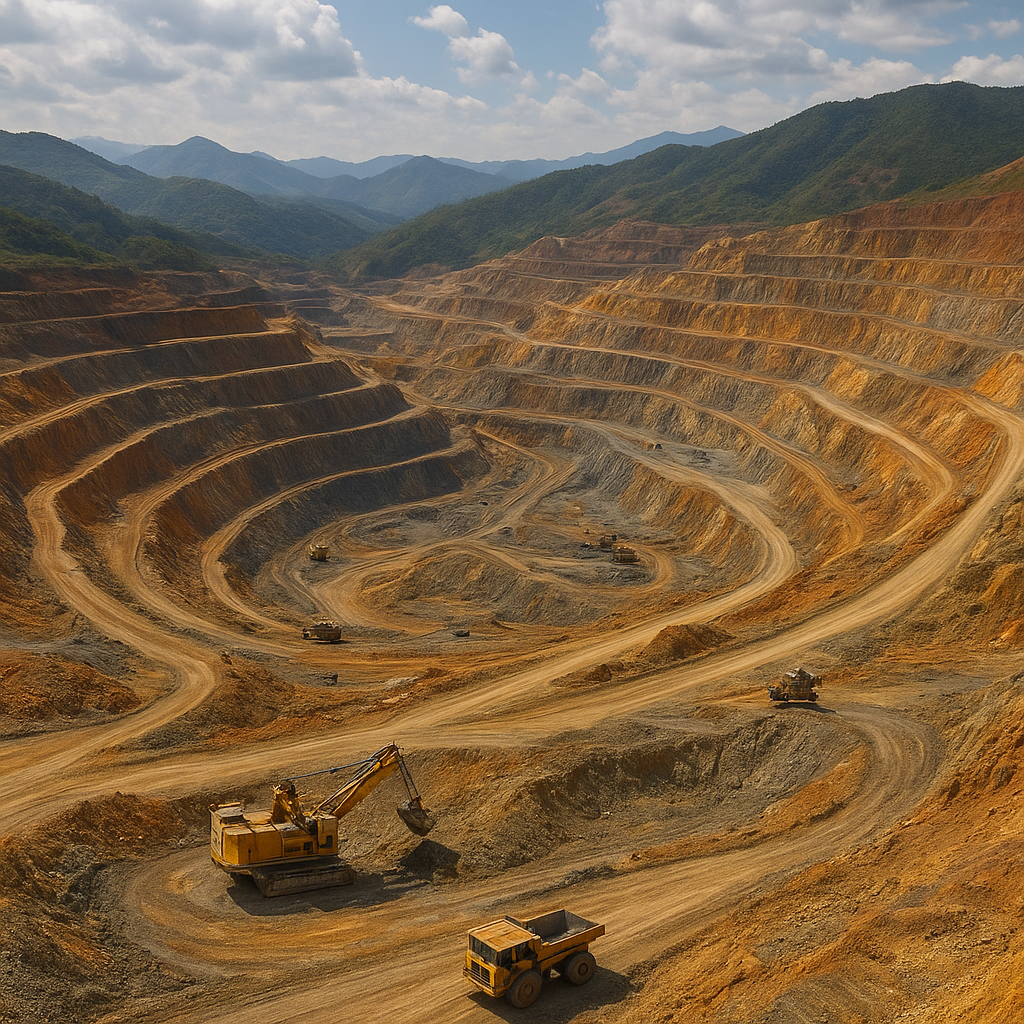
The Zijinshan Gold & Copper Mine in southeastern China is a prominent example of how a single mineral deposit can shape local economies, industrial trajectories and environmental debates. Operated by one of China’s leading mining companies, the site combines substantial reserves of both precious and base metals with a complex geological history and a long record of technological and social change. This article examines where the mine is located, what is extracted there, its broader economic importance and several notable or surprising aspects that make Zijinshan more than just another mine.
Location and geological setting
The Zijinshan deposit is situated in the southern part of China, in Fujian Province, within a geological belt that has produced a number of important mineral occurrences. The mine lies in a hilly to mountainous landscape, where roads and rail links connect the site to regional processing centers and ports on the southeastern coast. Its location in Fujian gives it strategic proximity to both domestic smelters and export routes through major Chinese seaports.
Regional geology
Geologically, Zijinshan is broadly associated with magmatic-hydrothermal mineralization common to much of southeastern China. The deposit shows characteristics typical of mixed-porphyry and skarn systems, where intrusive igneous activity has interacted with carbonate and other host rocks to concentrate metals. This style of mineralization is responsible for producing both copper and gold together, often accompanied by other valuable elements like silver and molybdenum.
Topography and infrastructure
The mine is set in an area of moderate relief where engineering has had to adapt to slopes, rainfall patterns and local drainage. Over the years, roads, power lines and water-management systems have been developed to support both extraction and processing activities. The presence of existing infrastructure in the region has helped lower initial capital costs and facilitated the integration of Zijinshan into a wider network of industrial activities.
What is mined: metals, by-products and processing
Zijinshan produces a combination of precious and base metals, giving it a dual economic role. The two headline commodities are gold and copper, but the ore often contains economically significant concentrations of silver and trace amounts of other metals.
Primary commodities
- Gold: Recovered as a primary revenue driver, gold is extracted from auriferous zones within the deposit. It is recovered via milling and concentration processes and either sold as dore or refined further off-site.
- Copper: Present as chalcopyrite and other copper-bearing minerals, copper is typically recovered through flotation to produce concentrates that are then smelted or sold to smelters.
By-products and trace elements
Silver often accompanies the gold-copper mineralization and is recovered as a by-product in concentrate streams. Other elements such as molybdenum or minor base metals can occur in parts of the deposit and contribute marginally to the overall project economics.
Mining methods and processing
Over its operational life, Zijinshan has employed a combination of surface and underground mining techniques—selected to match orebody geometry and economic considerations. Ore undergoes crushing and grinding, followed by froth flotation to separate valuable minerals from waste rock. Concentrates produced at the site are transported to smelters for further refinement. The processing cycle also generates tailings and wastewater that require careful engineering controls.
Economic significance
The mining operation plays a multifaceted role in regional and national economies. As an asset within the portfolio of a major mining group, Zijinshan contributes to metal supply, employment and fiscal receipts while also influencing local industrial development.
Local and regional impacts
- Employment: The mine provides direct jobs in mining, processing and administration, and indirect employment through contractors, transporters and service providers.
- Infrastructure investment: Roads, power lines and water systems developed to serve the mine have spillover benefits for nearby communities.
- Tax and royalty revenue: Local governments receive fiscal income that can be used for services and development projects.
National and global roles
At the national level, Zijinshan is part of China’s strategy to secure critical mineral supplies. The combined production of gold and copper supports domestic manufacturing, electronics and financial markets. Internationally, concentrates and refined metal produced from the mine enter global supply chains, affecting trade flows and commodity markets. The operation also highlights how Chinese mining companies have scaled up to become globally relevant producers.
Value chain and downstream industries
The metals recovered at Zijinshan feed a broad value chain: copper to electrical wiring and industrial components; gold to jewelry, investment and certain high-tech applications; and silver to electronics and industrial usage. This integration into manufacturing and financial markets amplifies the mine’s economic footprint far beyond its immediate geography.
Environmental, social and governance considerations
Large metal mines always raise questions about environmental stewardship and community relations, and Zijinshan is no exception. Concerns focus on water quality, tailings management, landscape disturbance and the well-being of local populations.
Tailings, water and pollution control
Processing operations at Zijinshan produce tailings and wastewater that require engineered containment and treatment. Modern practices at major operations include lined tailings storage facilities, wastewater treatment plants and monitoring programs to detect and prevent leaks or spills. The need to manage acid-generating materials and heavy metals has driven investments in containment and remediation technology.
Social responsibility and community engagement
The mine supports local communities through job creation, procurement and sometimes direct social programs such as health and education initiatives. At the same time, maintaining a social license to operate requires ongoing dialogue, compensation for impacts and measures to mitigate noise, dust and traffic effects.
Notable incidents and responses
Zijinshan has, at times, been the subject of environmental scrutiny. Several years ago, a wastewater release associated with mining activities attracted attention and prompted regulatory responses and remediation actions. Such incidents have influenced company policy, strengthened environmental monitoring and accelerated adoption of improved management practices. The handling of these issues demonstrates how environmental governance and operational transparency can become defining elements of a mine’s legacy.
Interesting and lesser-known aspects
Beyond its technical and economic profile, Zijinshan offers a number of intriguing facets that illustrate the intersections between geology, culture and modern industry.
The name and cultural resonance
The name Zijinshan literally evokes color and value—purple and gold—and resonates in Chinese culture where mountains and minerals often carry historical or symbolic meanings. While the mine is an industrial site, its name connects it to a broader cultural landscape and to the identity of the company that developed it.
Innovation and technology adoption
Like many contemporary mines, Zijinshan has been a platform for implementing new technologies: improved ore-sorting, automation of certain equipment, and more comprehensive data-driven monitoring of environmental parameters. These innovations aim to increase recovery rates, reduce costs and minimize environmental footprints—trends seen across the mining sector.
Global expansion and corporate strategy
The company behind Zijinshan has grown through acquisitions and international ventures, reflecting a broader pattern of Chinese firms expanding beyond national borders to access resources, diversify risk and build global operational expertise. Zijinshan serves as one of the operational cornerstones that supported that outward push.
Biodiversity and land reclamation
Post-mining land use and reclamation are increasingly part of mine planning. Efforts at sites like Zijinshan include progressive reclamation of disturbed areas, reforestation, and designs for post-closure landforms that can support new ecosystems or community uses.
Facts at a glance
- Primary commodities: gold and copper.
- Location: southeastern China, in Fujian Province, within a mineral-rich belt.
- Geological style: mixed porphyry/skarn-related mineralization typical of magmatic-hydrothermal systems.
- By-products: silver and minor base metals.
- Key concerns: tailings management, water quality, and community impacts.
- Broader importance: regional economy, national metal supply and global commodity markets.
Concluding observations
Zijinshan exemplifies how a single mine can be at once a geological feature, an economic engine and an environmental challenge. Its dual production of precious and base metals gives it a unique place in supply chains, while its operational history reflects broader trends in Chinese and global mining: rapid development, increasing technological sophistication and growing expectations for responsible environmental management. The mine’s story continues to evolve as stakeholders, regulators and communities interact to shape its future trajectory and legacy.

