
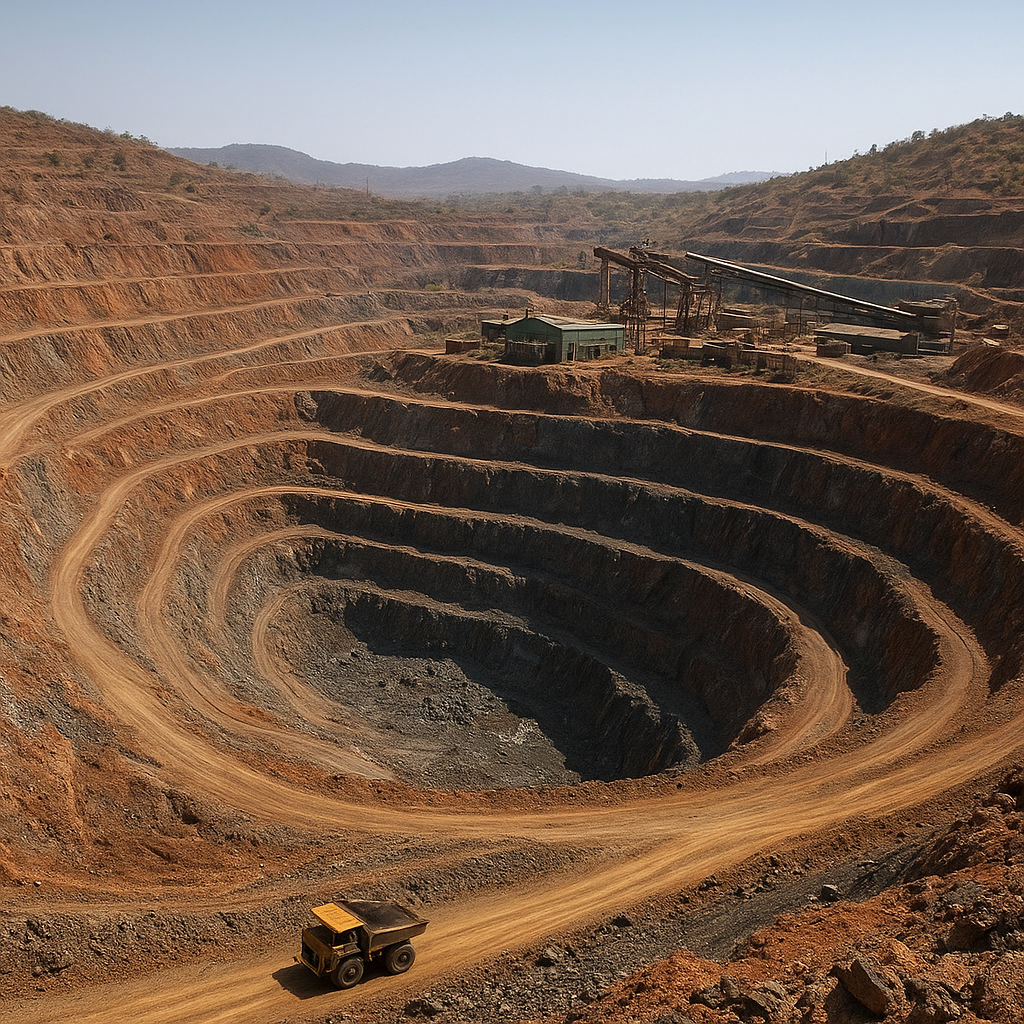
The Kolar Gold Fields occupy a remarkable place in the industrial and cultural history of Karnataka and India. For more than a century these mines were a center of intensive gold extraction, pioneering deep-level mining techniques on the subcontinent and shaping the lives of entire communities around the precincts of Kolar. This article describes where the fields are located, what was extracted there, their economic importance, and a selection of facts and observations that highlight why Kolar Gold Fields remain fascinating today.
Location, history and human landscape
The cluster known as the Kolar Gold Fields (widely abbreviated as KGF) lies in the Kolar district of southeastern Karnataka, roughly 70–100 kilometers east of the state capital, Bangalore. The mines are concentrated around the towns of Kolar and Bangalore Rural fringe villages, with the famous township developed by the mining companies to house European and Anglo-Indian staff alongside local workers. The Kolar area sits on the ancient Dharwar craton — a geological region that hosts some of India’s oldest rocks and mineralized belts.
Evidence suggests the region’s gold-bearing veins were known and worked long before the colonial period, but large-scale modern operations began in the late 19th century under British management. Mining at Kolar introduced many aspects of industrial mining to India: mechanized shaft-sinking, deep-level ventilation, extensive underground infrastructure and modern worker settlements. Over decades the mines supported a unique social fabric: schools, hospitals, clubs and a multicultural community shaped by the demands and rhythms of mining life.
Ownership and administration changed over time. By the mid-20th century, post-independence, the mines came under Indian management and eventually were run by public-sector companies such as Hindustan Gold Mines Limited (HGML). Financial pressures and geological challenges led to reduced operations, and eventually large-scale mining was suspended at the turn of the 21st century.
Geology, mineralization and what was mined
The reason for Kolar’s historic prominence is its geological setting. The region belongs to an Archean greenstone belt within the broader Dharwar craton; such greenstone belts commonly host hydrothermal quartz veins with sulfide-associated gold mineralization. At Kolar, the gold occurs primarily in quartz reefs and sulphide-rich veins cutting ancient volcanic and sedimentary host rocks. The ore system is often complex, with pyrite, chalcopyrite and other sulfides accompanying gold, and gold distributed in native form and as fine particles associated with sulfides.
Mining operations extracted gold-bearing ore by deep underground methods. The mining engineering at Kolar involved sinking vertical shafts, developing horizontal levels, and employing stoping techniques to remove ore. The mines extended to considerable depths — they were among the deepest in the region and at times considered some of the deepest in Asia — necessitating advanced dewatering and ventilation systems and posing significant technical challenges for miners and engineers alike.
Although gold was the main commodity, the mineral assemblage and byproducts included other sulfides and trace metals. Tailings and mine dumps contained sulfide residues that have been the source of environmental management concerns, while the complex mineralogy sometimes made ore processing and metallurgical recovery a technical challenge.
Economic significance: regional and national impacts
For more than a century Kolar Gold Fields contributed directly and indirectly to regional development. Direct economic impacts included employment of thousands of workers — miners, engineers, metallurgists, administrative staff — and the payrolls supported an entire local economy of shops, services and transport. The mining companies invested in infrastructure: roads, water supply, hospitals and schools. This led to the creation of a distinct township culture, with Anglo-Indian communities, mission schools and social institutions that carried a British industrial legacy into modern India.
At the national level, Kolar’s output contributed to India’s gold supplies when the mines were productive. While Kolar never matched the scale of some of the world’s giant goldfields, it was nonetheless an important contributor to the domestic mining sector. The operations also served as a training ground for Indian mining engineers and geologists, contributing to the development of local technical expertise in deep mining, ore processing and mine management.
Economic challenges emerged in the late 20th century. As easily accessible ore was depleted, costs of extraction rose sharply. Deep-level mining is capital and energy intensive: dewatering, rock support, ventilation, and hoisting costs increase with depth. Combined with fluctuating global gold prices, increasing labor costs and aging infrastructure, the economics of Kolar shifted unfavorably. Government and company reports in the late 1990s and early 2000s cited low ore grades and high operating costs as reasons for scaling down and eventually suspending major operations.
Even after active mining declined, the area’s economic profile continued to be shaped by legacies of the industry: derelict industrial installations, legacy housing, and a local economy coping with job losses and restructuring. Proposals to reopen or rehabilitate parts of the field have been periodically discussed, highlighting the tension between historical value, potential remaining resources and the costs of restarting deep mining in the modern era.
Technical and environmental dimensions
Deep mining at Kolar required continuous and sophisticated engineering. Sustained dewatering was essential: groundwater inflows in deep shafts demanded reliable pumping systems. Ventilation and temperature control were also significant technical issues, as rock temperatures rise with depth and the risk of hazardous gases increases. These operational needs drove technological adoption — from early steam and mechanical pumps to electric hoists and modern ventilation management — and helped shape India’s technical capacity in hard-rock mining.
Environmental challenges remain a prominent aspect of Kolar’s story. Historic tailings deposits, acid-generating sulfide wastes and abandoned underground workings affect groundwater quality and local soils in places. Managing legacy pollution, stabilizing old dumps, and ensuring safe closure of shafts are ongoing tasks for local authorities and any prospective developers. Social dimensions — such as the health and livelihoods of former mine workers and their descendants — also figure into the environmental and rehabilitation agenda.
In recent decades there have been efforts to evaluate residual resource potential, to improve tailings management, and to explore alternative uses for the existing underground infrastructure. Proposals ranged from reprocessing tailings for residual gold using improved metallurgical methods, to exploring the potential for geothermal energy in deep workings, or repurposing shafts for scientific uses. Each option carries technical feasibility questions, regulatory complexity and community considerations.
Social history and cultural legacy
Beyond rocks and economics, Kolar Gold Fields influenced regional social and cultural life in distinctive ways. The mining townships developed a cosmopolitan mix of communities: local Kannada-speaking workers, a significant Anglo-Indian population, and employees from other parts of India attracted by mining jobs. This diversity fostered unique institutions — clubs, schools, churches, and recreation facilities — many of which still stand as reminders of the mining era.
Oral histories from workers recount the rhythms of underground work, the camaraderie and dangers of deep-level mining, and the social networks that supported families across generations. The mines were a source of identity and pride for many families, even as closures brought economic dislocation and migration away from the area. The physical imprint of the industry — headgear, engine houses, and colonial-era bungalows — continues to give Kolar distinctive architectural features.
Interesting facts and contemporary resonance
- Cultural footprint: The name KGF has entered broader popular culture, famously inspiring high-profile Indian films that fictionalize aspects of the mining milieu and mythologize the historical setting. These productions have reintroduced the name to a national and international audience, albeit in a dramatized form.
- Technological milestones: Kolar’s adoption of deep-mining methods and mechanized dewatering placed it among the early adopters of industrial mining technology in the subcontinent, influencing mining practice in other Indian mining districts.
- Urban influence: The proximity of Kolar to Bangalore meant that the fields contributed to infrastructure and labor flows supporting the city’s growth, and that the social interactions between mining and urban communities left lasting legacies.
- Rehabilitation debates: The post-closure era has generated debates over whether to invest in mine reopening, reprocess tailings, create heritage tourism around industrial archaeology, or rehabilitate the landscape for agriculture and housing. Each pathway encounters trade-offs among economic returns, environmental remediation costs and social priorities.
- Scientific interest: The deep workings at Kolar have been of interest to geologists and mining engineers studying ancient greenstone-hosted gold systems and the challenges of deep-level extraction.
Future prospects and unresolved questions
Many questions about Kolar’s future remain open. Technically, modern mining and metallurgical advances make it possible to reconsider previously uneconomic ore bodies. Improved beneficiation and hydrometallurgical techniques can extract gold from lower-grade ores or reprocess tailings that older technologies left behind. Economically, however, any revival would require sustained capital, favorable metal prices and viable social and environmental management plans.
Policy and institutional factors will also shape outcomes. Decisions about public-sector engagement, private investment and community participation determine whether Kolar can transition to new economic activities. Rehabilitation programs — to stabilize old shafts, remediate tailings and redevelop industrial land — would create different kinds of employment and require coordinated funding and governance.
Finally, Kolar’s story continues to resonate because it embodies broader themes in resource economics: how finite mineral wealth creates prosperity, how technological limits and market dynamics lead to decline, and how communities negotiate the legacies of extractive industries. The physical and cultural imprint of the Kolar Gold Fields ensures that, whatever the future holds, the name will remain a reference point for mining history in India and for the many lives shaped by the quest for gold.

