
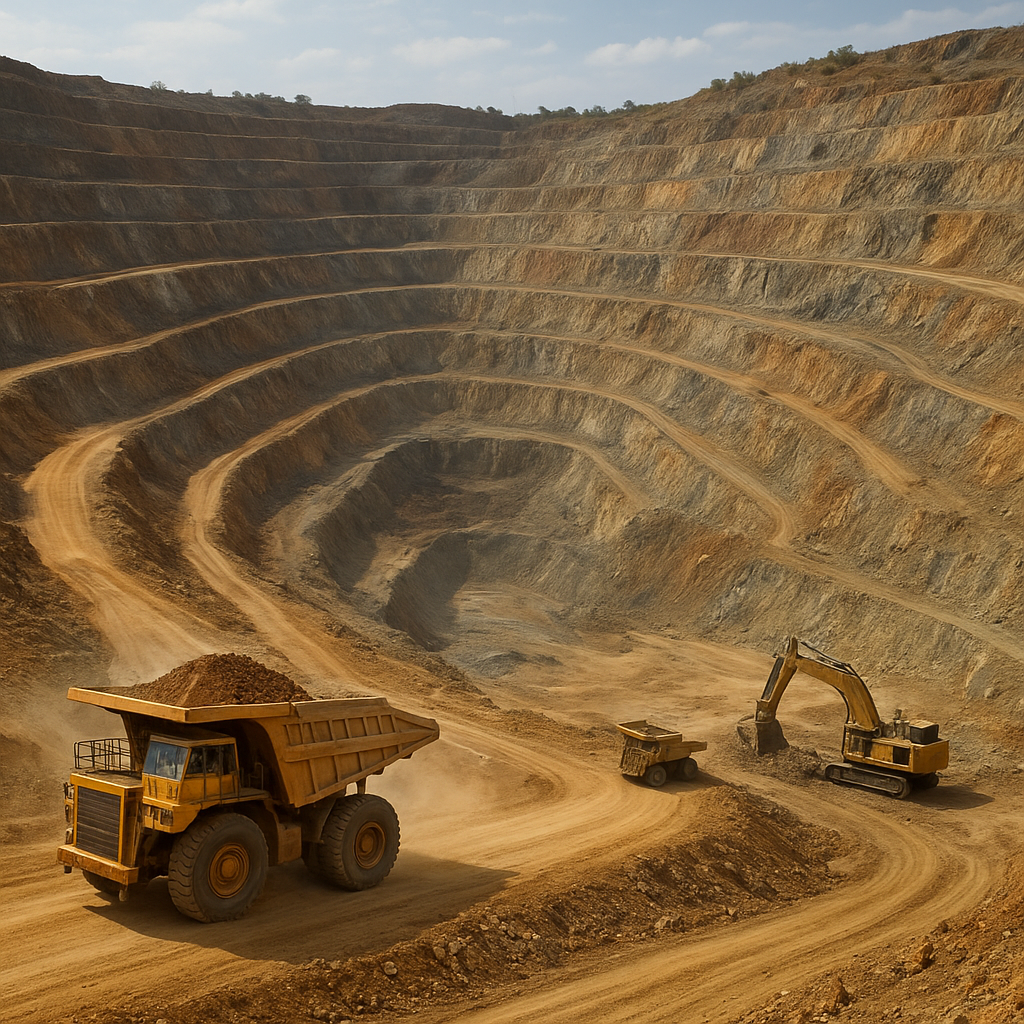
The Kolar Gold Fields, located in the southeastern part of the Indian state of Karnataka, have long been a focal point of industrial ambition, colonial extraction and local folklore. From ancient small-scale workings to the large underground shafts of the modern era, this mining complex shaped the region’s urban fabric, workforce and even its identity. The story of the area touches on geology, engineering, economics and cultural memory—an intersection where the lustre of gold met the grit of human endeavor.
Where Kolar Gold Fields Are and What Makes the Ground Special
The Kolar Gold Fields sit roughly 100 kilometers east of Bangalore, in the Kolar district of Karnataka. The deposits occupy a part of the Dharwar craton, a very old geological terrane dating back to the Archean Eon. The mineralization occurs in narrow veins and reefs within metamorphic host rocks—primarily quartz veins cutting schist and gneiss. It is this geological arrangement that concentrated gold into workable bodies, often associated with sulphide minerals such as pyrite and arsenopyrite.
Geology and Ore Types
- The gold is largely confined to quartz vein systems rather than widespread disseminated deposits.
- Ore was often complex and refractory, with gold locked within sulphide minerals, requiring chemical processing and roasting to free the metal.
- The structural controls—faults, shear zones and folding—dictated where rich veins formed, making mines highly discontinuous and variable in grade.
These geological factors are important because they influenced the economics of extraction. Narrow veins are expensive to access and follow underground, and when grades fall or when the sulphide content increases, the cost of extraction and processing climbs rapidly. The combination of geological complexity and the smallscale nature of the veins is a recurring theme in Kolar’s operational history.
Historical Trajectory: From Precolonial Workings to Industrial Mining
There is evidence of gold extraction from the Kolar area long before modern industry arrived. Local people worked alluvial and shallow vein deposits for centuries. Commercial, mechanized mining began in the late 19th century under British colonial management, when prospecting and capital investment allowed deeper shafts to be sunk and continuous underground operations to start. The region became synonymous with deep shaft mining in India and, for decades, stood among the country’s primary sources of gold.
Colonial Era and the Rise of Large-Scale Operations
- British companies introduced mechanized drills, efficient hoisting systems and crushing plants that enabled ore processing at scale.
- Workforce recruitment brought laborers from surrounding districts, resulting in a diverse, transient mining population with distinct social institutions in the KGF townships.
- The mines were among the deepest exploited at the time, which required advanced pumping systems to deal with groundwater and complex ventilation to manage underground conditions.
Under colonial rule, the Kolar operations fed export markets and colonial revenue streams. After independence, the mines were nationalized and became part of Bharat Gold Mines Limited (BGML). For many decades the area remained productive, supplying a significant fraction of the nation’s mined gold and supporting a local economy built around mining services and infrastructure.
Mining Methods, Technology and Working Life
Underground methods dominated Kolar’s operations. Shafts and galleries were sunk to access the thin veinlets, and the ore was extracted by stoping methods adapted to narrow reef conditions. Rock drilling, blasting, and timbering were regular activities. With time, mechanized loading and haulage, rock bolting and improved pumping technology reduced some physical burdens but could not fully remove the hazards.
Daily Life in the Mining Towns
- Residential townships with schools, hospitals and clubs were set up to serve the workforce and their families, creating semi-urban communities centered on the mines.
- Working conditions were tough: long hours, physically demanding labor, and risk of accidents or health issues related to underground work.
- Social structures in the towns reflected occupational hierarchies and often included segregated housing initially established during colonial times.
The mines fostered a distinct culture: amateur orchestras, sports clubs, and communal festivals appeared, and the local economy grew around the needs of the mining population.
Economic Significance: Local, Regional and National Roles
The economic contribution of Kolar Gold Fields extended beyond the simple tonnage of metal extracted. At multiple scales the area influenced employment, urban development and industrial capacity. For the surrounding district, the mines were the largest employer and a magnet for ancillary trades: transport, suppliers, workshops and retail. For Karnataka and India, the mine was a strategic mineral asset contributing to national metal supplies and technological know-how in underground mining and ore processing.
Channels of Impact
- Direct employment in extraction, processing and administration supported thousands of families over a century.
- Indirect economic activity—housing, education, transport—stimulated local markets and provided long-term social capital.
- Infrastructure such as roads, rail links and power installations built to serve the mines had spillover benefits for other industries and agriculture.
However, the economics of the Kolar operations were subject to volatility: global gold prices, ore grades, and the costs of deep mining directly affected profitability. When the grade diminished and operating costs rose, the mines became increasingly uneconomical to run.
Decline, Closure and the Aftermath
By the late 20th century, the Kolar operations faced multiple pressures. Depleting ore reserves, rising extraction and labor costs, and the technical challenges of continuing deeper work strained finances. Environmental and safety compliance also added to operating budgets. Eventually the government-owned company that managed operations could not sustain viable production and declared a closure, with the mines becoming inactive. The stoppage of pumps led to the gradual inundation of lower workings with groundwater, which further complicated any later attempts at reopening.
Consequences of Closure
- Job losses and outward migration reduced the population and altered local demographics.
- Infrastructure designed for a larger workforce—schools, housing, hospitals—fell into disuse or adapted to new roles.
- Economic decline increased dependence on agriculture and small trade, while attempts at restarting mining became politically and technically contentious.
The physical legacy included abandoned shafts, engine houses and processing plants, remnants of a once-bustling industrial landscape. While some parts of the township maintained civic life, large tracts of mining land changed hands, and the environmental footprint—tailings, altered drainage, and subsidences—remained a long-term issue.
Controversies, Environmental Challenges and Technical Hurdles
Several significant environmental and technical problems complicated both the operation and potential reopening of the Kolar mines. The geology that had concentrated the gold also made extraction technically demanding. Refractory ores required intensive metallurgical treatment, and sulphide-rich waste posed acid-generation risks. Additionally, long-term dewatering efforts required robust pumping and power supplies; when these stopped, the flooded workings became a barrier to returning to production.
Key Technical and Environmental Considerations
- Dewatering: Continuous pumping had been necessary to keep shafts dry; once discontinued, reflooding made re-entry and assessment costly.
- Tailings and waste management: Old tailings present potential leaching and contamination risks for soil and groundwater.
- Subsidence and infrastructure decay: Old underground voids can cause surface instability long after mining stops.
Local authorities and environmental scientists have debated remediation approaches, ranging from controlled dewatering and re-assessment to land rehabilitation and conversion to non-mining uses such as parks or solar installations. Any plan to restart mining must confront both the capital cost and the need to comply with modern environmental standards.
What Makes Kolar Gold Fields Interesting: Cultural, Technical and Human Stories
Kolar is more than a case study of resource depletion; it is a locus of intersecting stories that make the place compelling. The way the mines shaped lives, the unique engineering feats achieved to access deep reefs, and the mixture of colonial and indigenous influences in its townships all contribute to a layered narrative. The site also carries an aura in popular culture—most recently amplified by film and literature—that has renewed widespread curiosity in a younger generation.
Noteworthy Human and Cultural Elements
- The towns developed a cosmopolitan feel uncommon for rural India, with schools, clubs and hospitals that reflected industrial priorities.
- Generations of mining families created oral histories, songs and traditions connected to the rhythm of shifts and the hazards of the underground.
- Fiction, cinema and journalism have turned Kolar into a symbol: both of colonial industrial extraction and of the complex costs of resource-based development.
Engineers and historians also find the area fascinating because of the adaptive technologies implemented by successive operators to deal with groundwater, ventilation and narrow-vein stoping. These technical solutions—some improvised, some cutting-edge for their day—remain subjects of professional interest and study.
Attempts at Revival and Alternative Futures
Even after formal closure, Kolar periodically reappears in policy discussions. Proposals to restart mining, often supported by technological advances in ore processing and higher gold prices, have faced obstacles: high upfront costs, the need for modern environmental safeguards, and questions about the remaining resource base. Meanwhile, alternative visions for the area include industrial reuse, heritage tourism and renewable energy projects that repurpose mine lands.
Paths Considered for the Future
- Careful re-exploration using modern geophysics to determine whether economically mineable ore remains.
- Industrial redevelopment: converting workshops and plant sites into light industry or logistics hubs leveraging existing transport links.
- Heritage and tourism: conserving key buildings and shafts as museums or educational sites to tell the story of mining and labor history.
- Renewable projects: using open spaces and tailings surfaces for solar parks or reforestation schemes to stabilize soils and improve biodiversity.
Such alternatives depend on coordinated investment and political will, as well as community buy-in. Local stakeholders are often ambivalent: eager for jobs and services but wary of promises that might repeat past cycles of boom and bust.
Technical Curiosities and Lesser-Known Facts
Many aspects of Kolar’s past are striking for their combination of ingenuity and scale. For example, the requirement to pump vast volumes of water from deep shafts led to extensive surface plant and long-running pumping stations, which in themselves were feats of engineering and drew technical workers and specialists to the region. The townships established by mining companies included amenities and civic institutions that contrasted with the surrounding rural hinterland, creating a distinctive social geography.
- Some of the underground workings exhibit elaborate timbering and support systems, reflecting older mining practices that persisted alongside modern methods.
- The blend of languages, cuisines and customs in the townships mirrors patterns of labor migration: Kolar drew people from many parts of southern India.
- Even after closure, the imagery of Kolar—shafts, headframes and abandoned buildings—has been recycled in art, photography and film, offering a powerful visual shorthand for industrial decline and memory.
These curiosities underscore a broader point: mines like Kolar are not purely technical enterprises. They are complex social technologies that create, and are in turn created by, human relations, institutions and material networks.
Concluding Observations on Legacy and Lessons
The legacy of the Kolar Gold Fields is multifaceted. It includes an industrial heritage of engineering solutions to difficult geological problems, a social history of labor and community life, and an environmental record that warns of the challenges of abandoned extractive sites. The area has been important to regional economy and national mineral history, yet it also demonstrates how finite resources and changing economic contexts can upend entire ways of life.
For scholars, engineers and policymakers, Kolar offers lessons about sustainable resource management, the social responsibilities of extractive industries and the potential for adaptive reuse of industrial landscapes. For former miners and their descendants, it remains a living memory and an integral part of identity—one that continues to spark discussion about reclamation, heritage and the possibility of technological revival or transformation into new economic roles.

