Allanite is an intriguing and often overlooked member of the epidote group of minerals. It occupies a distinctive niche at the intersection of mineralogy, economic geology and geochronology because of its capacity to host significant amounts of rare-earth elements and radioactive elements such as thorium and uranium. Frequently found as an accessory mineral in a variety of igneous and metamorphic environments, allanite provides important clues about rock formation processes, elemental distribution and the thermal histories of host rocks. The following sections explore its chemistry and structure, typical occurrences, applications, analytical challenges, and several curious phenomena connected with this mineral.
Mineralogy, Chemistry and Physical Properties
Allanite belongs to the epidote group and is chemically complex, with a general formula often written to reflect extensive substitution: (Ca,Ce,La,Y)2(Al,Fe)3(SiO4)3(OH). Its composition can vary widely because the crystal structure accommodates a range of large cations, including many of the allanite defining rare-earth elements such as cerium, lanthanum and yttrium. The presence of significant amounts of thorium and uranium in many specimens leads to internal radiation damage over geological time, a process known as metamictization.
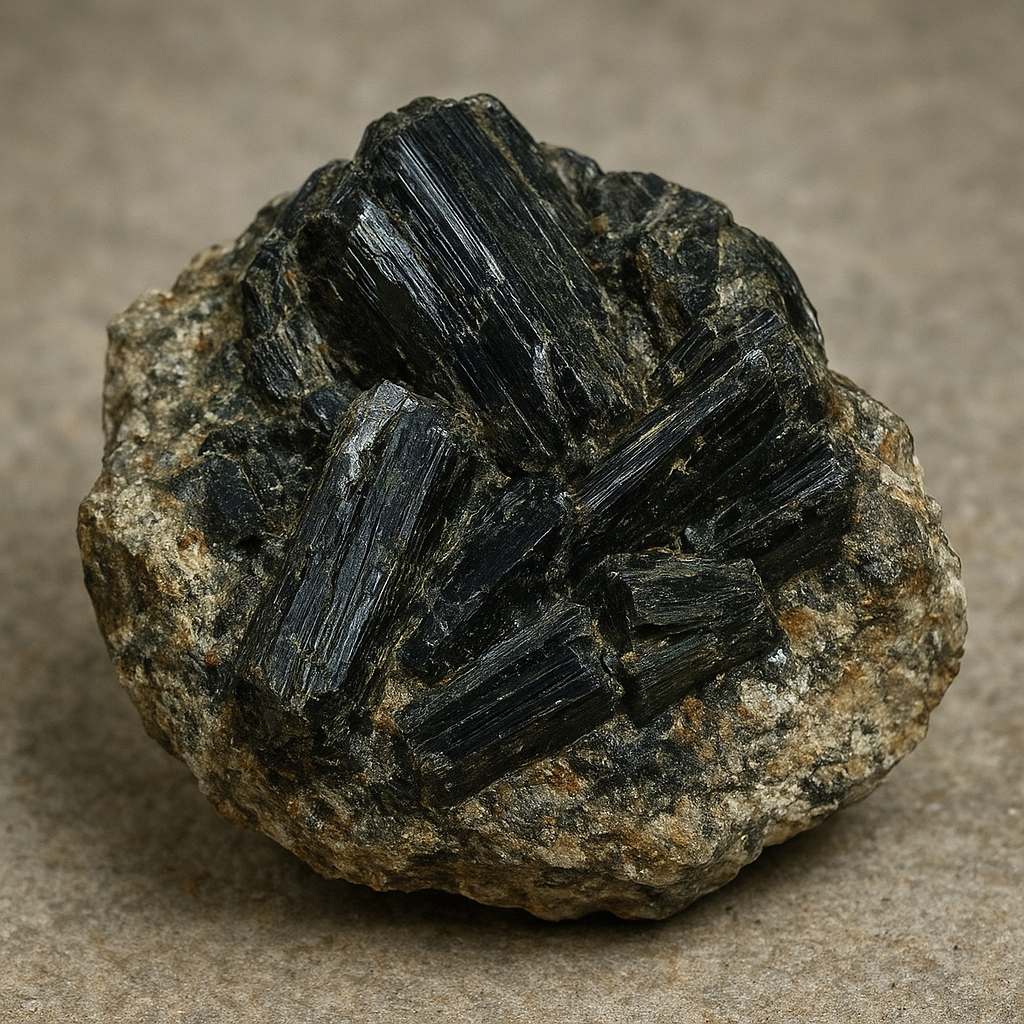
Crystallographically, allanite typically crystallizes in the monoclinic system and forms prismatic to stubby crystals, but it is more commonly encountered as granular aggregates or massive grains. Colors range from brown and black to greenish or reddish-brown, often with a resinous to vitreous luster. Hardness is modest (about 5–6 on the Mohs scale), and density is elevated relative to many silicates because of heavy element content. Under the microscope allanite displays moderate pleochroism and can be strongly birefringent, although metamict samples may show degraded optical properties.
Electron microprobe analyses, X-ray diffraction and Raman spectroscopy are commonly employed to characterize allanite chemistry and structure. Because many allanite grains contain variable amounts of radioactive elements, they also show characteristic radiation-induced changes in crystal lattice parameters and optical behavior. In some cases, annealing of metamict allanite (natural or experimental) can partially restore crystallinity and change physical properties, which has implications for interpreting thermal histories.
Geological Occurrence and Typical Associations
Allanite occurs in a wide variety of geological settings. It is most commonly an accessory mineral in intermediate to felsic igneous rocks such as granites, syenites and granodiorites, especially in peraluminous melts that concentrate large-ion lithophile elements and rare-earth elements. Allanite is also typical in pegmatites and can form sizeable crystals in coarse-grained pegmatitic pockets, hence the significance of the term pegmatite in many locality descriptions.
Metamorphic contexts are equally important. Allanite can form or survive in a range of metamorphic facies and is frequently found in high-grade rocks such as amphibolites and gneisses, where it may record prograde growth or preserve relics from earlier igneous precursors. It is particularly common in aluminous metamorphic rocks and in contact metamorphic skarns where fluids and metasomatism mobilize REE and actinide elements.
Typical mineral associations include epidote, garnet, zircon, monazite, titanite, allanite’s common partners in many rock types, and accessory sulfides in ore-related settings. In many granitoids and metamorphic terrains, allanite occurs alongside gness (note: correct term is gneiss — included here to highlight metamorphic environments), biotite, muscovite and quartz. Because the composition of allanite overlaps with that of monazite and xenotime in terms of REE host capacity, the three minerals often coexist and partition REE differently during crystallization or metamorphism.
Global Distribution and Key Localities
Allanite is globally distributed but is especially notable where REE-enriched rocks and metamorphic terranes occur. Classic localities include parts of Scandinavia (Norway, Sweden), the Canadian Shield (notably Quebec), Greenland, the United States (including pegmatite fields and metamorphic complexes), central Europe, and selected regions in Asia such as Russia and China. Some pegmatites and carbonatites also produce allanite-rich assemblages that are of scientific and sometimes economic interest.
- Scandinavia — well-documented in crystalline shield terrains and orogenic belts.
- North America — diverse occurrences in Canadian and U.S. granitic and metamorphic complexes.
- Greenland — noteworthy occurrences associated with Proterozoic igneous complexes.
- Europe — various occurrences in Alpine-type metamorphic zones, contact metamorphic skarns and granitic intrusions.
Because allanite can form in trace quantities, its presence is often detected and studied using thin-section petrography, electron microscopy and geochemical techniques, rather than by hand sample recognition. In some special pegmatitic pockets, however, it can reach appreciable size and be collected as mineral specimens of interest to museums and collectors.
Applications and Economic Importance
Allanite’s economic significance arises primarily from its role as a repository for rare-earth elements and its occasional enrichment in thorium and uranium. While allanite itself is rarely mined as a primary ore mineral (because it is usually disseminated and occurs in small grains), its presence can indicate REE-enriched magmatic or metasomatic systems worth further exploration.
Exploration geologists use allanite as a pathfinder mineral: the detection of allanite and its chemistry can point to broader REE mineralization or highlight zones with elevated actinide content that require environmental or safety consideration. In laboratory work, allanite can be a target for microanalytical extraction to quantify REE budgets in rocks and to constrain the conditions of formation.
In the field of geochronology, allanite has been used for U-Th-Pb dating because of its ability to incorporate uranium and thorium. However, geochronology using allanite is complicated by radiation damage and subsequent Pb loss or redistribution from metamictization. When carefully applied, combined analytical approaches that account for metamict domains, annealing histories and secondary alteration can yield useful age constraints on magmatic and metamorphic events. Thus allanite is both a potential resource indicator and a valuable chronometer when treated with the appropriate caution.
Analytical Challenges and Radiation Effects
One of the defining challenges in studying allanite is its variable degree of metamictization. As radioactive decay of incorporated thorium and uranium atoms damages the crystal lattice over geologic time, allanite can become amorphous or partially amorphous. This process affects optical properties, density, and chemical mobility of trace elements, making accurate microanalysis demanding.
Analytical techniques must therefore be chosen and interpreted carefully. Electron microprobe analysis provides major- and minor-element chemistry but can miss nanoscale heterogeneities. Laser ablation inductively coupled plasma mass spectrometry (LA-ICP-MS) is widely used to obtain trace-element and isotopic data for REE and U-Th-Pb systems. Transmission electron microscopy and synchrotron-based methods can reveal fine-scale structural recovery after thermal events or the presence of nanocrystalline domains embedded in amorphous host material.
In practical terms, metamict allanite often displays enhanced susceptibility to chemical attack and can exchange elements with hydrothermal fluids, leading to secondary alteration products. These processes must be accounted for when using allanite to reconstruct petrogenetic histories or when assessing its contribution to a rock’s REE budget.
Allanite in Geochronology and Thermal Histories
When allanite preserves closed-system behavior with respect to U and Th decay chains, it can be a powerful tool for dating crystallization and metamorphic events. The mineral’s ability to incorporate varying amounts of U and Th means that individual allanite grains can yield different age domains reflecting growth during distinct geological episodes. However, the presence of metamict zones often results in partial Pb loss, necessitating careful mapping of textural and compositional domains before age interpretation.
One common strategy is to combine high-resolution imaging (e.g., backscattered electron, cathodoluminescence) with spot analyses targeted to visually intact, crystalline zones. In some cases, thermal annealing during subsequent metamorphism can partially re-crystallize metamict allanite and reintroduce complexities such as mixing of age signals. Hence, interpreting allanite ages usually requires corroboration from other minerals (e.g., zircon, monazite) and a robust geological model.
Environmental and Safety Considerations
Because many allanite grains contain appreciable amounts of radioactive elements, they carry implications for environmental handling and mine-site safety. Although allanite is not typically processed as a radioactive ore, when it is concentrated (for example, in heavy mineral concentrates during mineral exploration) proper protocols are needed to measure and mitigate potential radiation exposure. Environmental mobility of REE and actinides can also be influenced by allanite weathering: breakdown of allanite in surficial environments may release REE and actinide-bearing solutions that migrate into soils and groundwater.
Assessing the environmental behavior of allanite-rich rocks requires geochemical leaching experiments, mineral stability modeling and field-based hydrogeochemical studies. In some remediation contexts, weathered allanite and its alteration products are considered in strategies to immobilize or contain actinides.
Interesting Phenomena and Research Frontiers
Several aspects of allanite continue to attract research interest:
- Radiation damage and recovery — experimental annealing studies explore how crystal structure and properties change with temperature and time after metamictization.
- REE partitioning — allanite plays a role in how REE are distributed between melts, fluids and coexisting minerals, which has relevance for ore genesis and petrogenetic modeling.
- Nanostructure and inclusions — high-resolution studies reveal complex inclusion assemblages and nanocrystalline domains that record multi-stage histories.
- Isotope systematics — improvements in LA-ICP-MS and SIMS methodologies enhance the reliability of U-Th-Pb dating of allanite and allow for coupled isotopic studies (e.g., Nd isotopes in REE-rich domains).
- Gem and collector interest — although rare, well-formed allanite crystals or unusual color varieties can be of interest to mineral collectors and museums, particularly when they display intact crystal habit in pegmatites.
Practical Tips for Field and Laboratory Study
For geologists and mineral collectors encountering allanite, a few practical considerations improve identification and study outcomes. In hand sample it is often dark and dense; testing for elevated density and brittle fracture can help distinguish it from common mafic minerals. Under the petrographic microscope, look for brown to green pleochroic grains with strong birefringence but be cautious where metamictization has modified optical behavior.
Laboratory work should prioritize non-destructive imaging (photomicrographs, BSE, CL) before destructive microanalytical techniques. Where geochronology is intended, map the grain textures carefully to avoid sampling altered or metamict domains that may produce mixed or reset ages. Finally, always consider safety when handling samples suspected to contain elevated concentrations of radioactive elements: monitor with appropriate detectors and follow institutional guidelines for storage, analysis and disposal.