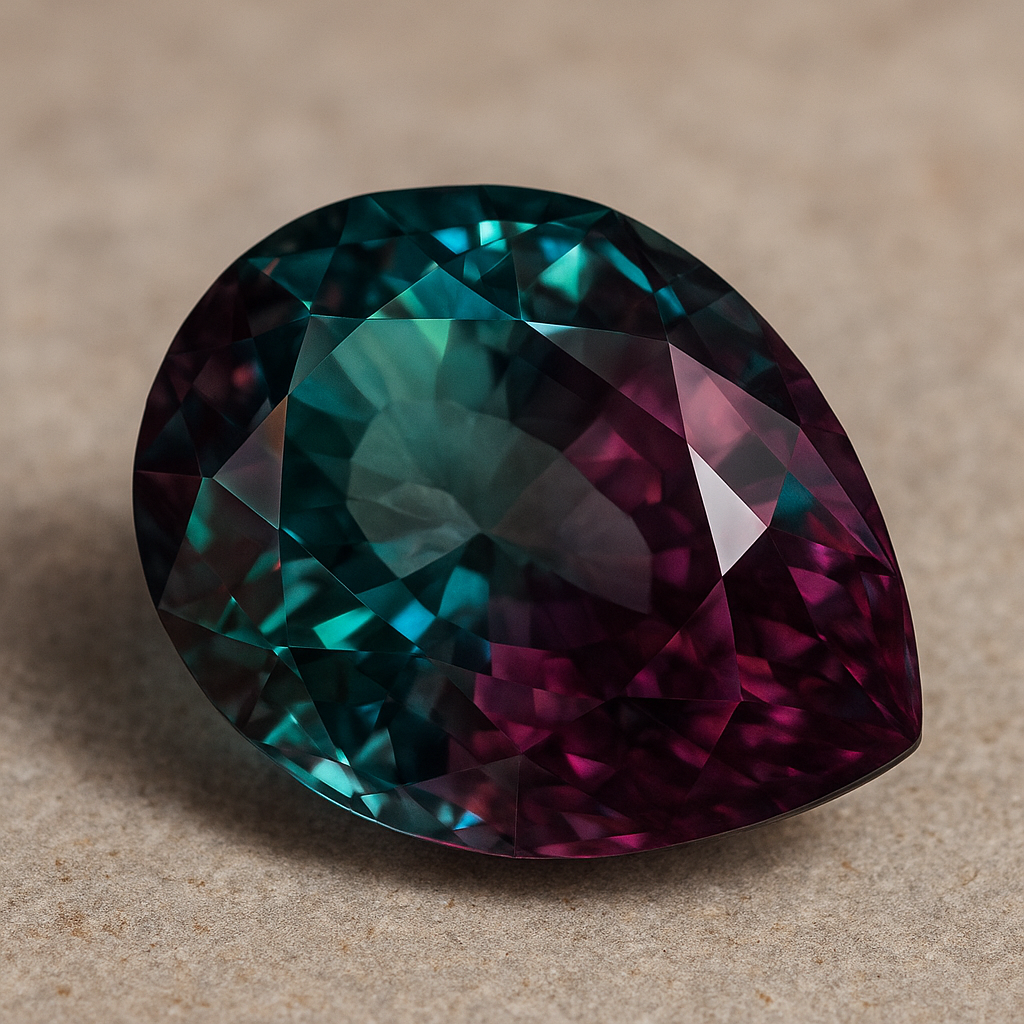
The mineral known as alexandrite has captured the imagination of gem lovers, scientists and collectors for nearly two centuries. Famous for its dramatic and often mysterious optical behavior, this relatively rare form of chrysoberyl offers a natural spectacle: under daylight it commonly appears greenish, while in incandescent light it can look reddish. That striking color-change effect, combined with durability and historical lore, ensures alexandrite occupies a unique place among gemstones and technological materials. The following sections explore where alexandrite forms, how it is identified and used, the modern market and synthesis, and a selection of lesser-known facts that help explain why this gem continues to fascinate.
Geology and Global Occurrence
Alexandrite is a variety of the mineral chrysoberyl (BeAl2O4) in which trace amounts of certain transition metals substitute into the crystal lattice and create its characteristic optical behavior. It forms in environments where beryllium-rich fluids interact with aluminum-rich host rocks under high temperature and pressure conditions. These geological settings are often associated with pegmatites and skarn deposits, as well as in hydrothermal veins.
Principal localities
- Ural Mountains, Russia — The historical and most famous source. The first recognized specimens came from the Ural mining districts in the early 19th century and set the standard for premium green-to-red material.
- Brazil — Several Brazilian deposits (notably in Minas Gerais and Bahia) have produced alexandrite since the 20th century, including stones with notably strong color change and larger sizes.
- Sri Lanka — Known for lighter or bluish-green stones and sometimes intense color-change examples, Sri Lanka provides considerable gem-bearing material although much of it is lighter in saturation than classic Russian stones.
- East Africa (Madagascar, Tanzania) — Newer finds have added to global supply; Madagascar in particular has supplied notable gem-quality alexandrite in recent decades.
- Other occurrences — Myanmar, Zimbabwe and certain parts of India have yielded alexandrite or alexandrite-like material, though usually in smaller quantities or lower color-change intensity.
Each locality imparts subtle differences in typical color, inclusion types and crystal habit, which both gemologists and collectors use to help determine origin. For example, Russian alexandrite is prized for its saturated bluish-green in daylight and strong raspberry-red in incandescent light, while Brazilian stones often show a truer emerald-green to purplish-red shift.
Optical Properties, Chemistry and Identification
At the heart of alexandrite’s allure is its remarkable optical phenomenon. This is not a simple dye effect but a consequence of crystal-field absorption by trace elements in the mineral structure. The principal scientific facts help explain its behavior and guide identification.
Chemistry and cause of color
- The basic chemical formula of chrysoberyl is BeAl2O4. Trace substitution of chromium ions (Cr3+) in place of aluminum is responsible for the classic green-to-red change. In some specimens, vanadium or other transition metals also contribute.
- The chromium ions create specific absorption bands in the visible spectrum. Under light sources dominated by shorter wavelengths (daylight, which has a strong blue-green component), the gem transmits the green; under incandescent light, rich in long wavelengths (reds), the transmitted color appears red.
Physical characteristics
- Hardness: about 8.5 on the Mohs scale — a durable gem suitable for everyday wear.
- Density (specific gravity): typically around 3.70–3.78.
- Refractive index: approximately 1.746–1.755 and weak birefringence; the gem is singly refractive enough to present clear brilliance when well cut.
- Cleavage: none — this contributes to toughness compared to minerals that split easily.
Identification techniques
Gemologists rely on a suite of tests to confirm alexandrite:
- Observation of a color change under different light sources and quantifying the shift.
- Spectroscopy to detect chromium-related absorption lines and to rule out color-change simulants.
- Inclusions and growth features visible under magnification — natural alexandrite often contains characteristic inclusions distinguishable from synthetics.
- Advanced methods including Raman spectroscopy and chemical analysis (EDX, LA-ICP-MS) for origin studies and impurity patterns.
Applications: Gemstone Use and Beyond
Most people associate alexandrite with high-end jewelry, where its rarity and color-change create striking rings, earrings and pendants. But alexandrite’s story extends beyond ornamentation.
Jewelry and decorative use
- Alexandrite is a classic choice for engagement rings and collector pieces. Fine stones with saturated color-change and good clarity command premium prices, especially those of Russian origin.
- Designers often set alexandrite with complementary stones—diamonds, sapphires or emeralds—to accentuate the color contrast.
- Because of its durability, alexandrite is suitable for daily wear but its value means owners often reserve it for special pieces.
Technological and medical applications
Beyond aesthetics, chromium-doped alexandrite crystals have proven useful as active media in solid-state lasers. The so-called alexandrite laser (using synthetic chromium-doped chrysoberyl) is tunable around 700–820 nm and has been adapted for medical and aesthetic applications, such as hair removal, tattoo removal and treatment of pigmented lesions. The properties that make alexandrite attractive for lasers include its broad tuning range and efficient energy absorption characteristics.
Collecting, investment and cultural roles
Alexandrite’s rarity, especially in fine color-change specimens, has given it strong appeal to collectors and investors. It occupies a cultural niche as a prestige gem, often featured in museum collections and royal jewelry. Many gem and mineral shows highlight alexandrite displays, and provenance (for example, a documented Russian origin) can significantly enhance a specimen’s desirability.
Synthetic Alexandrite, Treatments and Simulants
Because of demand and value, the market contains a variety of lab-grown alexandrite and materials that mimic its color-change effect. Differentiating natural from laboratory material is a key task for gem labs and buyers.
Methods of synthesis
- Flux-grown and hydrothermal techniques have been used to produce gem-quality synthetic alexandrite. Established firms developed high-quality synthetic material in the 20th century.
- Many synthetic stones will show growth patterns, gas bubbles or inclusion types characteristic of the specific synthesis method—diagnostic for experienced gemologists.
- The term synthetic must be clearly disclosed in trade; while chemically identical, synthetic alexandrite is priced and treated differently in the market.
Simulants and imitations
Several different materials may imitate alexandrite’s color change: color-change sapphires, certain garnets (like color-change garnet), spinel, and man-made glasses that exhibit a similar shift under different lighting. These are generally less durable or chemically distinct and can usually be identified by instruments used in gem labs.
Mining, Trade and Valuation
Valuing alexandrite combines traditional gem criteria with specific attention to the color-change phenomenon. Price factors include hue, saturation, clarity, cut, carat weight and origin.
Key valuation points
- Color-change strength and balance — the most prized stones show a vivid green in daylight and a strong red in incandescent light, with minimal brown or gray tones.
- Clarity — eye-clean stones are rare; small inclusions typical of natural growth are acceptable and sometimes help authenticate origin.
- Carat weight — larger stones are exponentially rarer and therefore far more expensive on a per-carat basis.
- Cut — skilled cutting maximizes color and minimizes windowing that can diminish the visible color-change effect.
- Origin — historically, stones from the Ural Mountains carry a premium when documented; newer sources may be less costly but can still produce beautiful gems.
Market trends
In recent decades, supply from new mines (for example in Madagascar and Brazil) has increased availability, especially of lighter or moderately strong examples. However, truly fine alexandrite — vivid color-change, good clarity and provenance — remains rare and highly sought after. Auction results for exceptional stones often set records relative to other colored gems.
Care, Cutting and Practical Considerations
Owning alexandrite requires some common-sense care, though its hardness makes it more forgiving than softer gems. Avoid exposure to harsh chemicals and extreme thermal shocks. Routine cleaning with warm soapy water and a soft brush is safe for most alexandrite jewelry; ultrasonic cleaners are generally acceptable but caution is advised if the gem contains fractures or certain inclusions.
Custom cuts and enhancement of color
Cutters of alexandrite follow two goals: enhance the color-change effect and maximize weight retention. Certain cuts—such as mixed cuts or modified ovals—can be optimized to intensify the perceived color change. Enhancement techniques are uncommon; heating or diffusion treatments used for other gems are not typical for alexandrite and any such treatment must be fully disclosed.
Historical Anecdotes and Interesting Facts
Alexandrite’s discovery is wrapped in historical drama. It was first identified in the 1830s in the Ural Mountains and named in honor of a young Russian Tsarevich, who later became Emperor Alexander II; the gem’s green-and-red colors were seen as reminiscent of the imperial colors and a sign of good omen. Whether myth or marketing, the connection to imperial Russia continues to intrigue collectors.
- Birthstone associations: alexandrite has been adopted in some modern lists as an alternative birthstone for June, alongside pearls and moonstone.
- Rarity at large sizes: fine alexandrite over 5 carats is exceptional and often commands collector-level prices.
- Color-change phenomenon is a natural demonstration of how light source composition interacts with electronic transitions in atoms—a striking example of applied physics appearing as beauty.
- The alexandrite laser, using chromium-doped media, represents a technological spin-off where properties of gem materials find medical and industrial uses.
Whether admired for its vivid transformations in the hand of a jeweler or studied in a lab for its optical and chemical properties, alexandrite remains a mineralogical and cultural treasure. From the old workings of the Urals to modern mines in Brazil and Sri Lanka, and from museum showcases to dermatology clinics employing alexandrite-based lasers, this gem bridges art, science and history in ways few other minerals do. Collectors continue to seek top-quality pieces, gemologists refine techniques to distinguish natural from synthetic material, and designers keep exploring how best to reveal the magic of its color-change under changing light — a reminder of how a single element like chromium or vanadium can transform a mineral into a legend that spans continents and centuries.