
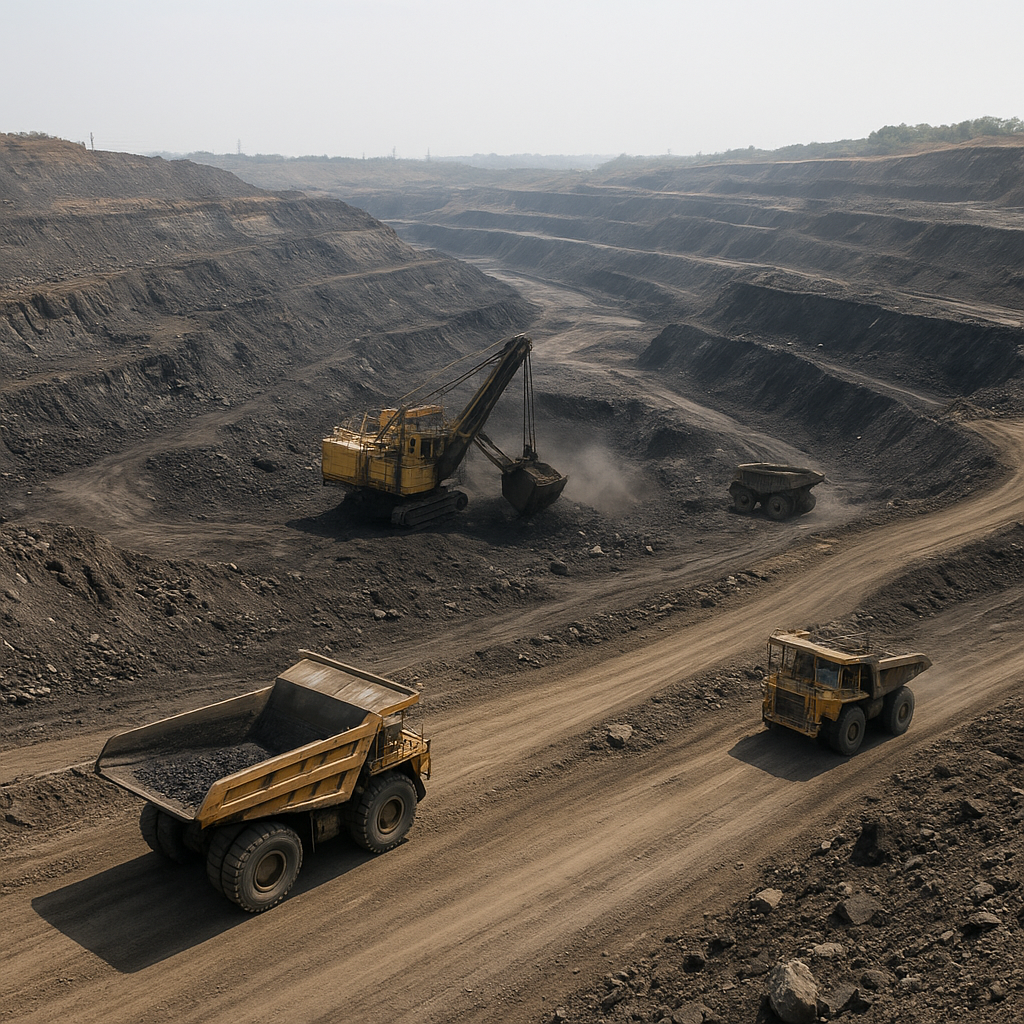
The Singrauli region, often referred to as a powerhouse of India’s energy landscape, hosts one of the country’s most important coal basins. Located on the borderland of two Indian states, this coalfield has shaped regional development, industrial growth and national energy planning for decades. The following article explores where the Singrauli coalfield is situated, what kinds of coal and other resources are extracted there, the broader economic implications of mining and power generation in the area, and several notable and sometimes surprising aspects that make Singrauli a distinctive chapter in India’s industrial story.
Geographic setting and geological background
Singrauli coalfield lies in central-northern India, straddling parts of the state of Madhya Pradesh and neighboring Uttar Pradesh. The coal-bearing tracts are concentrated around the administrative region known as Singrauli district and extend northwards into adjoining districts. Positioned within a landscape of plateaus, river valleys and forested tracts, the coalfield is part of the broader Gondwana sedimentary basin that hosts most of peninsular India’s coal deposits.
Geologically, the coal seams in Singrauli were formed during the late Paleozoic and Mesozoic eras under conditions that produced the characteristic Gondwana coals. These seams vary in depth and thickness across the basin and are typically amenable to both opencast (surface) and underground mining, though opencast methods dominate modern extraction because of the relative shallowness and lateral continuity of many seams. The coal in Singrauli is largely of the non-coking to semi-anthracitic range, making it particularly suited for thermal power generation rather than metallurgical uses.
What is mined in Singrauli: coal and associated resources
The primary resource is obviously coal. The dominant varieties are bituminous and sub-bituminous coals with relatively high ash content compared to some international benchmarks. Their calorific value is nevertheless well-matched to the needs of large-scale steam-driven thermal plants. Mining operations in Singrauli focus on extracting these coal seams at scale to feed nearby and regionally connected power stations.
In addition to bulk coal extraction, the region yields associated minerals and by-products typical of coalfields:
- Coal seams sometimes host minor concentrations of inorganic constituents that require removal during washing and processing.
- Fly ash and bottom ash are generated in vast quantities by thermal power plants; these by-products have encouraged the development of ash utilization industries such as cement and brick manufacturing.
- There is scope for exploration of coalbed methane in certain zones — a potential supplementary energy resource that can be recovered while reducing greenhouse gas emissions from mined seams.
Because of the nature of the coal and the configuration of the basin, most operations emphasize large-volume, mechanized opencast mining. This method allows for rapid extraction and economies of scale but has significant implications for land use and ecology, which are discussed below.
Industrial clusters: power plants, industries and fuel logistics
What elevates Singrauli’s importance beyond being merely a coal reserve is the concentration of thermal power capacity in and around the basin. Several major power stations—state-owned and private—are located close to the mines, enabling an integrated coal-to-power supply chain that minimizes coal transport costs and supports high plant load factors. The close proximity between mines and power plants is one reason the region is often labeled the energy heartland.
Key industrial sectors that rely on Singrauli coal include:
- Large-scale power generation for regional and national grids.
- Energy-intensive manufacturing such as cement and certain chemical processes that can utilize fly ash and residual heat.
- Supporting logistics networks including railheads, conveyor systems and road transport infrastructure tailored to bulk coal movement.
The integration of coal mines and thermal plants has also fostered specialized local services — from equipment maintenance and spare parts supply to skilled technical manpower — creating an ecosystem centered on fossil-fuel-based electricity production.
Economic significance at local, regional and national levels
Singrauli’s economic role can be understood on multiple scales. Locally, the mines and power plants are major employers, providing direct jobs in extraction, plant operations, transport and administrative roles as well as indirect employment in services, retail and construction. For many surrounding towns, the coal industry forms the backbone of the economy.
Regionally, coal from Singrauli feeds thermal power plants whose electricity supports industrial corridors, urban consumption and agricultural needs across several states. Reliable coal supply from Singrauli helps maintain grid stability and reduces dependency on long-distance coal transport lanes, thereby improving logistics efficiency for power companies.
At the national level, the basin contributes to India’s broader energy security. Given India’s historically coal-centric electricity mix, fields such as Singrauli are strategically important in meeting base-load demand. Revenue from coal production, royalties and taxes also flow into state and central government coffers, and coal-linked industries enhance the industrial output of the central belt of India.
Beyond direct economic metrics, Singrauli catalyzes infrastructure investment — rail links, roads, township development and utilities — which in turn have multiplier effects for the wider economy.
Social and environmental dimensions
No account of Singrauli is complete without addressing the complex social and environmental trade-offs that accompany large-scale mining and thermal power generation. The region has experienced significant transformation: forests and agricultural lands were cleared for mines and plant sites, and established communities were often relocated to make way for industrial development. The social costs include displacement, disruption to traditional livelihoods and the challenge of rehabilitating resettled populations.
Environmentally, several issues stand out:
- Air quality: Emissions from coal combustion — particulate matter, sulfur oxides and nitrogen oxides — along with dust from mining operations, contribute to degraded air quality in and around industrial zones.
- Water resources: Thermal plants and mines require substantial water; extraction and effluent discharge can alter local hydrology and affect water availability for agriculture and households.
- Land use and ecology: Opencast mining leads to large-scale land disturbance and habitat fragmentation. Restoring mined-out areas remains a long-term challenge requiring concerted reclamation strategies.
- Fly ash management: While fly ash can be valorized in construction materials, safe storage and utilization require appropriate infrastructure and regulation to prevent contamination.
Public health concerns and community activism have grown in response to these impacts. Policymakers and operators have increasingly focused on mitigation: improved dust suppression, effluent treatment, afforestation of reclaimed land, and compliance with environmental norms. Some operators have also invested in local social development programs — health camps, education initiatives and skill development — to offset social costs and build local capacity.
Technological and operational trends
Mining and power operations in Singrauli have evolved with technology. Mechanized excavation, high-capacity draglines and belt conveyor systems streamline coal movement from pit to pithead, while modern thermal plants incorporate supercritical technology to improve fuel efficiency and lower specific emissions per unit of electricity generated. Coal washing and beneficiation plants aim to raise calorific value by removing ash and impurities, which improves combustion performance and lowers transport costs by reducing inert mass.
There is growing attention to cleaner coal technologies and emission controls: flue gas desulfurization units, electrostatic precipitators and selective catalytic reduction systems are examples of pollution control equipment being applied. Where feasible, coalbed methane recovery and waste heat recovery represent opportunities to capture additional value and reduce greenhouse gas intensity.
Interesting aspects and lesser-known facts
Several features make Singrauli particularly interesting beyond its industrial functions:
- Energy cluster identity: Singrauli is sometimes called the „energy capital” due to its dense concentration of power plants and mines in a relatively compact geographic area. This clustering generates synergies in supply and service industries.
- Fly ash utilization efforts have spurred local entrepreneurial activity: brick making, road base and cement blending plants have been established to make productive use of a major by-product.
- Despite heavy industrialization, pockets of traditional culture and forestry remain, and efforts at ecological restoration have seen experimental afforestation on reclaimed mine sites using native species.
- Strategic logistics: the basin’s location close to major rail corridors and load centers has historically guided the siting of power plants — an example of how resource geography shapes industrial geography.
- Community activism and legal action in the region have raised public awareness about environmental governance and corporate social responsibility, contributing to broader debates about sustainable mining in India.
Future prospects and challenges
The outlook for Singrauli hinges on multiple, sometimes conflicting, pressures. On one hand, continued demand for reliable electricity in India supports the role of coal-fired generation in the medium term. On the other hand, national and global trends toward decarbonization, renewable energy expansion and stricter environmental standards create imperatives for change.
Possible trajectories include:
- Modernization of existing thermal assets with efficiency upgrades and tighter emission controls to reduce environmental footprint.
- Diversification of the local economy to include renewable energy projects, industrial parks based on cleaner technologies and value-added industries that utilize by-products.
- Roll-out of reclamation and rehabilitation programs that transform exhausted mines into agricultural land, forestry plots or even recreational areas, depending on feasibility.
- Exploration of coalbed methane and other cleaner hydrocarbon recovery techniques as transitionary energy sources while renewable capacity scales up.
Ultimately, balancing the economic benefits of the Singrauli coalfield with social well-being and environmental sustainability will demand integrated planning, stakeholder engagement and investments in both technology and human capital. The region’s future will be a test case for how a historically fossil-fuel dependent industrial cluster adapts to new energy realities while attempting to secure livelihoods and ecological resilience.
Concluding observations
Singrauli is emblematic of the complex role coal plays in modern development: it is a source of power, an engine of economic activity, and a focal point for environmental and social challenges. The coalfield has contributed significantly to regional transformation and national electricity supply, while also prompting necessary conversations about sustainability, community rights and technological transition. For policymakers, operators and communities alike, Singrauli’s story offers lessons on the trade-offs and opportunities inherent in resource-driven development.

