
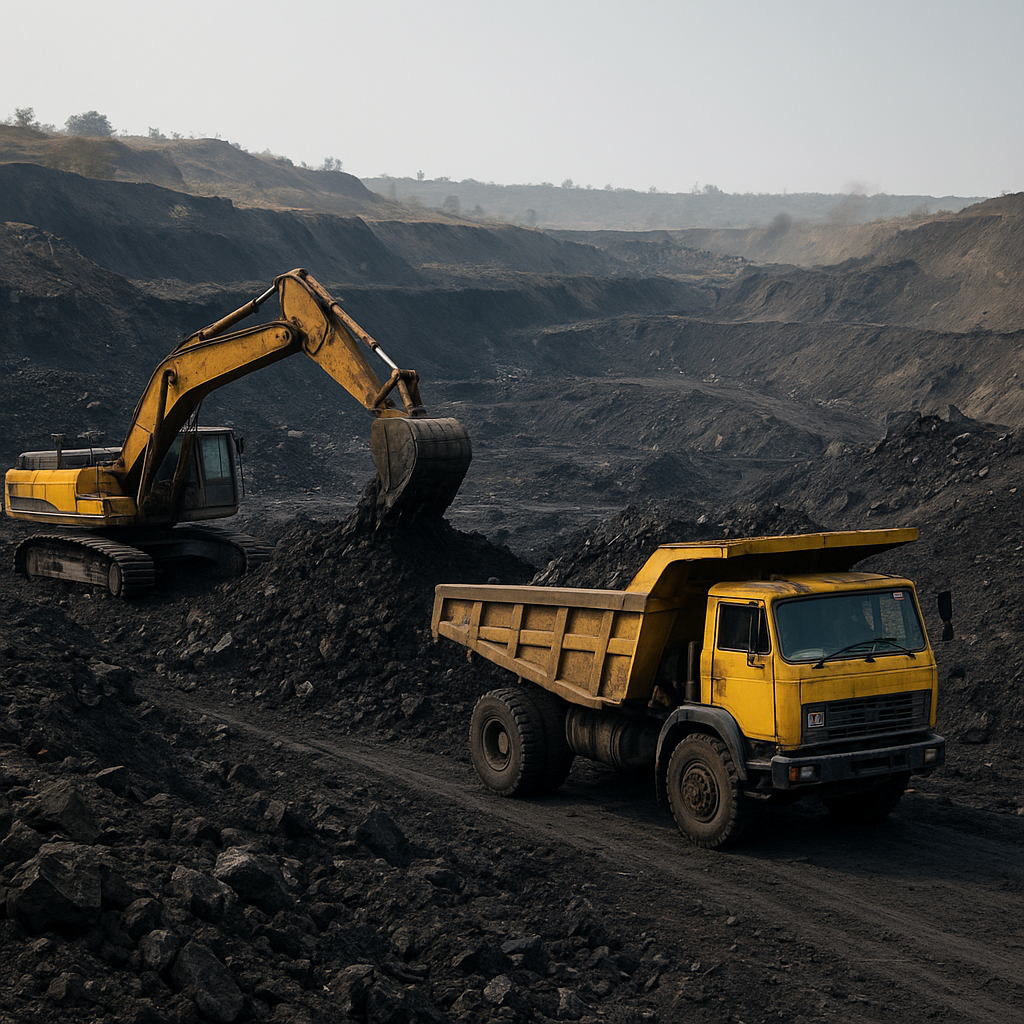
The Jharia Coalfield is one of the most famous and problematic mining regions in South Asia, combining immense industrial importance with a long history of environmental and human challenges. Located in the eastern part of the Indian subcontinent, it has been central to India’s growth in heavy industry and steelmaking for more than a century, while at the same time exemplifying the complex consequences of fossil-fuel extraction. This article examines where the coalfield is located, what kinds of coal are extracted there, its economic role, and a selection of notable and unusual facts that make Jharia a unique case in global mining history.
Location and Geological Setting
The Jharia Coalfield lies in the Dhanbad district of the state of Jharkhand in eastern India. It sits within the broader Damodar Valley coal-bearing basin, a region that has powered industrial activity in the subcontinent since the late nineteenth century. Geologically, the coal seams at Jharia belong to the Gondwana formation and consist predominantly of thick, laterally continuous beds of high-quality bituminous coal. Many of the seams are relatively shallow, which facilitated early exploitation through underground workings.
Administratively and physically the coalfield is centered around the town of Jharia and the larger urban cluster of Dhanbad, often referred to as the “coal capital” of India. The area is crisscrossed by a dense network of mine shafts, adits, and spoil heaps. Over the decades, the landscape has been dramatically altered by mining activity; surface topography shows evidence of subsidence bowls, fissures, and spoil mounds. The proximity of mining zones to densely populated neighborhoods has been a defining feature in the field’s social and environmental history.
Types of Coal and Mining Methods
Jharia is particularly known for its concentration of high-grade, metallurgical coal—commonly called coking coal—valued for its ability to produce coke, an essential input for iron and steel production. The coal here is typically bituminous and has properties (such as volatile matter, calorific value, and caking ability) that make it suitable for converting into coke in industrial furnaces.
Historically, most of the extraction in Jharia has been through underground mining methods: room-and-pillar operations, bord-and-pillar techniques, and various forms of shaft-based access. In peripheral areas and in later decades, opencast (open-pit) mining has been used where geology and economics allowed. Illegal and unregulated mining—often small-scale, hazardous hand-dug operations—has also been a persistent feature. These informal workings frequently intercept active workings or fire zones, increasing risk to miners and residents.
Key mining actors
- BCCL (Bharat Coking Coal Limited), a subsidiary of Coal India Limited, operates many collieries in Jharia and is the principal formal mining company in the area.
- Private and earlier colonial-era operators played a major role in the initial development of the coalfield in the late 19th and early 20th centuries.
- Numerous informal groups and individuals carry out small-scale extraction, often with little safety oversight.
Economic Significance
The Jharia Coalfield has been a backbone of India’s industrialization. The coal produced from Jharia has been a key feedstock for metallurgy and has supplied coking coal to major steel plants, power stations, and industrial users across the country. Because coking coal is comparatively scarce in India, Jharia’s reserves have historically been of strategic value. Even with domestic diversification and imports, Jharia continues to be an important domestic source of metallurgical-grade material.
Economic impacts include:
- Direct employment in mines, workshops, transport and ancillary services, historically supporting tens of thousands of workers and their families.
- Indirect economic activity in nearby urban centers—Dhanbad, Bokaro (nearby), and other towns—ranging from rail logistics to heavy engineering and supplier industries.
- Government revenues through royalties, taxes, and wages tied to nationalized and private mining operations.
Beyond direct extraction, Jharia’s coal has underpinned broader industrial chains: steel mills, railway traction (historically), and chemical industries that rely on coke and coal-derived intermediates. The coalfield’s economic footprint extends into national policy, where secure access to metallurgical coal affects industrial planning, import decisions, and energy-security considerations.
Environmental and Social Challenges
Jharia is well known for its severe and long-running environmental problems. The most notorious is the prevalence of underground fires—smoldering combustion that has affected large parts of the coalfield for decades. These fires began in the early 20th century and have been sustained by exposed coal seams, abandoned workings, and high oxygen availability through fissures and voids. The consequences are profound:
- Persistent emissions of smoke and toxic gases, including carbon monoxide and particulate matter, leading to respiratory illnesses among local residents.
- Surface subsidence and formation of sinkholes that endanger buildings, roads, and people.
- Contamination and alteration of groundwater and surface water through acid drainage and coal-derived pollutants.
- Economic losses due to the degradation of arable land, displacement of communities, and interrupted infrastructure.
Socially, entire neighborhoods and communities have been affected. Government and company efforts have sought to resettle residents from the most hazardous zones, but relocation is complex and often contested. The process involves questions of compensation, livelihood continuity, cultural ties, and the psychological impact of moving from ancestral homes. Illegal mining activity, poverty, and limited local alternatives complicate mitigation and rehabilitation measures.
Public health and governance
Air quality in parts of Jharia and surrounding towns regularly exceeds safe limits. Chronic exposure to pollutants has raised rates of asthma, bronchitis, and other respiratory conditions, as well as skin and eye irritation. Occupational safety in both formal and informal mines has been poor historically; cave-ins, suffocation, and toxic-gas accidents have claimed many lives. These realities have placed pressure on local authorities, state governments, and national agencies to devise long-term solutions.
Remediation, Rehabilitation, and Policy Responses
Over the years a range of technical and policy initiatives have been attempted to control fires, stabilize the ground, and protect communities. Measures include:
- Mechanical sealing of mine openings and ventilation shafts to limit oxygen access to burning seams.
- Inertization and fire suppression using inert gases, water flooding, grout injection, or controlled burning in some contexts to eliminate fuel continuity.
- Filling and stabilization of subsidence-prone voids to reduce surface collapse.
- Relocation and resettlement programs for communities in the most dangerous zones, including planned townships and housing schemes.
- Regulation and enforcement initiatives to curb illegal mining and reclaim land for safe uses.
Implementation has been uneven. Technical challenges—such as the depth and complexity of workings, the spread of fires through fissures, and the heterogeneity of coal seams—make full eradication difficult and expensive. Institutional coordination between central agencies, state departments, BCCL, and local governments is essential but not always smooth. Still, incremental progress has been achieved in some pockets: certain fire zones have been contained, roads and infrastructure have been relocated, and some families have received housing and basic services in resettlement sites.
Interesting and Notable Aspects
Beyond the stark facts of extraction and environmental harm, Jharia displays a number of unusual or compelling features that make it noteworthy:
- Historical depth: Coal mining in Jharia dates back to the late 19th century during the British colonial era. Early demand for coal from railways and industry shaped regional development patterns and spawned a distinctive mining culture.
- Persistent underground fires: Few coalfields in the world have flames and smoldering seams that are so long-lived. The Jharia fires are often compared to other long-running coal-seam fires globally, but the scale and human impact here are particularly severe.
- Human stories: Generations of mining families have lived with the risks, building livelihoods around the industry while coping with displacement and hazardous conditions. Oral histories and local narratives reveal a nuanced picture of resilience, conflict, and adaptation.
- Urban-mining interface: The close proximity of dense urban settlements to active and abandoned mines creates an unusual landscape where residential neighborhoods, markets, and schools sit alongside mine shafts and burning ground.
- Scientific and technical interest: Jharia serves as a living laboratory for mine-fire science, hydrogeology impacted by coal, and the dynamics of subsidence. Researchers study the site to improve fire suppression methods, subsidence prediction models, and sustainable reclamation techniques.
Economic Transition and Future Prospects
Looking ahead, Jharia’s future depends on multiple, sometimes conflicting, trajectories. On one hand, domestic and global shifts away from coal for power generation may reduce some types of demand, but metallurgical coal for steel remains strategically important. On the other hand, pressing environmental and human-safety imperatives require an accelerated timetable for remediation, relocation, and land restoration. Policy choices will need to balance:
- Continuing safe extraction where feasible, to support industry and livelihoods.
- Accelerating fire-control and land-stabilization projects to reduce immediate risks to life and property.
- Investing in resettlement, education, and alternative employment opportunities to ease the social transition away from hazardous sites.
- Exploring technologies for cleaner coal utilization, carbon capture, or industrial diversification to reduce the long-term environmental footprint.
Economic viability will be influenced by the cost of mitigating long-standing hazards, the market for coking coal, and broader industrial policy—especially actions to modernize steelmaking and reduce greenhouse-gas emissions. Local stakeholders, national authorities, and international partners may play roles in financing and implementing comprehensive plans.
Culture, Memory, and the Landscape
The Jharia Coalfield is not only an industrial space but also a cultural landscape shaped by labor migration, colonial-era enterprise, and post-independence nationalization. Community life, festivals, and daily routines have adapted around the rhythms of the mines. At the same time, the visible scars of mining—smoke plumes, ruined buildings, and fenced-off pits—are constant reminders of the costs of industrial development.
Documentation through photography, film, and journalism has kept Jharia in public view, helping to mobilize attention and occasionally prompting policy responses. Local museums, archives, and oral-history projects preserve the memories of miners and their families, highlighting the human dimension alongside technical discussions.
Concluding Observations
As a concentrated source of metallurgical-grade coal, the Jharia Coalfield has been a crucial node in India’s industrial supply chain. At the same time, it exemplifies the environmental and social dilemmas that accompany long-term fossil-fuel extraction: fires that silently consume seams, ground that collapses without warning, and communities that negotiate survival amid chronic risk. The story of Jharia is therefore both technical and deeply human—a combination of geology, engineering, policy, and the lived experience of people whose lives are intertwined with coal.
Efforts to contain the legacy of mining, improve safety, and envision a sustainable future remain ongoing. The balance struck among continued extraction, environmental remediation, and social justice will shape Jharia’s next chapters, and will offer lessons for other mining regions confronting similar histories and challenges.

