The natural occurrence of native copper in the form of nuggets and masses has fascinated geologists, miners, historians and collectors for centuries. This article explores the geological origins, global distribution, physical properties, applications and cultural significance of copper in its native metallic state. Along the way you will encounter scientific details, practical uses and some lesser-known stories connected to these striking metallic specimens.
Geology and formation of native copper
Native copper belongs to the group of native elements and occurs where geological processes allowed copper to be deposited in the metallic state rather than bound in sulfide or oxide minerals. At the atomic level copper is a transition metal with high ductility and malleability; in nature it commonly appears as irregular masses, dendritic or wire-like forms, and less frequently as well-formed crystals. The most important mechanisms that produce native copper include magmatic segregation in basaltic flows, hydrothermal deposition, and secondary supergene processes in the oxidized parts of copper-bearing deposits.
Primary magmatic and basalt-hosted copper
In some volcanic environments, particularly in amygdaloidal basalts, native copper can form when copper-rich fluids concentrate in vesicles or fracture networks during cooling. The classic example of this process is the native copper found in basaltic flows of the Lake Superior region. There, copper was concentrated in the vesicles and cavities of Precambrian flood basalts, forming masses that can reach impressive sizes. The physical setting—fluid circulation through impermeable volcanic layers—favored precipitation of metallic copper rather than sulfides.
Hydrothermal and replacement processes
Hydrothermal systems carrying dissolved copper can precipitate native copper when conditions change: reduction of the fluid, changes in pH, interaction with organic matter, or mixing with cooler waters. In veins and replacement bodies, copper can be deposited alongside minerals such as malachite, azurite and cuprite. Many classic specimens show copper intimately intergrown with green copper carbonates, creating striking visual contrast.
Supergene enrichment and weathering
Near-surface oxidation can convert primary copper sulfides into secondary minerals and, in special circumstances, reduce copper back to its elemental state. Weathering of copper deposits sometimes mobilizes copper as complex ions, which later precipitate as native copper when they encounter reducing conditions—for example, contact with carbonaceous material. Erosion and transport can then produce placer concentrations of copper nuggets or fragments.
Where native copper occurs — notable localities
Native copper is distributed worldwide, but a few regions are particularly renowned for spectacular specimens or economic historicities.
- Keweenaw Peninsula and Isle Royale (Michigan, USA): The Lake Superior copper district is arguably the most famous source of large native copper masses and nuggets. Native Americans exploited this copper for thousands of years, and during the 19th century it became the focus of large-scale mining that produced both ore and impressive specimen pieces.
- Butte (Montana, USA) and various districts in the American Southwest: While many deposits here are dominated by sulfides, native copper has been recovered from pockets and oxidized zones in some mines.
- Tsumeb (Namibia): The Tsumeb mine has yielded world-class mineral specimens including rare native copper intergrown with other secondary minerals.
- Ural Mountains (Russia) and various sites in Eastern Europe: Historic mining districts occasionally produce native copper specimens.
- Chile and Peru (Andean region): In certain porphyry and epithermal systems, native copper can form as part of complex copper mineralization.
- Australia (South Australia, Tasmania, parts of Queensland): Several historic copper fields have produced native copper specimens, sometimes associated with oxidized gossans and secondary minerals.
Beyond these, smaller nuggets and copper-rich float can be found in many places where copper-bearing rocks are exposed to erosion. Beach and shoreline deposits near old basalt exposures sometimes yield small native copper pieces carried by wave action and glacial movement.
Physical and mineralogical properties
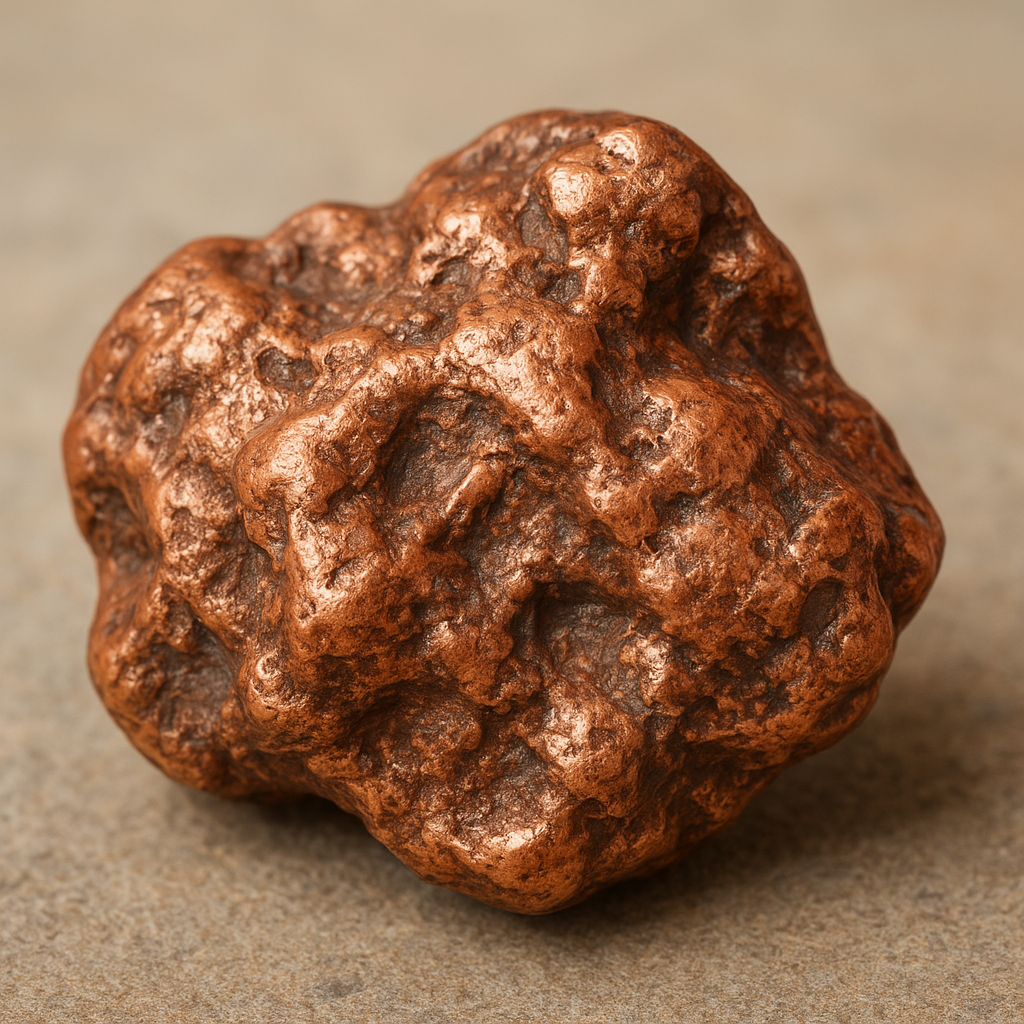
As an element, native copper carries the usual physical properties of metallic copper: a distinctive reddish-orange color when fresh, high metallic luster, and a characteristic reddish streak. Important diagnostic features for field identification include:
- Color and streak: Fresh surfaces show a bright metallic copper hue; the streak is a reddish metallic color.
- Hardness and malleability: Copper is relatively soft (Mohs ~2.5–3) and very malleable. Nuggets can be hammered, drawn into wire or cut with effort. This malleability explains the frequent occurrence of flattened masses and twisted wire-like specimens.
- Density: Copper is dense (specific gravity about 8.9), so nuggets feel heavy for their size.
- Crystal system: Copper crystallizes in the isometric (face-centered cubic) system, though well-formed crystals are uncommon; dendritic and irregular shapes are widely encountered.
- Conductivity and thermal properties: Copper exhibits excellent electrical and conductivity and thermal conductivity, properties that define much of its modern industrial value.
Exposure to air and moisture produces characteristic surface alteration: a brown or black tarnish at first, eventually transforming to attractive green and blue layers of carbonate and sulfate minerals such as malachite (green) and azurite (blue). This surface coating, or patina, is often prized on specimen pieces and decorative objects.
Uses of native copper and nuggets
While most industrial copper today is extracted from sulfide and oxide ores and refined by smelting and electrorefining, native copper and nuggets have several distinct applications and cultural roles.
Historical and cultural uses
Native copper was one of the first metals used by humans. Prehistoric peoples discovered and fashioned copper into tools, ornaments and ritual objects long before the development of smelting. In the Lake Superior region, archaeological evidence shows extensive pre-European copper working, often referred to as the Old Copper Complex. Native copper artifacts provide insight into early metallurgy and long-distance trade networks.
Industrial and technological roles
Today the majority of copper used industrially comes from processed ores, but the properties that made native copper valuable historically remain central to modern applications: excellent electrical and thermal conductivity, corrosion resistance and mechanical workability. These properties underpin uses in wiring, electronics, heat exchangers, plumbing and construction. Native nuggets themselves are rarely fed directly into industrial circuits because of their scarcity and collector value, but the metal they represent is essential to modern infrastructure.
Jewelry, art and collector markets
Large, aesthetically pleasing nuggets and wire copper specimens are sought by mineral collectors and lapidary artists. Nuggets may be cut and set into custom jewelry, polished for display, or left with their natural patina. Collectors prize rare forms—especially twisted wires, crystalline faces or specimens with contrasting green carbonates. The market value for a nugget depends on size, form, rarity and provenance, often commanding large premiums over copper’s raw market price. Many museums host striking native copper pieces, and private collectors compete for top specimens.
Identification, handling and conservation of specimens
Identifying native copper in the field is straightforward for experienced collectors but requires caution and basic testing. Visual inspection, density, malleability and streak tests are key. Chemical reactions—such as a green-blue solution when a small piece is exposed to nitric acid—confirm copper presence, but such tests should be used carefully and with appropriate permits.
- Handling: Wear gloves or handle minimally to avoid oils that can accelerate tarnish.
- Cleaning: Gentle cleaning with soap and distilled water is usually sufficient for display pieces. Strong acids or abrasives will remove patina and can damage a specimen’s value.
- Storage: Store in stable, low-humidity environments, and use padding to prevent mechanical damage. For valuable specimens, archival materials and silica gel can help control humidity.
- Legal and ethical considerations: Many significant localities are protected; removal of specimens from national parks, protected sites or private land is illegal without permission. Collectors should verify local regulations and obtain permits when required.
Environmental and economic aspects
Although native copper nuggets are fascinating, modern copper supply derives mainly from large-scale mining and ore processing. Extraction and refining carry well-known environmental impacts: landscape disturbance from open-pit and underground mining, tailings disposal, acid mine drainage and emissions from smelting operations. Advances in environmental management—improved tailings handling, water treatment, emissions control and mine remediation—seek to mitigate these impacts.
Economically, copper is a strategic industrial metal: it is essential to electrical grids, construction and electronics. Price volatility can affect mining practices and investment in exploration. Nuggets themselves are economically insignificant in volume but often significant in cultural and historical value—museum pieces or collectors’ items frequently sell for much more than their copper content alone would justify.
Interesting stories and lesser-known facts
Native copper has a number of intriguing cultural and scientific anecdotes:
- Archaeological significance: The Lake Superior native copper deposits enabled prehistoric metallurgy in North America long before the arrival of Europeans. Artifacts and trade networks show how important this metal was for indigenous peoples.
- Specimen rarity: Fully crystalline copper crystals are rare; most spectacular specimens are those that preserve unusual shapes such as twisted wires or intergrowths with colorful secondary minerals.
- Metal detectors and modern prospecting: Prospectors sometimes recover small copper nuggets with metal detectors in areas with glacial or fluvial reworking. These finds are typically small but can be scientifically informative about local geology.
- Antimicrobial research: Copper’s antimicrobial properties have long been recognized, and modern hospitals and public spaces increasingly utilize copper alloys for high-touch surfaces to reduce microbial load and transmission of disease.
- Artistic uses: Patinated copper and copper sculptures are common in public art because the evolving patina provides a changing aesthetic that many artists and communities prize.
Associated minerals and paragenesis
Native copper rarely occurs alone. It is typically associated with a suite of secondary and primary copper minerals. Common associates include malachite, azurite, cuprite, chrysocolla, tenorite, and various sulfides and carbonates depending on the depositional environment. In volcanic-hosted examples, zeolites and calcite may also occur in the same cavities. Understanding these associations helps geologists reconstruct the paragenetic sequence—what minerals formed first and under what conditions.
Prospecting and mining history
The discovery and exploitation of native copper have shaped regional histories. In the Lake Superior region, Native American mining and later 19th-century industrial mining transformed local economies and settlement patterns. Elsewhere, pockets of native copper prompted smaller-scale mining efforts. Prospecting techniques included surface reconnaissance, trenching, and later drilling and geophysical surveys. Metallurgical advances allowed extraction from lower-grade ores, but native copper deposits often offered the most straightforward metal recovery where accessible.
From nugget to refined metal
Historically, native copper could be used directly after minimal shaping. In modern metallurgy, copper recovered from ores—whether native or processed—undergoes smelting and electrorefining to produce high-purity copper for industrial use. The key steps include concentration (for sulfide ores), roasting or smelting to produce matte, conversion to blister copper and final electrorefining to high-purity cathodes suitable for electrical applications.
Collecting ethics and legalities
Collecting native copper can be rewarding, but collectors must act responsibly. Many classic localities are protected by law; removing specimens without permission can be illegal and unethical. Collectors should:
- Verify land ownership and regulations before collecting.
- Obtain permits when required and report significant scientific finds to local authorities or museums where appropriate.
- Avoid damaging sensitive archaeological or ecological sites—many copper-bearing regions also contain important cultural artifacts or fragile ecosystems.
Well-documented provenance enhances the scientific and monetary value of a specimen. Museums and academic collections place high value on specimens with clear locality, geological context and acquisition history.
Closing thoughts on native copper nuggets
Native copper nuggets bridge Earth science, human history and practical technology. As a naturally occurring metallic form of one of humanity’s most important elements, they tell stories about geological processes, ancient craftsmanship and modern industry. Whether admired as museum specimens, fashioned into jewelry, or studied by geologists, native copper pieces remain a tangible connection between the metal’s deep Earth origins and its central role in human society. For collectors and scientists alike, responsible study and stewardship preserve these links for future generations.
For those intrigued by specimens, a deeper dive into regional geology, mineral associations and historical records will often reveal surprising narratives—how a nugget moved from molten fluids to a human hand, and how it became part of a culture’s craft, trade or scientific heritage. The next time you see a bright metallic nugget or a twisted wire of native copper in a display case, consider the long series of natural and cultural events that made that piece possible: from subterranean fluids and basalt flows to the steady hands of ancient artisans and the careful labeling by modern collectors and curators.