
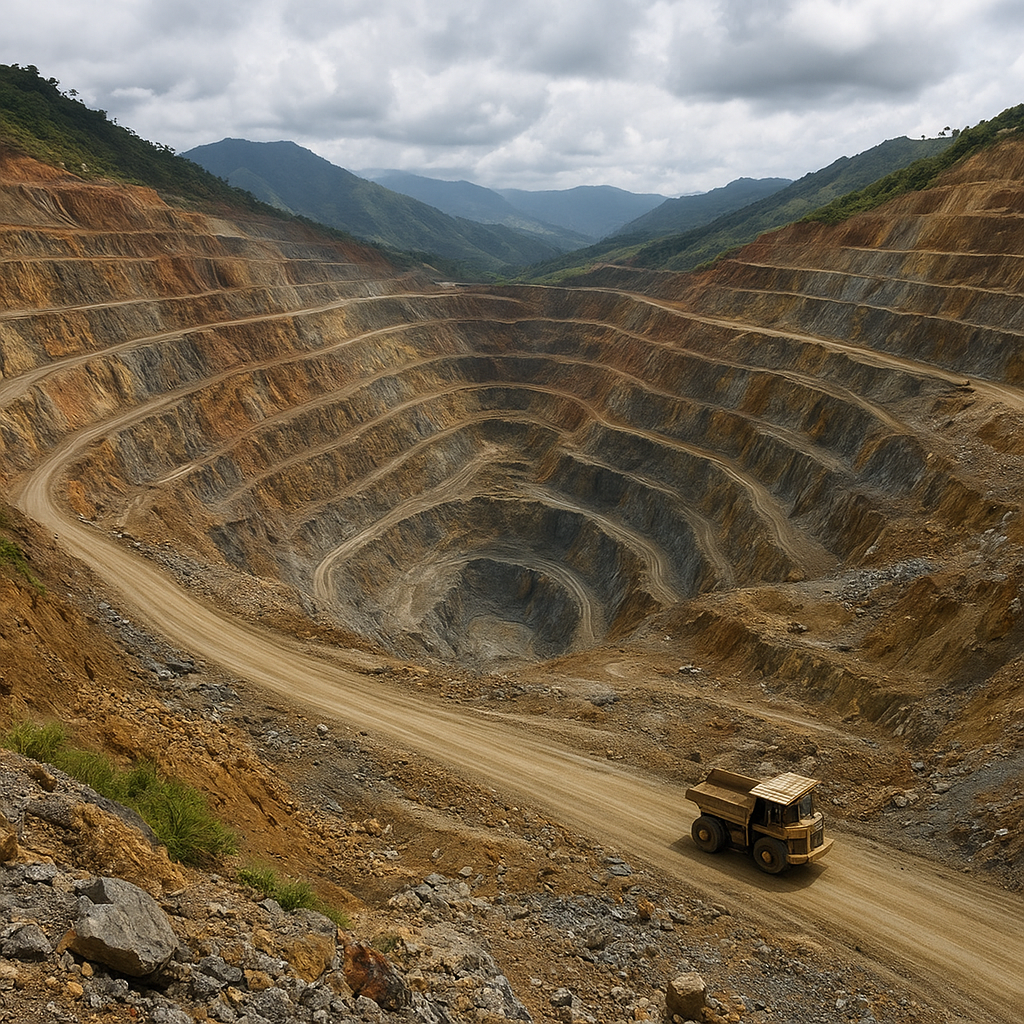
The Porgera operation is one of the most discussed and consequential mining projects in the South Pacific. Located in a remote mountain valley of Enga Province, it has been a focal point for debates about the value and costs of mineral extraction in developing countries. This article explores where the mine is located, what resources are produced there, its economic role for the region and Papua New Guinea as a whole, and several noteworthy technical, social and environmental aspects that shape the story of Porgera.
Location and geological setting
The Porgera project is situated in the highlands of central Papua New Guinea, in the Porgera Valley within Enga Province. The site lies at elevations above 2,000 metres in rugged, often cloud-covered terrain that is reachable only by long, often-weathered roads and air transport. The remoteness and altitude contribute greatly to the logistical and operational challenges of running a major industrial operation in this environment.
Geologically, Porgera is classified as a high-grade, epithermal-style gold deposit with close associations to hydrothermal systems and intrusive activity. The deposit occurs within complex, metamorphosed host rocks with veins and stockworks that concentrate mineralization. While gold is the primary metal of economic interest, the ore has historically contained other valuable and trace metals which are recovered or captured as part of the processing stream. The deposit’s character—high grades concentrated in vein systems—has made it attractive for large-scale underground and open-pit mining strategies over many years.
Mining operations and production
Porgera has operated as a large-scale commercial mine for decades, employing a combination of open pit and underground mining methods to access high-grade ore zones. The operation includes a processing plant where ore is crushed, ground, and treated to extract gold, often through gravity separation followed by flotation and cyanide leaching circuits typical for epithermal gold ores. The operation has periodically been modernized to improve recovery rates and to handle geological and operational changes as mining moves deeper and ore characteristics evolve.
Key operational elements at a complex like Porgera include:
- Mining and haulage fleets capable of operating on steep, often muddy roads.
- A milling and processing plant engineered for high-grade ore and variable throughput.
- Extensive tailings and water-management infrastructure designed to handle the high rainfall of the highlands.
- Security and camp facilities for a large workforce operating in a remote location.
For many years the mine contributed significantly to national gold output and export earnings, and it has been an important source of employment—both directly at the operation and indirectly through service providers, contractors and local businesses. In addition to formal mining work, the area around the operation has long supported a large population of independent or artisanal miners who seek to supplement incomes by recovering gold from waste rock, old tailings and working sections of the ore body that are not accessible to the main operation.
Economic significance at local and national scales
Porgera has been one of the largest contributors to foreign exchange earnings for Papua New Guinea. As a major exporter of gold, the mine has generated important government revenue through taxes, duties, royalties and equity arrangements, and it has provided employment and business opportunities in a part of the country with limited alternative economic activities.
At the provincial and local level, the presence of the mine has led to infrastructure investments—roads, airstrips, power and some social facilities—that would otherwise have taken much longer to appear. The company and successive governments have negotiated benefit-sharing frameworks intended to channel some of the mine’s wealth to local landowners and communities, funding projects in health, education and local business development.
Nevertheless, the economic relationship has been complex and contested. Challenges have included:
- Disputes over the adequacy and transparency of payments to landowners and to the provincial and national governments.
- Concerns that local communities do not always receive proportionate long-term benefits after short-term compensation or project-driven jobs end.
- Dependence on a single resource industry, which creates vulnerability to global gold-price swings and operational disruptions.
From a macroeconomic perspective, mines such as Porgera are prized for their ability to attract foreign investment and to expand export receipts. At the same time, they require sustained governance, contract clarity and regulatory oversight to convert resource wealth into enduring public goods.
Environmental and social controversies
Porgera is often cited in international discussions about the environmental and social impacts of mining. A number of issues have been raised over the years, ranging from tailings management and river contamination to allegations of abuses by security personnel and conflicts with local communities. These concerns have driven scrutiny from non-governmental organizations, human rights groups and the international press.
Key environmental questions at Porgera include the management of tailings and process water, the handling of waste rock that may contain elevated metal concentrations, and the effects of altered river flows downstream from the highlands. High rainfall and steep terrain amplify the risk of erosion and mobilization of fine tailings, so containment and water management are among the most technically demanding aspects of operating here.
On the social side, interactions between the company and customary landowners have sometimes been fractious. Issues that have arisen include disputes over compensation, resettlement impacts, the presence and conduct of security personnel, and claims of human rights violations. The combination of a large population of informal miners (who often enter the mine site to recover residual gold) and the mine’s security posture has led to high-profile incidents that have attracted legal action and international scrutiny.
In response to criticism, operators and governments have implemented various reforms: independent audits and reviews, community development agreements, adjustments to revenue-sharing arrangements and, at times, changes to operational practices. However, reconciling the technical demands of a large mineral operation with local expectations and environmental stewardship in a culturally complex setting remains a persistent challenge.
Governance, ownership and legal context
The governance of large mines in Papua New Guinea typically involves multiple stakeholders: the operating company, the national government, provincial authorities and customary landowner groups. Over time, governance disputes at Porgera have included debates over special mining leases, renewal terms, and the degree to which national and provincial governments exercise oversight or assert ownership rights.
Legal claims, international attention and evolving civil-society scrutiny have all influenced how the mine is managed. Negotiations over benefits, environmental obligations and community relations are often protracted and subject to national political dynamics. For policy-makers the Porgera story highlights the importance of clear legal frameworks that balance investor certainty with adequate protection for local communities and the environment.
Interesting technical, cultural and historical aspects
There are several features of Porgera that many observers find particularly noteworthy:
- High-altitude operations: The mine’s elevation and weather patterns mean work must be adapted to cold temperatures, fog, and heavy rain—conditions not commonly associated with tropical Papua New Guinea.
- Complex underground and open pit sequencing: Managing simultaneous underground and surface mining in a high-grade vein system requires sophisticated geotechnical monitoring and mine-planning to keep operations safe and economic.
- Extensive artisanal activity: The presence of thousands of small-scale miners around the site creates a parallel economy and a continuous management challenge for safety and security.
- Cultural landscapes: The mine sits within territories shaped by strong customary land tenure systems and traditional governance institutions, which influence how benefits are distributed and how conflicts are mediated.
- Innovation under constraint: Because of the remoteness, operators have had to innovate in areas like onsite logistics, medical support, and remote communications—lessons that are transferable to other remote projects worldwide.
These technical and cultural elements make Porgera a case study for the broader global conversation about responsible resource development in sensitive settings.
Future prospects and ongoing challenges
The future of Porgera depends on a mix of geological, economic, social and political factors. Orebody continuity and grade control will determine the mine’s technical longevity, while gold prices and operational costs will shape commercial decisions. Equally important are the political and social frameworks that govern lease renewals, benefit-sharing and environmental compliance.
Key challenges for the coming years include:
- Securing stable, transparent agreements between operators, the state and landowners that can withstand political change.
- Improving environmental safeguards—especially around tailings and water—so downstream communities and ecosystems are protected.
- Finding effective ways to formalize and manage the artisanal mining population to reduce risks to people and to the operation.
- Ensuring a greater, more visible flow of benefits from mining activity into long-term community development and provincial economies.
From a global perspective, Porgera exemplifies both the promise and the difficulties of mineral-led development in a resource-rich, governance-challenged context. The project has generated substantial foreign exchange, jobs, and infrastructure, yet it has also been at the centre of contestation over how the proceeds of extraction should be shared and how environmental and human-rights responsibilities should be discharged.
Concluding observations
Porgera remains one of the most important mining projects in the Pacific, notable for its geological value and the breadth of issues it raises. Its trajectory will continue to inform policy discussions in Papua New Guinea and beyond—about how to reconcile large-scale resource extraction with community rights, environmental protection and long-term economic development. While the technical processes of mining and processing remain central, the long-term legacy of Porgera will largely be judged by how well stakeholders can translate resource wealth into durable, broadly shared benefits.

