
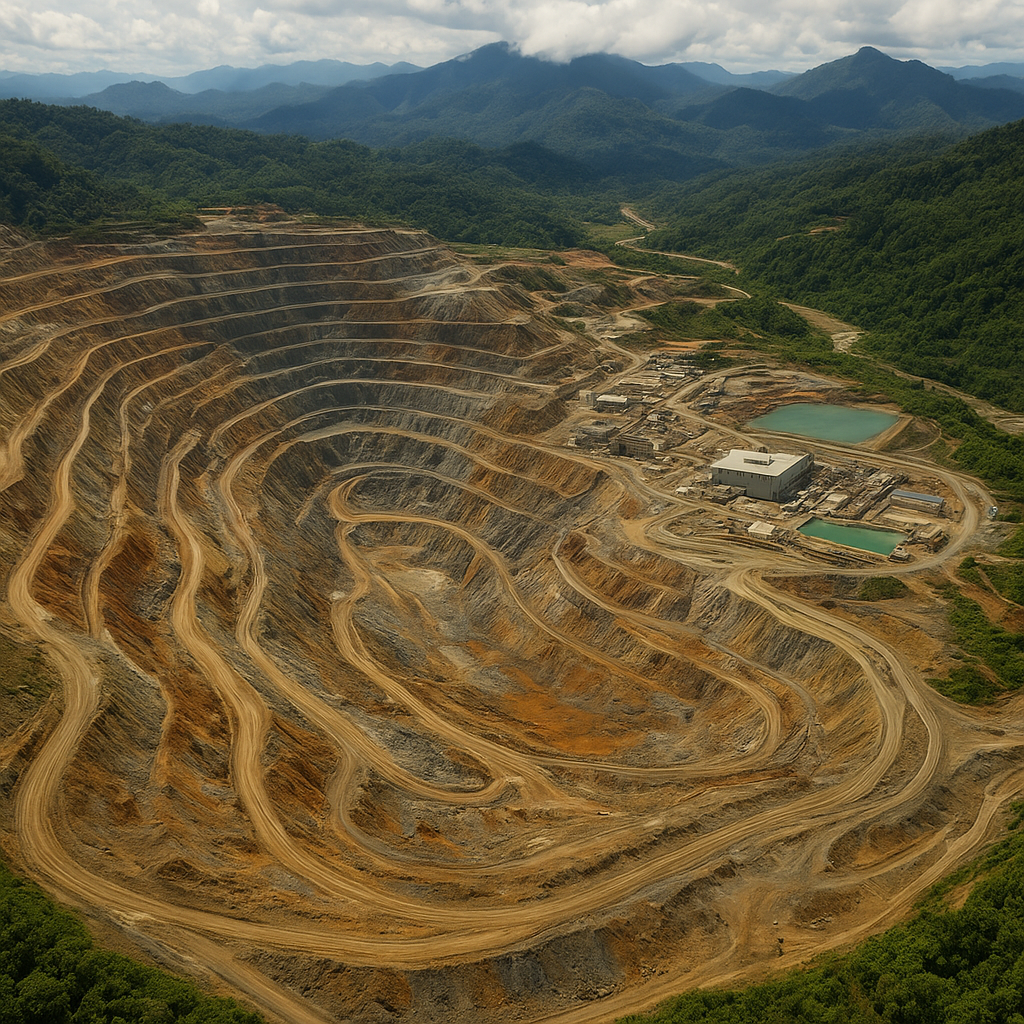
The Ok Tedi mine is one of the most consequential and controversial mineral operations in the Pacific region. Located in the remote highlands and lowlands transition of western Papua New Guinea, it has produced vast quantities of copper and gold while shaping the economic, social, and environmental landscape of the country. The story of Ok Tedi combines geology and engineering, corporate decision-making and local livelihoods, and has important lessons about resource management, environmental responsibility, and the complex trade-offs of large-scale extractive projects.
Where Ok Tedi is located and how it developed
Ok Tedi sits on the slopes of the Star Mountains at the edge of the interior highlands, draining into one of the major waterways of New Guinea. The mine lies in the West Sepik/Western Province border region of Papua New Guinea, with its physical footprint centered around the former volcanic mass known as Mount Fubilan. The deposit was discovered in the mid-20th century during exploration that identified a large porphyry-style copper-gold system. Mining began in earnest in the 1980s when an open-pit operation was established to exploit the near-surface ore bodies.
Access is challenging: the site is deep inland in rugged terrain, with limited road links to the nearest coastal ports. The operation relies on a combination of an airstrip, riverine transport, and overland logistics for supplies and concentrate shipments. Historically, concentrator plant facilities processed ore on-site to produce copper concentrates with associated gold and silver content, which were then transported to smelters elsewhere for refining.
What is mined at Ok Tedi
The principal commodities extracted at the site are copper and gold, with additional by-products that have included silver and other elements typical of porphyry deposits. The geology of the deposit features extensive mineralization hosted in altered volcanic and intrusive rocks, with copper sulphide minerals and disseminated gold. Mining has been carried out mainly by open-pit methods, moving vast quantities of rock and ore to an on-site mill where mineral concentrates are produced.
Because the economic value of the site derives primarily from its copper and gold content, the mine has been a strategic asset for national revenues and foreign exchange earnings. Over decades of operation, the mine has generated concentrates destined for the global metals market, reinforcing its role as a significant industrial producer in the region.
Economic significance for Papua New Guinea
Ok Tedi has had an outsized role in the economy of Papua New Guinea. For several decades it has been one of the country’s largest single sources of export revenue, taxes, and royalties. The mine’s fiscal contributions have funded government programs, provincial development initiatives, and public services in ways that few other enterprises in the country could match.
Direct and indirect employment has been another major economic contribution. The operation provided thousands of jobs over its lifetime, supporting local communities and attracting a workforce from across the country. It also stimulated secondary economic activity in transport, hospitality, and service sectors linked to mining operations. Infrastructure improvements — including airstrips, local roads, and power facilities — have been part of the project’s footprint, sometimes providing broader community benefits.
At the same time, the mine has highlighted the governance challenges that accompany large resource projects. Questions around revenue management, benefit distribution to landowners, and the long-term stewardship of funds and infrastructure have prompted institutional responses. One notable institutional development stemming from Ok Tedi’s history is the establishment of trusts and programs intended to manage proceeds and support sustainable development objectives for affected communities and future generations.
Environmental and social impacts
Ok Tedi is widely known for the significant environmental damage associated with the disposal of mine waste. Instead of being fully contained in an engineered tailings storage facility, large volumes of tailings and pit waste were discharged into the river system. This practice led to profound ecological changes along the Fly River and its tributaries: contaminated and sediment-laden waters, smothered riverbeds, and the collapse of fisheries and riverine ecosystems in affected areas.
The environmental impacts translated into severe social consequences for communities dependent on river resources. Fishing yields declined, floodplains and gardens were buried under silt, and traditional livelihoods were disrupted. The scale and longevity of impacts triggered local and international attention, catalyzing legal action, public debate, and calls for stronger environmental regulation of mining operations. The case of Ok Tedi became a reference point in discussions about the consequences of on-site waste disposal in sensitive river systems.
Efforts to mitigate impacts have included attempts at remediation, community compensation programs, and investments in alternative livelihoods. However, the sheer scale of the disturbance has made full ecological restoration extremely challenging. The case continues to provoke analysis of how environmental risk, engineering choices, and corporate accountability intersect in the context of resource extraction.
Legal, corporate and governance dimensions
The environmental controversies around Ok Tedi led to a series of legal disputes and negotiations involving local landowners, the Papua New Guinea government, and international corporate players. A notable chapter involved litigation that sought compensation for environmental damage and impacts on livelihoods. These proceedings drew attention in Australia and elsewhere, reflecting the transnational nature of corporate responsibility when multinational entities operate in developing-country jurisdictions.
One of the long-term responses to the governance challenge was institutional innovation to manage mining revenues and landowner interests. Mechanisms were established to hold shares, channel dividends, and fund development projects intended to deliver lasting benefits to affected communities. While such mechanisms aimed to improve accountability and direct benefits locally, they also revealed the complexities of trust governance, potential political pressures, and the difficulty of balancing short-term needs with long-term sustainability.
- PNG Sustainable Development Program (PNGSDP) and other trust arrangements were created to steward parts of the mine’s financial returns for community and national benefit.
- Corporate changes and ownership transitions reflected shifting responsibilities for operations, environmental legacy, and remediation obligations.
- Ongoing debates about compensation, environmental monitoring, and rehabilitation illustrate the long tail of social and legal obligations for major mines.
Technical and logistical challenges
Operating a large open-pit mine in the remote and geologically rugged terrain around Mount Fubilan posed significant technical and logistical hurdles. Building and maintaining heavy machinery, concentrators, and transport links in an area with limited infrastructure demanded substantial capital investment and careful planning. Weather and tropical conditions added to operating difficulties, affecting access and equipment longevity.
The chosen approach to tailings management — which involved riverine disposal — was partly influenced by the site’s topography and the costs of alternative containment strategies. That decision, however, became one of the most contentious aspects of the mine’s engineering and risk assessments when downstream environmental consequences became evident.
Interesting and lesser-known aspects
Several facets of the Ok Tedi story make it particularly interesting beyond the headlines about environmental harm and legal battles:
- Geological uniqueness: The deposit is a textbook example of a high-grade porphyry copper-gold system in a rugged island-arc setting, offering valuable lessons for geologists and exploration teams about mineralization in complex terrains.
- Community resilience and adaptation: Despite severe disruption, many communities have shown adaptive strategies, diversifying livelihoods, developing small-scale enterprises, and engaging in local planning to secure future prospects.
- Policy influence: The mine’s controversies have shaped national and regional mining policy, spurring stricter environmental standards, community consultation practices, and more rigorous closure planning for future projects.
- Scientific studies: The site has been the focus of extensive environmental and social research, producing data on riverine pollution dynamics, impacts on biodiversity, and long-term social change processes in resource-rich regions.
- Regional geopolitics: Revenue flows from the mine and the governance of its proceeds have had implications for provincial politics and national debates about decentralization and benefit-sharing.
Contemporary perspectives and the future
As the mine moves through its operational lifecycle, questions about closure, rehabilitation, and legacy management have taken center stage. Contemporary perspectives emphasize planning for a post-mining future that secures community wellbeing, restores ecosystems where possible, and ensures that financial benefits are preserved for future generations.
Future priorities include:
- Strengthening independent environmental monitoring and transparent reporting of impacts and remediation progress.
- Expanding livelihood programs and infrastructure investments that continue after mining operations cease.
- Enhancing legal and institutional frameworks so benefits from mineral wealth are distributed equitably and used for sustainable development.
- Investing in scientific rehabilitation trials to explore river restoration techniques and land rehabilitation where feasible.
Conclusion: why Ok Tedi matters
Ok Tedi is emblematic of the promises and perils of large-scale mineral extraction in developing-country contexts. It demonstrates how a single mine can transform national finances, local economies, and natural systems. The site highlights the importance of robust environmental safeguards, meaningful community engagement, and accountable governance. At the same time, it offers lessons in geology, engineering, and policy that continue to inform mining practice globally. The legacy of Ok Tedi is complex: a mixture of economic opportunity, environmental cost, legal precedent, and ongoing efforts to secure a viable future for the people and ecosystems of western Papua New Guinea.

