
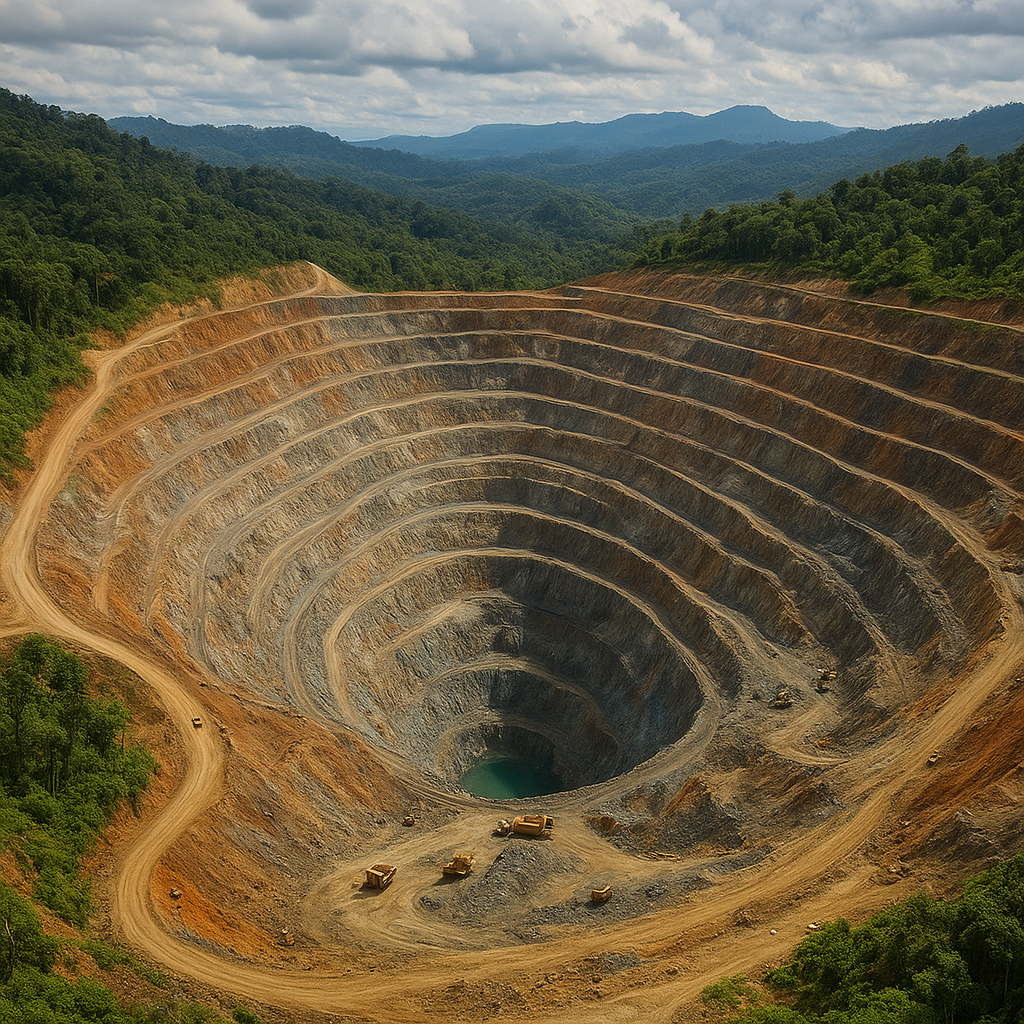
The Wafi-Golpu project in Papua New Guinea is one of the most talked-about mineral deposits in the Southwest Pacific. Located in a mineral-rich part of the country, the area hosts a large porphyry-style deposit that contains significant quantities of both copper and gold. Its geological scale, potential for long-term production and the broader social, economic and environmental implications make Wafi-Golpu a focal point for industry observers, local communities and policymakers alike. The following sections explore where the deposit is located, what minerals it contains, how it might be mined, its likely economic importance and several notable and sometimes controversial aspects of the project.
Location and Geological Setting
The Wafi-Golpu deposit lies in the Morobe Province of Papua New Guinea, on the island of New Guinea. The project area is inland from the provincial capital of Lae, set within rugged, tropical terrain that combines steep hills, river valleys and dense vegetation. The region forms part of a larger corridor of metallogenic belts that run through the island and host a number of world-class mineral deposits.
Geologically, Wafi-Golpu is classified as a porphyry copper-gold system. Such systems are typically large, lower-grade orebodies that form from magmatic fluids and are often associated with extensive alteration zones. The deposit shows the classic zonation: a core of disseminated sulphide mineralisation rich in copper and gold, surrounded by broader envelopes of alteration and lesser mineralisation. In and around the porphyry core, higher-grade veins and structural zones can host richer concentrations of gold, sometimes resembling epithermal-style mineralisation that complements the broader copper-gold resource.
The combination of a substantial porphyry body and associated higher-grade zones is what gives Wafi-Golpu its economic allure: the size of the porphyry provides scale and long-life potential, while the higher-grade parts can help improve project economics.
Minerals and Mining Methods
Primary Commodities
The two main commodities at Wafi-Golpu are copper and gold. Copper typically occurs as chalcopyrite and other sulphide minerals, while gold is present both disseminated in sulphide-hosted rock and in localized higher-grade veins. Minor amounts of silver and other by-product metals may also be recoverable as part of concentrate products.
Mining Options and Technical Considerations
Given the deposit’s geometry and depth, developers and engineers have considered a range of mining methods. These include large-scale open-pit mining for more near-surface portions of the resource and underground mining methods for deeper, higher-grade zones. A combination of both—open pit for the upper sections and underground for the deeper ore—could maximize recovery and project life.
Processing would typically involve crushing, grinding and flotation to produce a copper–gold concentrate. The concentrate would then be transported to a port for export to smelters. Site-specific challenges include access, water management, tailings storage, and the logistics of moving concentrate across rugged terrain to coastal shipping facilities.
- Crushing and grinding to liberate the ore minerals.
- Flotation to produce a copper–gold concentrate suitable for export.
- Tailings management and containment in a tropical, high-rainfall environment.
- Transport infrastructure (roads, conveyors, pipelines, port access) to move product to market.
Economic Significance
The potential economic importance of Wafi-Golpu for Papua New Guinea is substantial. Large copper-gold projects can generate long-lived export revenue, create employment, stimulate local business opportunities and attract inward investment. For a country whose economy remains heavily reliant on resource exports, a project of Wafi-Golpu’s scale could be transformational.
Revenue and Exports
Revenue from mineral exports typically flows through several channels. At the national level, the government benefits through royalties, corporate taxes, and taxes on workers and related industries. At the provincial and local levels, landowner agreements, equity participation and community development funds may provide direct financial flows to affected communities. The export of copper concentrate and dore from gold production would contribute to the country’s foreign exchange earnings and balance-of-payments.
Employment and Local Development
Operations of this size create a spectrum of employment opportunities—from highly skilled technical and managerial roles to a wide range of indirect jobs in construction, supply, services and transport. Local procurement policies can stimulate small and medium-sized enterprises (SMEs) in the region. Infrastructure improvements—roads, power and port facilities—can provide long-term benefits for other sectors such as agriculture and fisheries.
Macro-Economic and Fiscal Considerations
On the macro level, a large mine can provide a durable tax base and significant annual export receipts. However, countries with resource sectors often face challenges such as commodity price volatility, Dutch disease effects (where a strong resource sector crowds out other industries), and the management of resource revenues to ensure intergenerational equity. Effective governance, transparent fiscal frameworks and robust agreements with landowners and local government are critical to capturing maximum public benefit.
Environmental, Social and Governance Issues
Large-scale mining in a biodiverse, high-rainfall, tropical setting like Morobe Province inevitably raises environmental and social governance (ESG) considerations. Stakeholder engagement, careful environmental baseline studies and robust mitigation measures are essential components of any responsible development plan.
Environmental Risks
- Biodiversity: The project area includes habitats that support a range of flora and fauna. Clearing for open pits, roads and infrastructure can fragment habitats and disrupt ecosystems.
- Water quality and hydrology: Mining and tailings facilities can affect river systems through sedimentation, diversion and potential chemical contamination if not properly managed.
- Tailings management: The safe storage of tailings in a seismically active, high-rainfall environment is a major engineering and regulatory challenge. Decisions about on-land storage versus other disposal methods generate strong debate.
Social and Cultural Considerations
Land ownership in Papua New Guinea is largely customary, and mining projects must negotiate agreements with landowning groups. These agreements address compensation, employment, business opportunities and cultural protections. Community expectations can be high, and perceived or real exclusions from benefits can create social tension. Ongoing consultation, transparent benefit-sharing mechanisms and culturally sensitive programs are essential to maintaining license to operate.
Governance and Institutional Capacity
The governance of large resource projects depends on the strength of institutions—regulatory agencies, environmental authorities, and fiscal institutions. Clear contracts, independent oversight and public reporting guard against corruption and ensure that communities see tangible benefits. The Wafi-Golpu project has been a focal point for scrutiny by both national and international stakeholders for exactly these reasons.
Interesting Aspects and Wider Context
Beyond the technical and economic facets, several aspects of Wafi-Golpu make it particularly interesting.
1. Scale and Regional Significance
Wafi-Golpu is frequently cited as one of the larger undeveloped copper-gold deposits in the Asia–Pacific region. Its size means it could underpin a long-life operation, making it strategically significant not just for PNG but also for global supply of copper, a metal central to electrification and decarbonisation technologies.
2. Strategic Metal for the Energy Transition
As the world shifts toward electrification, demand for copper—used extensively in electric vehicles, renewable energy systems and grid infrastructure—is rising. A major, stable source of copper like Wafi-Golpu can therefore play a role in global supply chains for the low-carbon transition.
3. Complex Logistics and Infrastructure Opportunities
The location of Wafi-Golpu necessitates investment in transport and port infrastructure. Projects of this nature often catalyse broader infrastructure development—improved roads, power solutions (including potential renewable energy integration) and port upgrades—that can benefit other industries and communities.
4. Interaction of Different Mining Styles
Wafi-Golpu’s combination of porphyry-hosted copper-gold mineralisation and adjacent higher-grade gold zones is an interesting geological combination. It offers technical challenges and opportunities in resource extraction and metallurgical processing—optimising recovery across a spectrum of ore types can improve project returns.
5. Social Complexity and Landowner Relations
The customary land tenure system in Papua New Guinea means that securing agreements with landowners is central to any project’s progress. Wafi-Golpu has been a case study in how companies and governments approach negotiation, benefit-sharing and local development planning. Innovations in community agreements, local content strategies and long-term development planning are closely watched here.
6. Environmental Debates and Engineering Solutions
Because the site lies in a sensitive environment, the project has led to technical and policy debates about how to manage waste rock, tailings and water in an environmentally responsible way. These discussions often involve international standards, independent scientific reviews and the development of tailored engineering designs to mitigate risks.
Future Prospects
The future of Wafi-Golpu depends on a mix of factors: commodity prices, technical feasibility studies, investor appetite, the outcomes of community negotiations and the strength of regulatory approvals. If developed responsibly, the project could be a major contributor to national and regional development. Conversely, if environmental or social issues are not satisfactorily addressed, it could face delays or prolonged opposition.
Key determinants for moving forward include:
- Completion of detailed feasibility studies to optimise mining method and processing flowsheet.
- Robust environmental management planning and tailings solutions adapted to the local climate and seismic conditions.
- Transparent, fair agreements with landowners and provincial authorities to ensure sustainable benefit sharing.
- Investment in infrastructure that balances project needs with broader community development goals.
- Long-term fiscal planning by national authorities to convert resource rents into enduring public goods.
In summary, Wafi-Golpu exemplifies both the promise and the complexity of modern mineral development. It is a project with the potential to generate significant export earnings and local economic opportunities, but one that also demands careful stewardship of environmental values, meaningful engagement with traditional landowners and strong governance to ensure that benefits are shared fairly and sustainably.

