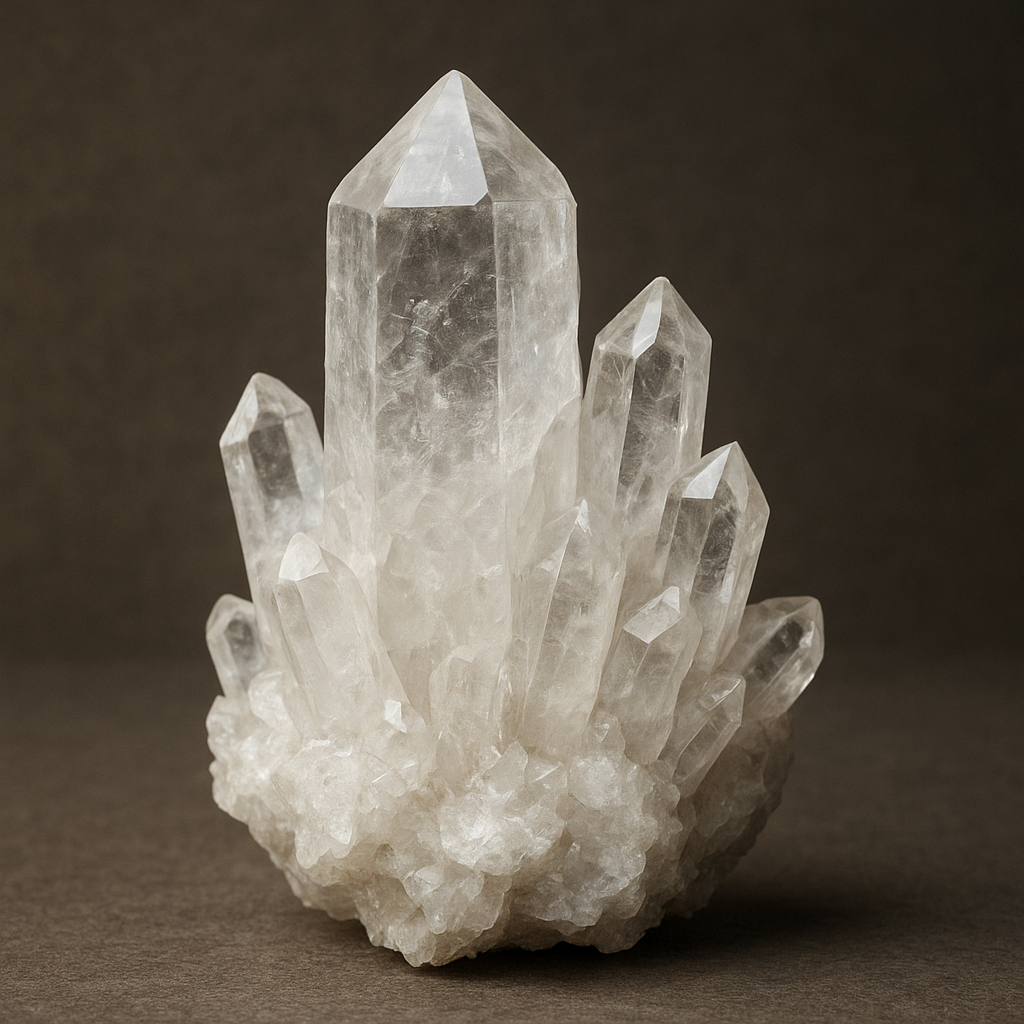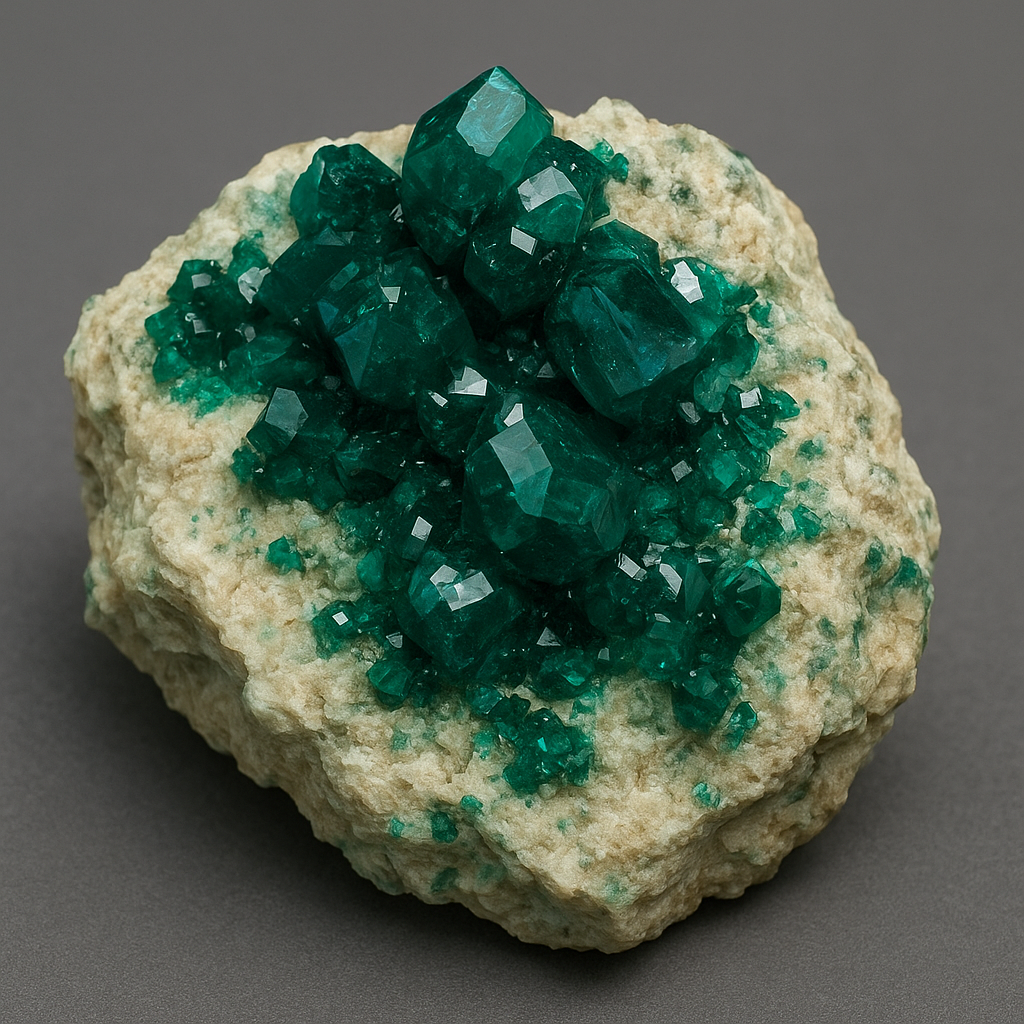
Dioptase is a strikingly colored copper mineral prized by mineralogists, gem cutters, and collectors for its vivid green to bluish-green crystals. Though not commonly used in mainstream industry due to its relative softness and scarcity, dioptase occupies an important niche in the world of decorative stones, mineralogical study, and cultural lore. In the following sections I will explore its geological occurrence, physical and chemical characteristics, notable localities, practical and creative applications, care and markets, and a few intriguing historical and cultural connections that make this mineral especially fascinating.
Geological occurrence and formation
Dioptase forms in the oxidized zones of copper sulfide deposits, where the original primary copper minerals break down and react with silica-bearing fluids. It is typically a secondary mineral, appearing after the weathering of copper ores and forming in association with other copper minerals such as malachite, azurite, chrysocolla, and cuprite, as well as with silica minerals like quartz. The conditions that favor dioptase formation include a combination of copper-rich solutions, availability of dissolved silica, and relatively low temperatures in a supergene environment.
Typical host environments are fractures, cavities, and vugs in oxidized zones and the walls of old mine workings, where fluids can precipitate colorful micro- to centimeter-sized crystals. Because dioptase requires a narrow range of chemical conditions to form — namely, a balance of copper, silica, and a slightly acidic to neutral pH — it is less widespread than more robust copper minerals and often appears as isolated pockets or veins rather than extensive deposits.
Mineral associations and paragenesis
- Commonly found alongside malachite and azurite, which form under similar supergene oxidation conditions.
- Often associated with silica phases like quartz; in some deposits, dioptase and quartz form striking contrasts between brilliant green crystals and clear to smoky quartz.
- May be present with cuprite, chrysocolla, and various manganese oxides depending on local chemistry.
The paragenetic sequence typically begins with the oxidation of primary sulfides, mobilizing copper into solution. Silica introduced via circulating fluids then precipitates with copper under favorable conditions to yield dioptase. Because these fluids can be episodic, dioptase crystals often record multiple growth phases, zoning, or overgrowths that are interesting to microscopists and mineralogists.
Physical and chemical characteristics
The visual appeal of dioptase is one of its most defining characteristics: it displays an intense, saturated emerald-green to bluish-green color that rivals some gemstones. This color arises from the presence of divalent copper in its structure. Dioptase typically forms well-defined, slender, and terminated crystals that are highly transparent to translucent with a bright, vitreous luster, making specimens exceptionally photogenic and desirable for display.
Key physical traits include:
- Color range: vivid green to bluish-green, sometimes deep teal.
- Crystal habit: commonly prismatic to short, slender crystals often forming clusters, druses, or isolated terminated crystals.
- Luster: vitreous to sub-adamantine, which enhances the apparent depth of color.
- Hardness: moderate; dioptase typically rates around hardness 5 on the Mohs scale, meaning it is softer than many gem materials and requires care when used in lapidary applications.
- Cleavage and fracture: cleavage is imperfect; fracture tends to be conchoidal to uneven in massive material.
- Specific gravity: moderately high due to copper content (often in the range of about 3.2–3.4 g/cm3).
Chemically, dioptase is a copper silicate containing silica and hydroxyl/water components; it is often described as a copper cyclosilicate in mineralogical classifications. Its chemical sensitivity and solubility in acids or strong alkalis make it unsuitable for many industrial settings but render it a subject of interest in geochemical and crystallographic studies.
Notable localities and famous finds
Although dioptase is not globally abundant, certain localities have produced world-class specimens that shaped the mineral’s reputation.
- Tsumeb, Namibia — one of the most celebrated localities in the mineral world, Tsumeb has produced extraordinarily aesthetic dioptase crystals often found with contrasting azurite, malachite, and cerussite. The mine’s complex oxidation zones and varied paragenetic environments created ideal conditions for rare and attractive secondary minerals.
- Democratic Republic of the Congo (Katanga/Upper Katanga region) — sites in this region, historically associated with remarkable copper mineralization, have yielded rich pockets of dioptase that can form dense sprays of crystals and deep-colored specimens prized by collectors.
- Kazakhstan — certain stratabound copper-silica deposits in Kazakhstan have produced fine dioptase specimens; these finds often include well-formed crystals suitable for study and for small cabochons.
- Other occurrences — numerous localities worldwide produce dioptase in smaller quantities, including pockets in parts of Europe, Asia, and the Americas. Many of these produce specimens favored by museums and private collectors.
Collectors particularly value large, transparent, and sharply terminated crystals, especially when presented on matrix with contrasting minerals. Specimens showing excellent crystal faces, intact terminations, and deep saturation command premium prices at mineral shows and auctions.
Uses and applications
Dioptase’s primary role today is ornamental and educational rather than industrial. Its vibrant color and crystal habits make it desirable for display specimens, museum pieces, and limited jewelry use where protective settings are possible. Applications include:
- Collectors and display specimens: The majority of dioptase production goes to collectors and museums. Pristine clusters, large isolated crystals, and matrix pieces are exhibited and studied for both aesthetic and scientific value.
- Jewelry: Because of its moderate hardness and perfect to imperfect cleavage, dioptase is best suited for pieces that will not be exposed to heavy wear — for example, pendants, earrings, and brooches in protective settings. Cut stones tend to be small cabochons or faceted gems used sparingly in designer pieces that emphasize color over durability.
- Lapidary art: Skilled lapidaries create cabochons, small faceted stones, and inlay pieces from higher-quality, transparent dioptase, but such uses are specialized and often carry a higher retail premium due to the rarity of suitable rough.
- Scientific study: Dioptase is of interest to mineralogists, crystallographers, and geochemists studying supergene processes, copper mobility, and silicate mineral formation in weathering environments.
- Cultural and metaphysical contexts: In many contemporary metaphysical and crystal-healing circles, dioptase is valued for its striking green hues and associated symbolic properties; while these uses are non-scientific, they contribute to demand among certain buyers and artisans.
Limitations for commercial/industrial use
Dioptase’s relative scarcity, sensitivity to chemicals, and moderate hardness make it unsuitable for most industrial applications. It is not used as an ore of copper or in construction; rather, its value is primarily aesthetic and educational. Because dioptase crystals are often delicate, they are typically preserved intact for display rather than crushed or processed.
Cutting, care, and handling
Working with dioptase requires knowledge of its fragility. For collectors and jewelers, proper care extends the life and beauty of specimens and finished pieces.
- Cleaning: Avoid harsh acids, ammonia, or strong detergents. Clean gently with a soft brush and lukewarm water. Ultrasonic cleaners and steam cleaning are not recommended because vibrations and heat can damage crystals.
- Storage: Store dioptase pieces individually wrapped or padded to prevent abrasions. Keep away from chemicals and prolonged exposure to sunlight, which in some specimens can cause slight fading over long time periods.
- Setting for jewelry: Use protective bezels, closed-back settings, or halo designs that reduce the risk of mechanical impact. Rings are generally discouraged for daily wear unless the stone is exceptionally protected.
- Repair and restoration: Because dioptase can cleave or chip, repairs should be handled by specialists experienced with fragile minerals. Consolidants or adhesives must be chosen carefully to avoid chemical interaction with the mineral.
Collectors often prefer to display dioptase in cabinets with controlled humidity and minimal handling to preserve luster, color, and crystal integrity.
Market, collecting, and value considerations
The value of dioptase specimens depends on several factors: crystal size, color saturation, transparency, quality of crystal faces and terminations, presence of matrix, and rarity of the locality. Perfectly terminated, transparent crystals with deep green color on contrasting matrix command the highest prices among collectors. Smaller gem-quality stones suitable for cutting are rarer and also command high prices per carat compared with more common gem materials.
- Specimens from classic localities like Tsumeb often carry a locality premium because of their provenance and historical importance.
- Specimen provenance, documentation, and ethical sourcing increasingly affect market value as collectors prefer traceable, responsibly obtained material.
- Fakes and treated pieces: As with many attractive minerals, buyers should be alert to dyed or stabilized material, and dealers should provide disclosure about treatments. Natural, untreated dioptase retains the highest collector value.
Cultural, historical, and scientific curiosities
Dioptase has influenced both science and art through its intense color and rarity. A few interesting aspects include:
- Historical use in small-scale ornaments and as a curiosity among early mineral collectors, with specimens from classic mines entering museum collections in the 19th and early 20th centuries.
- Its name, derived from Greek roots (di- + optase), historically reflects aspects of its appearance or optical properties in early descriptions — a reminder of how classical languages and early mineralogy intersect.
- Dioptase’s role in educating geologists about supergene copper enrichment processes and the mobility of silica in oxidizing environments. Studies of dioptase-bearing veins can illuminate fluid pathways and paleo-environmental conditions at mine sites.
- Its use in contemporary artisanal jewelry and objet d’art: designers often place dioptase in limited-edition pieces that emphasize the mineral’s natural beauty while acknowledging the need for careful wear and preservation.
Noteworthy scientific investigations
Research on dioptase touches a few technical domains: crystallography (investigating growth patterns and microstructures), geochemistry (tracing copper and silica transport), and conservation science (methods to preserve fragile minerals). Microscopic studies reveal zoning and growth histories that can be read like natural archives of fluid chemistry and temperature during formation. These insights are valuable for understanding ore-deposit evolution and the broader story of how colorful secondary minerals enrich the geological record.
Practical advice for enthusiasts
If you are considering collecting, displaying, or wearing dioptase, a few practical tips will help you get the most from your pieces:
- Buy from reputable dealers and request provenance information when possible; locality and history can greatly enhance a specimen’s scientific and monetary value.
- Handle minimally and display in a way that minimizes vibration, direct sun, and contact with chemicals.
- For jewelry, prefer protective settings and limit use to occasions where impact will be unlikely. Consider insuring valuable pieces and documenting their condition with photographs.
- Join mineralogical societies or online communities to learn identification tips, meet experienced collectors, and stay current on new finds and market trends.
Dioptase stands out among copper minerals for its exceptional color and often gemmy transparency. While not a workhorse of industry, it plays an outsized role in the culture of collecting and in scientific study of supergene mineralization. Its beauty, combined with a sensitivity that demands respect and careful handling, gives dioptase an aura of rarity and refinement that continues to fascinate mineral lovers and researchers alike.