
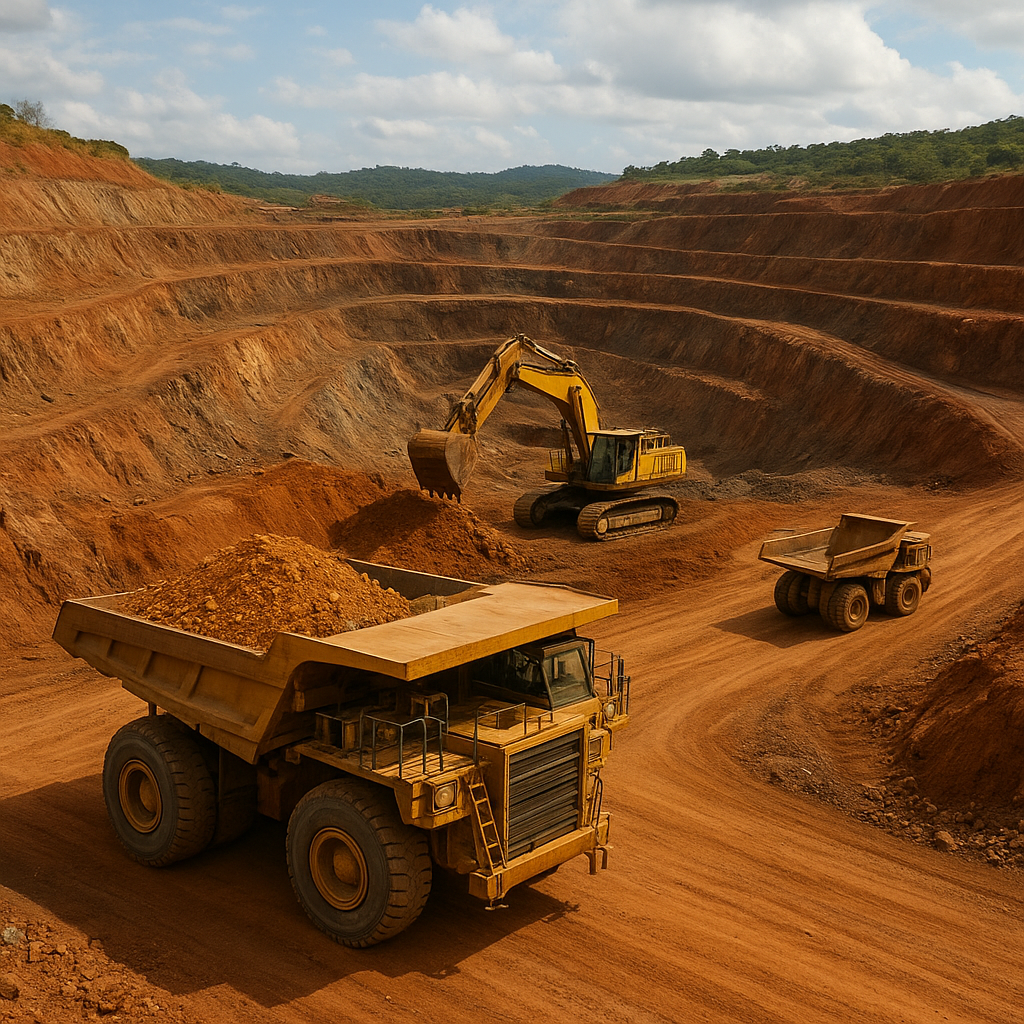
The Obuasi Mine sits at the heart of Ghana’s historic Ashanti gold belt and has been a keystone of the country’s mining identity for more than a century. This article examines where the mine is located, what it produces, the ways it influences the local and national economy, and several aspects that make Obuasi particularly interesting — from its geology to social and environmental challenges and its ongoing modernization. Throughout the text, a handful of essential terms are emphasized to draw attention to the mine’s most significant elements.
Location and historical background
The Obuasi mining complex is located in the southern part of the Ashanti Region of Ghana, roughly south-southwest of the regional capital of Kumasi. The town of Obuasi developed around the mining works and has long been dependent on the mine for employment, infrastructure, and services. The area lies within the prolific Ashanti Belt, one of West Africa’s most important mineralized greenstone belts.
Gold was reported from the Obuasi area in the late 19th century during the period when modern mining methods began to be applied in West Africa. Commercial-scale operations rapidly took root, transforming Obuasi from a rural settlement into a mining town. Over the decades the mining complex expanded and changed ownership and management structures several times, most recently operating under the direction of a major global producer. The mine’s long history makes it one of the oldest continuously exploited gold districts in Africa.
Obuasi’s historical role has also been shaped by its proximity to the cultural heartland of the Ashanti people; that intersection of traditional authority and industrial development has influenced land tenure, local governance and how mining benefits are negotiated and distributed in the community.
Geology, mineralization and what is produced
The Obuasi deposit is hosted in Birimian-age greenstone sequences — a geological environment known across West Africa for rich gold occurrences. Mineralization at Obuasi occurs as narrow, high-grade quartz-carbonate-vein systems and disseminated sulphide zones that have produced exceptionally high-grade ore compared with many other large-scale deposits.
Obuasi is primarily a gold mine. The ore typically contains free-milling gold associated with sulphide minerals such as pyrite and arsenopyrite. Processing has traditionally focused on crushing, milling and gravity/CIL (carbon-in-leach) or flotation circuits tailored to recover gold from both free-milling and refractory material. Over time, improvements in metallurgical testing and plant design have allowed higher recovery rates for more complex ore types.
Mining at Obuasi has been predominantly underground for many decades. The deposit’s geometry and the depth of high-grade shoots favored underground mining methods — declines, ramps, shaft systems and various forms of stoping — rather than large-scale open-pit operations. Modern redevelopment programs have aimed to combine mechanization with selective mining to keep production focused on the most profitable, high-grade zones.
Exploration and reserves
- Exploration around Obuasi continues to target extensions of known high-grade veins and deeper shoots that may extend below existing workings.
- Because of its long life, Obuasi has both mined-out areas and significant remaining resources, which necessitate a continuous program of exploration to sustain operations and support mine-life extensions.
Economic importance and contribution
The Obuasi Mine plays a multifaceted role in the Ghanaian economy. At a national level, gold is one of Ghana’s leading export commodities, and large operations like Obuasi contribute significantly to export earnings, government revenues (taxes, royalties and levies), and foreign exchange inflows. As a recognized industrial complex, the mine also has an outsized effect on the local economy of the Ashanti Region.
Direct and indirect employment is one of the clearest ways Obuasi influences livelihoods. The mine employs a workforce that includes mining professionals, engineers, geologists, metallurgists and a large number of skilled and semi-skilled local workers. In addition to direct employees, Obuasi supports contractors, suppliers, transport providers and service industries in the town and surrounding districts. This employment base stimulates markets for housing, education, healthcare and retail. The mine’s payroll circulates locally, supporting many small businesses.
Public revenues from the mine fund infrastructure and services. Taxes and royalties help finance national and regional budgets, while some mining companies also maintain community development programs that directly invest in local projects such as schools, clinics, roads and potable water systems. Local procurement and capacity-building programs can induce further economic diversification if well-managed.
Beyond immediate fiscal contributions, Obuasi has historically been an anchor institution. The presence of large-scale mining raises demand for construction, power, and communication services and often accelerates improvements that benefit non-mining sectors. That said, the long-term sustainable development of the region depends on converting mining-generated wealth into durable assets and alternative economic activities that persist after the mine’s productive life ends.
Social, environmental and governance issues
Large, long-lived mining operations like Obuasi raise complex social and environmental challenges that require careful management. The legacy of past mining includes land disturbance, tailings storage areas, possible hydrogeological changes, and the social disruption that can follow boom-bust cycles in commodity markets.
One of the most acute issues in the Obuasi area is the interaction between formal mining operations and informal or artisanal miners. Known locally by terms such as artisanal or “galamsey,” small-scale miners have often entered the perimeter of larger concessions in search of high-grade material or reworking of tailings. This leads to conflict, safety risks and environmental degradation (soil erosion, pollution of watercourses by sediment and chemicals). Addressing these tensions requires both enforcement and the provision of legal and profitable alternatives for artisanal miners.
Environmental management programs at modern mines include progressive rehabilitation of disturbed land, controlled tailings and waste rock management, water treatment facilities, and measures to limit dust and noise impacts. The redevelopment of Obuasi in recent years incorporated contemporary environmental controls and mine closure planning, but legacy issues remain a priority for regulators, communities and the operator.
Social license to operate has become an increasingly important concept in Obuasi’s governance. Regular engagement with traditional authorities, local governments and community groups is necessary to negotiate land access, resettlement agreements and community development programs. Transparent benefit-sharing and local procurement can improve outcomes, but failures or perceived inequities can generate protests, legal disputes and reputational damage for the company.
Modernization, innovations and the future
Obuasi has seen major redevelopment programs in the 21st century designed to turn a historically high-grade but aging asset into a safer, more efficient modern underground mine. Modernization efforts have included:
- Upgrading decline and shaft infrastructure to improve access and ore hoisting speed
- Introducing mechanized equipment to increase productivity and safety
- Implementing improved ventilation, ground support and monitoring systems
- Updating processing plants to optimize recoveries and treat more complex ore types
- Strengthening environmental controls and community engagement programs
Technological advances in orebody modeling, remote monitoring, and automation have the potential to further increase efficiency and safety. For Obuasi, continued exploration at depth and along strike is key to extending the mine life. New discoveries or the re-evaluation of lower-grade ore with improved economics and processing could sustain operations for decades, depending on market conditions and capital investment.
The mine’s future is also tied to broader shifts in global markets, including the price of gold, investor sentiment toward mining in Africa, and international expectations on environmental, social and governance (ESG) performance. Growing emphasis on responsible sourcing and traceability could create incentives for producers that demonstrate best practice in sustainability, transparency and community benefits.
Interesting facts and lesser-known aspects
Several features make Obuasi more than just another gold mine:
- Historical prominence: Obuasi’s long record of production makes it part of Ghana’s mining heritage and a focal point for studies of colonial and post-colonial extractive development.
- High-grade shoots: Unlike many giant gold operations that rely on bulk, low-grade ore, Obuasi’s high-grade deposits have historically allowed for profitable production at relatively smaller volumes of ore.
- Local culture: The mine exists alongside strong traditional institutions; cultural practices and local leadership play a role in negotiating land access and benefit distribution.
- Adaptive reuse of infrastructure: Over time, old workings, shafts and tailings areas have required creative engineering and reclamation approaches.
- Community initiatives: The mine has supported local clinics, educational programs and small-scale enterprise initiatives intended to improve living standards in Obuasi and surrounding towns.
Another compelling angle is the interplay between modern corporate mining practices and informal small-scale mining. The dynamics here reflect global debates about how best to formalize artisanal miners, eliminate hazardous practices, and ensure that rural populations benefit from mineral wealth without suffering environmental harm.
Obuasi also provides a real-world laboratory for innovations in underground mining — integrating geomechanics, remote sensing, and newer mining methods to safely extract deep, narrow vein systems. The lessons learned here can be relevant for other mature mining districts worldwide that are seeking to transition from legacy operations to more technically sophisticated and socially responsible production.
Stakeholders and community engagement
Key stakeholders in and around Obuasi include the mining company, national and local government agencies, traditional authorities, employees and their families, artisanal miners, local businesses and civil society organizations. Effective engagement among these groups underpins the mine’s operational stability and the ability to address social and environmental risks proactively.
Mechanisms such as community development agreements, local employment targets, skills training programs and transparent grievance mechanisms are tools that have been deployed to build trust and provide tangible benefits. Equally important are independent oversight and regular reporting, which help ensure commitments are met and that the community has access to reliable information about the mine’s operations and impacts.
Conclusion — pathways forward
Obuasi exemplifies both the promise and the complexities of large-scale gold mining in Africa. Its deep historical roots, high-grade geology and scale of operation have delivered substantial economic benefits to Ghana. At the same time, managing social and environmental legacies, integrating artisanal miners into safer and legal livelihoods, and investing resource revenues into durable public goods remain central challenges.
Looking forward, success at Obuasi depends on sustaining exploration and technical excellence, maintaining strong community relationships, adhering to high environmental standards, and ensuring that the wealth generated contributes to long-term, inclusive development in the region.

