
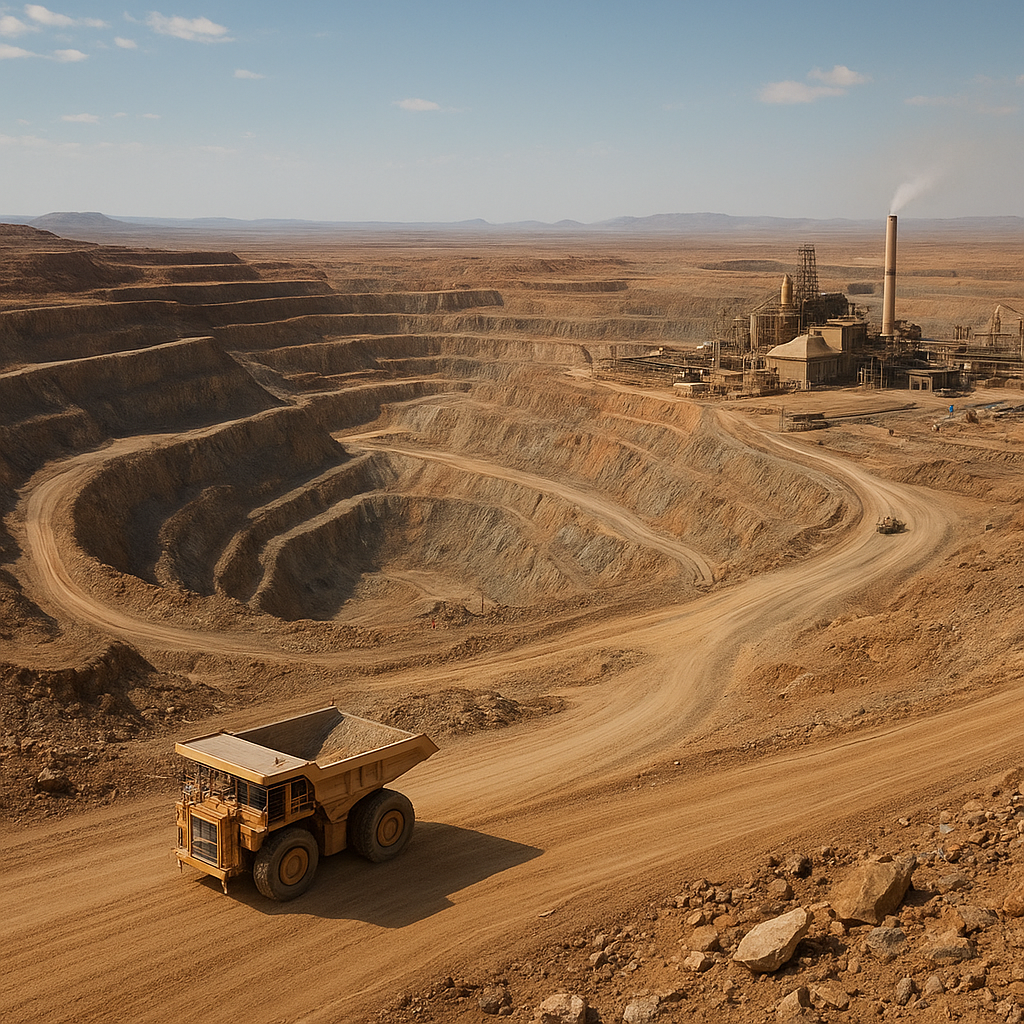
The Rossing mine stands as one of the most significant and historically important uranium operations in Africa. Located in an arid stretch of the Namib Desert, the mine has shaped local economies, national policies and global uranium markets for decades. This article explores where the mine is situated, what is extracted there, how it operates, its wider economic role, and several notable and lesser-known aspects that make Rossing a distinctive industrial landmark.
Location and Geological Setting
Rossing is situated in western Namibia, within the Erongo region, some 65 to 70 kilometres east of the coastal town of Swakopmund and only a few kilometres north of the small mining settlement of Arandis. The mine sits in the central Namib Desert, a harsh and hyper-arid environment characterized by sparse vegetation, strong coastal winds and dramatic temperature swings between day and night.
Geology and orebody
The deposit exploited by Rossing is an open-pit calcrete-hosted uranium deposit. Uranium mineralization occurs mainly within surficial calcrete and shallow alluvial sequences, formed where uranium has been concentrated by groundwater and climatic processes over geological time. Oxidized uranium minerals predominate, and the ore is well-suited to extraction by large-scale excavation and downstream chemical processing.
The geological setting is the result of prolonged interaction between bedrock, groundwater and climatic cycles. As a result, the orebody is relatively continuous and amenable to mechanized mining, which allowed the development of one of the world’s early large-scale uranium mines in a desert environment.
What Is Mined and How It Is Processed
The primary commodity produced at Rossing is uranium, in the form of a concentrated oxide product commonly referred to as U3O8 (uranium oxide concentrate, also called “yellowcake”). The mine extracts low- to medium-grade ore, which is then crushed, milled and chemically treated to extract uranium into solution, before precipitation and drying to produce the final concentrate.
Mining methods and processing
- Open-pit excavation: Large fleet operations remove overburden and ore in benches. The pit has been steadily expanded and deepened over decades of operation.
- Milling: Crushed ore is processed in a mill where leaching agents are used to dissolve uranium from the ore matrix.
- Hydrometallurgical treatment: Conventional uranium processing techniques—such as acid leaching followed by solvent extraction or ion exchange, and precipitation—concentrate uranium into U3O8.
- Tailings management: Solid and liquid residues from milling are handled in purpose-built tailings facilities, with ongoing monitoring and progressive rehabilitation required to mitigate environmental impact.
The technology and specific flowsheets have evolved over time to improve recovery, reduce reagent consumption and manage environmental footprints. Water management is a particularly important challenge in the desert setting, so process water recycling and careful tailings water control are central to operations.
Economic Significance
Rossing has been an economic pillar in the region and an important asset for the Namibian national economy. From direct employment to export revenues, the mine exerts a multifaceted economic influence.
Local and national economic impacts
- Employment and skills transfer: For decades Rossing has been one of the larger employers in the Erongo region, providing both skilled and unskilled jobs, vocational training and engineering roles. The mine’s presence spurred the growth of nearby settlements and services.
- Government revenue and royalties: As an export-oriented mining operation, Rossing contributes taxes, royalties and dividends to national and regional governments, supporting public spending and infrastructure.
- Supply chain and local procurement: The mine’s needs for goods and services—from heavy equipment to catering and logistics—create business opportunities for Namibian suppliers and contractors.
- Foreign exchange and export earnings: Uranium concentrate is exported to international markets to supply nuclear fuel demand, generating foreign exchange income that strengthens Namibia’s trade position.
Beyond immediate financial inputs, Rossing’s presence contributes to Namibia’s reputation as a reliable uranium supplier. The country’s regulatory framework, geological potential and existing infrastructure attract exploration and investment into other uranium projects, amplifying the sector’s economic multiplier effect.
Global role in nuclear fuel supply
Although not the largest uranium mine worldwide, Rossing has historically been one of the most important individual sources of uranium in the global market. Its steady production helped supply reactors across several continents. In years of tight supply, mines like Rossing play a role in stabilizing prices and ensuring continuity of supply for nuclear utilities.
Social and Community Dimensions
Mining operations in isolated environments often shape lives and communities in complex ways. Rossing’s long lifespan has knitted it into the social fabric of its locality.
Community investment and infrastructure
- Urban development: The nearby town of Arandis grew significantly because of Rossing, with housing, schools and health facilities developed to support the workforce and their families.
- Social programs: The mining company has historically supported community projects—education, healthcare, and small-enterprise development—aimed at improving living standards locally.
- Training and education: Scholarships, apprenticeship schemes and vocational training linked to the mine have improved local skill levels and expanded opportunities beyond mining itself.
At the same time, the social legacy of mines includes dependence on cyclical commodity markets, and communities must continually adapt to fluctuations in operational intensity and employment.
Environmental Management and Safety
Operating in a desert near the Atlantic coast presents unique environmental constraints. Water scarcity, fragile ecosystems, and the radiological nature of uranium require meticulous environmental and safety management.
Water use and desalination
Because freshwater is scarce in the inland areas where Rossing operates, a portion of water used in processing has historically been sourced from the coast via a dedicated supply and, in some operational stages, through desalination. The goal is to minimize drawdown of inland water resources and reduce the environmental footprint on groundwater systems.
Tailings, radiation and rehabilitation
Tailings storage facilities (TSFs) are one of the most consequential environmental legacies of uranium milling. Managing these safely involves controlling seepage, dust, and long-term stability, along with monitoring radiation levels to protect workers and communities. Progressive rehabilitation of disturbed land and post-closure plans are integral parts of permitting and social license to operate.
Health and safety measures extend to radiological protection for workers, including monitoring of exposure, controlling airborne dust and radon, and ensuring robust occupational health services.
Historical Evolution and Ownership
Rossing’s operational history spans several decades. The mine began production in the mid-1970s after extensive exploration and feasibility assessment. Over time the company and its ownership structure evolved, involving multinational mining groups, local shareholders and government interests.
From exploration to long-term operation
Developing a major mine in a remote desert required substantial capital investment in roads, power, water, processing facilities and a skilled workforce. Once established, the mine underwent expansions and technical upgrades to maintain competitiveness while responding to the global uranium price cycle.
Ownership arrangements have reflected both international investment flows and national policy objectives to retain domestic participation in mineral wealth. The presence of a significant state interest alongside international partners is a common pattern in strategic mineral projects.
Interesting Facts and Lesser-known Details
Rossing is more than an industrial operation; it is a source of intriguing anecdotes and technical points that highlight the interplay of geology, technology and human endeavor.
- Longevity and adaptation: Few mines in harsh desert settings have remained continuously influential for as long as Rossing. Its ability to adapt processing methods and operational practice to changing ore characteristics and market conditions is a testimony to sustained engineering effort.
- Visibility: The pit and associated infrastructure form a conspicuous feature in satellite imagery of the Namib. While claims that mines are among the few human-made structures visible from space are often overstated, Rossing is clearly apparent in high-resolution imagery.
- Technological evolution: Over the decades, Rossing has incorporated advancements in ore processing, waste handling and environmental monitoring—reflecting wider progress in the nuclear materials industry.
- Desert wildlife and conservation: The mine operates in an ecosystem with specially adapted flora and fauna. Environmental management plans often include measures to mitigate impacts on biological corridors and to monitor biodiversity in and around the lease area.
- Strategic mineral: Uranium’s role as a fuel for electricity generation and as a strategic energy resource places Rossing in a geopolitical context beyond the local economy. The mine has supplied materials for civil nuclear programs in several countries.
Challenges and Future Prospects
The future trajectory of Rossing depends on multiple interacting factors: global uranium prices, technological change in mining and processing, regulatory frameworks and Namibia’s national development objectives.
Market and price sensitivity
Like all commodity producers, Rossing’s operations are sensitive to swings in the uranium market. Periods of low prices have prompted cost-cutting, operational adjustments, and review of long-term plans, while price recoveries encourage investment and extensions of mine life.
Technological and regulatory drivers
Improvements in exploration, ore sorting, processing efficiency and environmental controls can extend economic life and reduce per-unit costs. At the same time, evolving regulatory standards for radiation protection, tailings safety and water management impose obligations that shape operational decisions.
Community and sustainability expectations
Increasingly, mining companies are judged not only on production metrics but on social and environmental performance. Local communities, regulators and investors press for tangible benefits to host regions and credible plans for mine closure and rehabilitation.
Conclusion
Rossing remains a prominent example of a long-lived uranium operation in a challenging environment. Its contributions to local employment, national revenues and the global nuclear fuel supply are balanced by the ongoing responsibility to manage environmental impacts, protect worker and community health, and plan for eventual closure and land rehabilitation. The mine’s history and ongoing evolution illustrate how geology, engineering, economics and social policy intersect in contemporary mining.
Rossing, as such, will continue to be closely watched by stakeholders interested in energy raw materials, desert mining practices and the development pathways of resource-rich countries.

