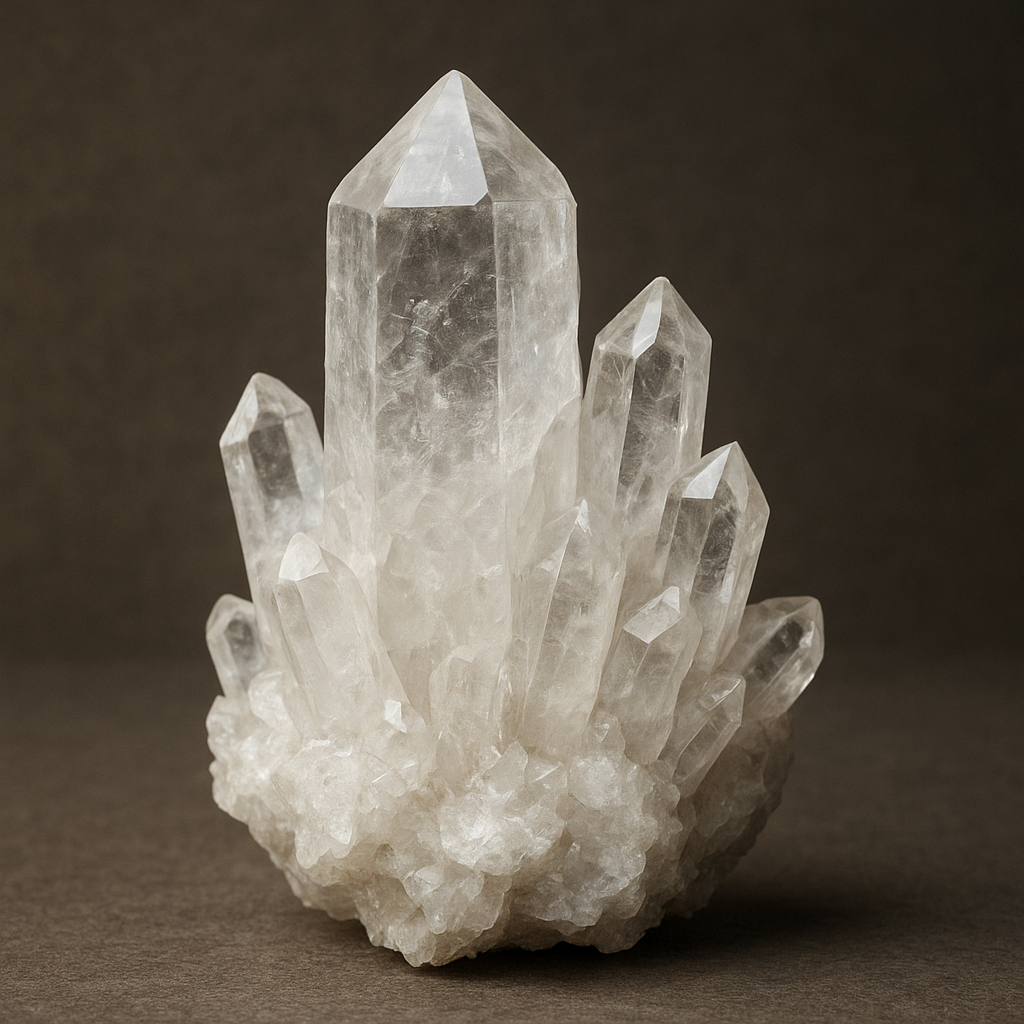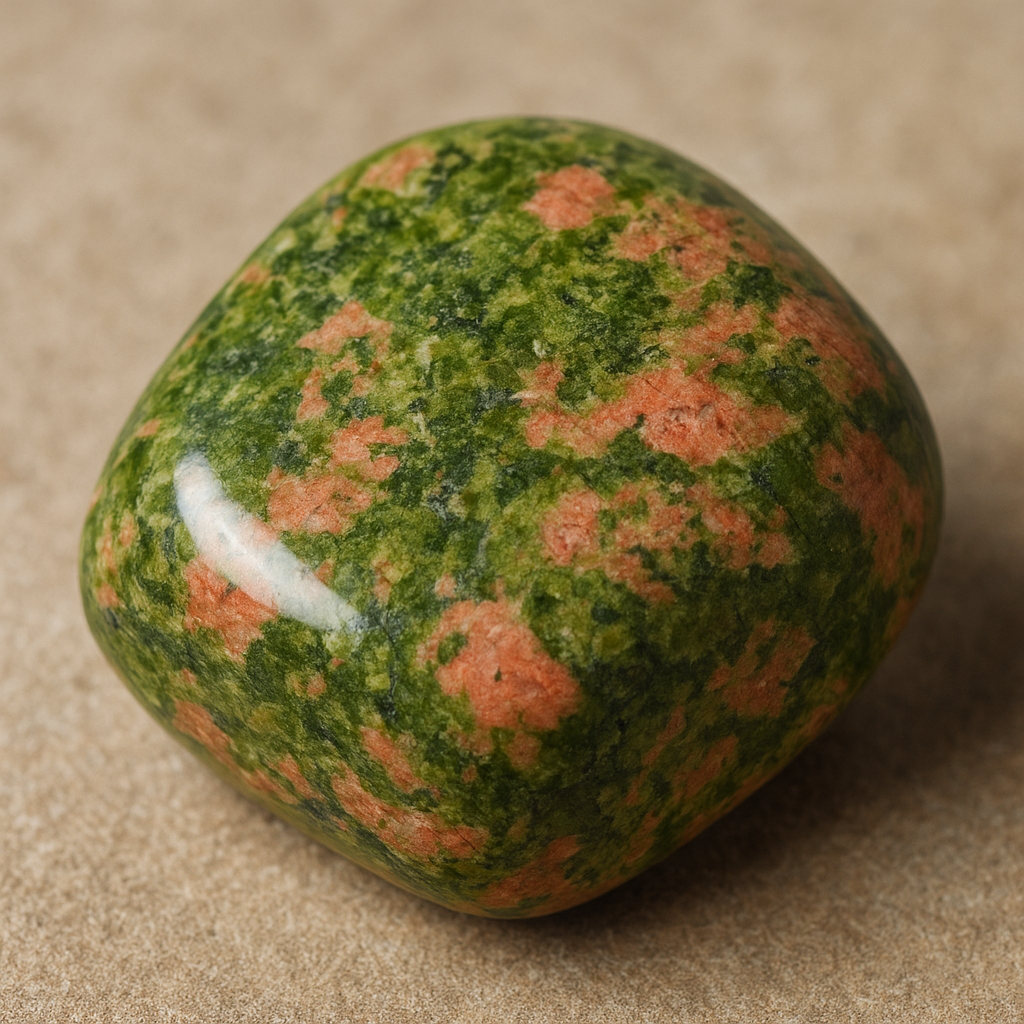
Unakite is a striking, mottled stone that attracts collectors, lapidaries, and metaphysical enthusiasts alike with its mixture of **unakite**’s green and pink tones. Formed through the interplay of mineral alteration processes, it presents a visually rich texture that combines the glassy sparkle of **quartz** with the deep green of **epidote** and the warm pink of orthoclase **feldspar**. This article explores unakite’s geological background, where it is found, how it is used in jewelry and ornamentation, its role in cultural and metaphysical contexts, and practical guidance for identification, care, and ethical collecting.
Geological formation and mineralogy
Unakite is not a single mineral but a coarse-grained, altered rock, best described as an epidotized granite or a metasomatic assemblage derived from granite. Its characteristic appearance results from the partial alteration of original feldspar crystals to **epidote**, while unaltered potassium **feldspar** retains pink to salmon hues. Interstitial **quartz** commonly fills remaining spaces, producing a durable and attractive composite.
The process that produces unakite typically involves hydrothermal fluids or low-grade metamorphism acting on granite. During alteration, calcium and aluminum-rich fluids interact with preexisting feldspar and other components, leading to the growth of epidote along cleavage zones and grain boundaries. The resulting rock is a mosaic of pink feldspar crystals veined and interspersed with pistachio-green epidote and clear-to-milky quartz, often creating a visually appealing speckled or patchy pattern.
From a petrological standpoint, unakite can reveal information about the post-magmatic history of its host rocks. The presence of epidote suggests fluid-rock interaction at relatively low temperatures and pressures, characteristic of hydrothermal alteration near cooling intrusive bodies or along zones of tectonic fluid flow. While often labeled simply as “unakite,” variations exist in grain size, epidote-to-feldspar ratio, and overall texture; some specimens show coarse porphyritic feldspar set in an epidote-quartz groundmass, while others are more uniformly granular.
Where unakite occurs
Unakite was named for the Unaka Range of the Appalachian Mountains, and its type locality is in the eastern United States. It is commonly encountered in regions where granite and other feldspar-rich intrusive rocks have undergone alteration. Notable occurrences include the Appalachian areas of North Carolina and Virginia, where it can be found as irregular pods and seams within weathered granites.
Beyond the southeastern United States, unakite has been reported in several other parts of the world. Important commercial and collector sources include sites in South Africa, Brazil, and China, where it is worked locally and exported for lapidary use. Smaller localities occur in parts of Europe and Africa where granitic bodies have been subject to epidotization. Because unakite forms as an alteration product rather than a primary magmatic phase, its distribution is patchy—occurring where localized hydrothermal fluids have altered host rocks rather than forming continuous seams.
Collectors often find unakite in roadcuts, quarry outcrops, and in glacial or alluvial deposits downstream of unakite-bearing bedrock. In the Appalachian region, weathered exposures and talus slopes can reveal attractive specimens suitable for cutting and polishing.
Historical and cultural uses
Historically, unakite did not have the same widespread use as classical gems, but it has long been appreciated for ornamental and talismanic purposes. Early local uses were pragmatic—small tools, polished items, and decorative pieces—and from the 20th century onward unakite gained popularity in beadwork and cabochon jewelry as lapidary techniques became more accessible.
Because of its visually comforting color combination, unakite became popular among New Age and metaphysical communities in the latter half of the 20th century. It is often fashioned into worry stones, palm stones, and pendants intended for carrying or wearing close to the body. While archaeological evidence for ancient symbolic use is limited—unakite is primarily a product of modern interest—the stone’s present-day cultural role is significant in craft markets and gemstone fairs.
Metaphysical and wellness associations
In metaphysical circles, unakite is frequently associated with emotional recovery, inner harmony, and spiritual growth. Practitioners claim that the complementary colors of green and pink visually and symbolically represent heart-centered transformation: the green of **epidote** linked to grounding and renewal, and the pink of feldspar linked to compassion and inner warmth. Many describe unakite as a stone of **balance**—helpful for integrating emotions and promoting steady progress during periods of change.
- Common metaphysical uses: meditation support, balancing emotions, aiding recovery after trauma or loss.
- Chakra associations: often connected with the heart chakra due to its green and pink coloration.
- Tool forms: tumbled stones, worry stones, palm stones, cabochons, and beads used for carry or wear.
It is important to note that metaphysical claims are cultural and spiritual in nature rather than scientifically proven. Those attracted to unakite’s purported properties often emphasize personal anecdotal experiences and symbolic meanings over measurable therapeutic effects.
Lapidary and jewelry applications
Unakite’s attractive color contrast and workability have made it a favorite among lapidaries. Its moderate hardness—around 6–7 on the Mohs scale—allows for a variety of cutting and polishing techniques without the fragility of softer stones. The presence of quartz increases toughness and polishability, producing bright, glassy surfaces when cabochoned or tumbled.
Typical uses include:
- Cabochons for rings and pendants, where the mottled pattern can be displayed to advantage.
- Beads for bracelets and necklaces; uniformity of color can be challenging, so skilled beadmakers select and match pieces carefully.
- Inlay work and mosaics, using small pieces to create tapestry-like designs.
- Carvings and small ornamental objects—figurines, eggs, and polished spheres are popular collector items.
Because unakite is relatively economical compared to precious gems, it finds wide use in artisan and costume jewelry. The stone’s patterns can be oriented deliberately during cutting to maximize visual effect—striped, patchy, or flecked faces can be chosen to suit the design. Jewelers commonly set unakite in sterling silver or base metals, sometimes pairing it with complementary materials like turquoise, jasper, or wood for earth-toned designs.
Identification, imitations, and quality factors
Recognizing authentic unakite is generally straightforward for experienced collectors. Key identification features include its mottled green-and-pink coloration, granular texture, and the visible interplay of epidote and feldspar grains with clear or translucent quartz between them. Under magnification, the green components will show the elongated, prismatic crystal habit typical of **epidote**, while the pink areas reveal blocky feldspar cleavage.
- Hardness check: unakite resists scratching by softer materials and can usually be scratched by harder tools—useful as a rough field test when combined with visual inspection.
- Streak test: powdered unakite will not show a vivid streak (often white to gray due to mixed minerals), so streak tests have limited diagnostic value.
- Density: bulk density is in a moderate range; an unusually heavy or light specimen may indicate a different rock or impregnation with resin.
Imitations and look-alikes include dyed jaspers and altered rocks engineered to mimic the green-and-pink contrast. Because unakite’s value is modest, imitations are not as financially driven as with precious gems, but dyed or assembled materials can appear in low-cost jewelry. Buyers should prefer reputable sources and request return policies or testing where possible.
Care, maintenance, and practical handling
Unakite is reasonably durable for everyday jewelry but benefits from careful care. Cleaning with warm, soapy water and a soft brush is generally safe. Avoid prolonged exposure to harsh chemicals or strong acids that can attack the feldspar or epidote. Ultrasonic cleaners and steam cleaning may pose risks if the stone contains microfractures or if it has been stabilized with resins; when in doubt, stick to manual cleaning.
Storage recommendations:
- Store separately from harder gemstones to avoid scratches; wrap in soft cloth or place in a padded compartment.
- A void extreme temperature changes which can stress composite rocks and glued settings.
- When wearing unakite jewelry, remove during heavy work, contact with household chemicals, or activities that may cause knocks and abrasions.
Collecting, sustainability, and ethical considerations
As unakite’s popularity grows in artisan markets, attention to sustainable and ethical sourcing becomes more important. Many unakite specimens are produced as a byproduct of quarrying and small-scale mining; responsible sourcing means supporting operations that minimize environmental impact, rehabilitate disturbed land, and respect local communities.
Collectors should consider:
- Purchasing from dealers who disclose locality and mining practices or who can document ethical supply chains.
- Favoring pieces that are locally crafted to support artisan economies and reduce carbon footprint from shipping.
- Being aware of the environmental impact of large-scale extraction and preferring small-quantity, carefully sourced specimens when possible.
Because unakite is relatively abundant in some regions, it is not currently a conservation-critical stone; however, irresponsible large-scale collection can still damage habitats and local environments, so mindful sourcing is always encouraged.
Interesting variants and related materials
Unakite’s visual appeal has led to related trade names and variants. In some markets, you may see terms like “unakite jasper” or “epidotized granite” used interchangeably; technically, “unakite” is the more specific name for the epidote-feldspar-quartz assemblage. Variants with stronger quartz content may appear lighter or semitranslucent, while more epidote-dominant pieces display deeper greens and more dramatic contrast.
Collectors and artisans often value specimens with unusual patterns—veining, orbicular structures, or high-contrast streaks—because they can yield visually arresting cabochons and carvings. Some pieces are cut to highlight linear patterns and create dramatic jewelry focal points, while others are polished into spheres and eggs that display complex internal color dynamics.
Practical tips for buyers and enthusiasts
- When buying jewelry, ask about the stone’s origin and whether it has been stabilized or treated.
- Examine unakite pieces under natural light to appreciate true color balance—artificial lighting can alter perceived hues.
- If purchasing beads, inspect drilled holes for fractures or fissures that may compromise durability.
- For lapidary work, start with a coarse-grit shaping and progress carefully through sanding and polishing to bring out the stone’s natural luster without rounding away attractive patterns.
Final notes on appreciation
Unakite occupies a niche between geological curiosity and accessible decorative stone. Its combination of **epidote** and pink feldspar creates a palette that appeals to those drawn to earthly, calming aesthetics. Whether you are a collector, jewelry maker, or someone attracted to its metaphysical reputation for emotional **healing** and **balance**, unakite offers both material substance and symbolic meaning. For lapidaries, the stone’s polishability and patterning deliver creative opportunities; for collectors, locality, pattern, and translucency can make certain pieces stand out. Above all, unakite’s charm lies in the natural story it records—the interaction of minerals, fluids, and time that produced a durable, attractive rock ready to be shaped into wearable art or cherished as a piece of Earth’s handiwork.