
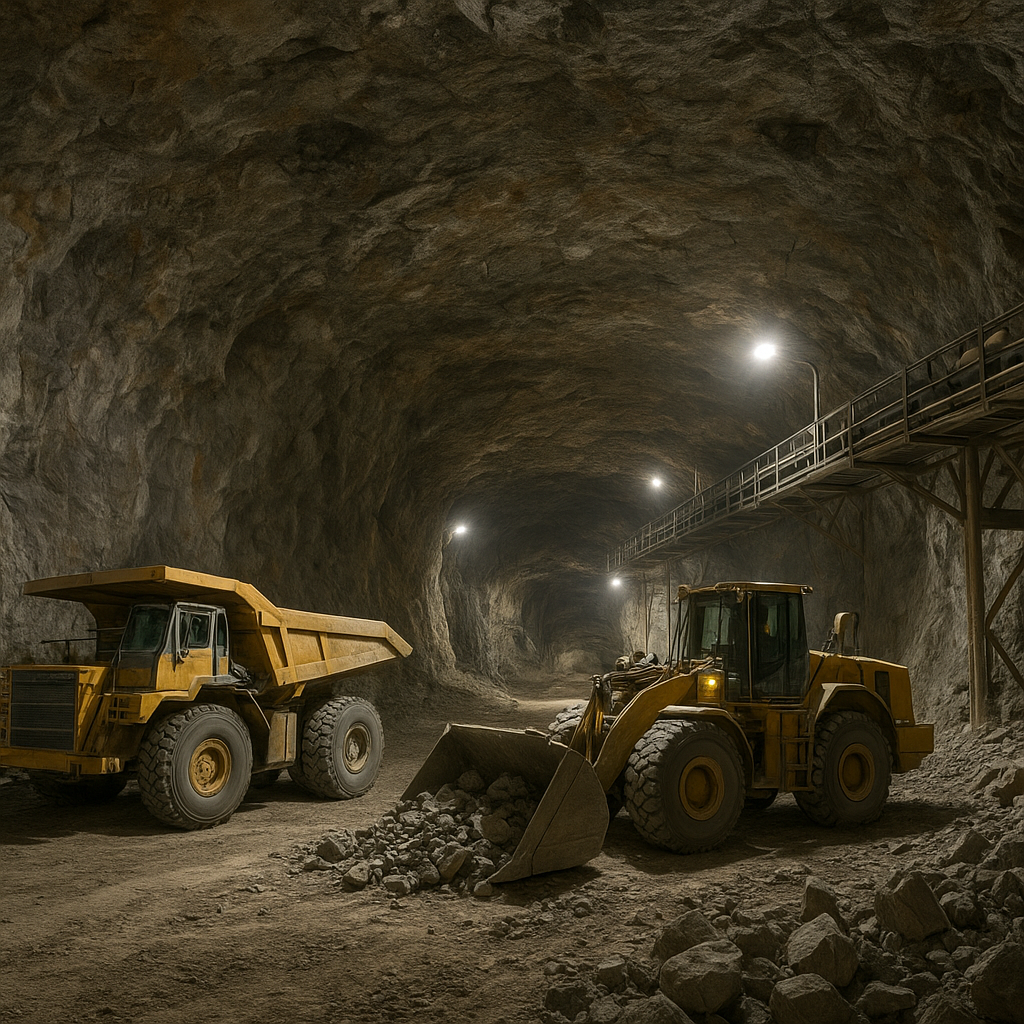
The Pyhäsalmi Mine is one of the most recognizable names in European base-metal mining. Located in the village of Pyhäsalmi within the municipality of Pyhäjärvi, the mine has been a focal point for extraction of **copper** and **zinc** and a testbed for industrial adaptation and underground science. Its long history of operation, exceptional depth, and recent transformation into a multi-purpose subterranean facility combine to make Pyhäsalmi a compelling case study in mining, regional development and technological innovation.
Location and geological setting
Pyhäsalmi Mine sits in the heart of central Finland’s bedrock, in a landscape characterized by forests, lakes and glacially sculpted terrain. The deposit is located near the village of Pyhäsalmi in the municipality of Pyhäjärvi. Although the above-ground surroundings are quietly rural, what lies beneath is an industrial complex and one of Europe’s deepest working mines during its operational peak.
Geology and deposit type
The ore body exploited at Pyhäsalmi is a sulphide-rich deposit, hosting economic concentrations of **copper** and **zinc**, with accessory amounts of lead, silver and sometimes traces of gold. The ores typically occur as massive and semi-massive sulphides comprising minerals such as chalcopyrite (a primary copper mineral) and sphalerite (the principal zinc mineral), along with pyrite and other sulfide species. The deposit is hosted within an older metamorphic and volcanic sequence, and its formation is linked to the region’s complex tectonic and volcanic history.
Depth and structural characteristics
One of the mine’s defining features is its exceptional vertical extent. The workings extend deep into the crust, reaching depths of over a kilometer below surface — making the mine notable for its impressive vertical shaft infrastructure and deep-level operational experience. The deep rock environment led to the development of specialized systems for ventilation, cooling, rock mechanics and dewatering, as well as unique opportunities for deep underground uses after active ore production declined.
Mining operations, processing and products
For decades Pyhäsalmi produced concentrates that fed smelters and refineries around the world. Ore was extracted underground, brought to surface via shafts and hoisting systems, and processed to separate valuable sulfide minerals from waste rock. The mine’s production focused on recovering **copper** and **zinc** in concentrate form, which were then sold on international markets. Processing typically involved crushing, grinding and flotation circuits to produce copper and zinc concentrates suitable for customers.
Typical ore minerals and concentrates
- Chalcopyrite — major carrier of copper.
- Sphalerite — principal source of zinc.
- Pyrite and other sulphides — commonly present and influencing metallurgy.
- Minor phases carrying silver or trace elements that may enhance concentrate value.
Mine infrastructure and technology
Operations required a complex mix of underground development (drifts, stopes, service levels), hoisting shafts, underground utilities and surface processing plants. Deep-level mining demanded sophisticated rock support systems, water pumping and ventilation networks designed to manage air quality and temperatures at depth. Modern mining techniques were applied to improve safety, productivity and ore recovery, such as mechanized drilling and loading, remote monitoring, and optimized ore haulage to the concentrator.
History and economic role
The history of mining at Pyhäsalmi spans several decades and reflects shifting global markets, technological evolution and changing local priorities. The mine was discovered and developed in the mid-20th century and for many years provided employment and economic stimulus to the surrounding region. Through periods of expansion and modernization, Pyhäsalmi contributed both to Finland’s exports and to the local economy through direct jobs, supplier networks and municipal revenues.
Employment and local impact
At its peak, the mine employed hundreds of people directly, and supported many more indirectly through contractors, service providers and local businesses. The presence of a large industrial employer in a rural setting generated demand for housing, services and infrastructure, and the mine became a major element of the community identity in Pyhäjärvi and nearby towns.
Contribution to metals supply
Concentrates from Pyhäsalmi supplied smelters that convert sulfide concentrates into refined metals. Both **copper** and **zinc** are crucial industrial metals: copper for electrical wiring, electronics, and increasingly for electrification and renewable energy technologies; zinc primarily for corrosion protection (galvanizing) and alloys. The mine’s output therefore played a role, even if modest in global terms, in supplying materials essential for industrial activity and infrastructure.
Transition, innovation and the Callio concept
As ore grades and market conditions evolved, and as mining at depth becomes more technically challenging and costly, Pyhäsalmi entered a period of transition. Rather than disappearing entirely, the site became a laboratory for creative adaptation of deep mine infrastructure. The most visible manifestation of this shift is the development of the underground complex known as Callio, a brand for a range of post-mining uses including research facilities, industry testing and novel energy solutions.
Underground research and test facilities
The deep, controlled environment of the mine makes it attractive for a variety of scientific and industrial tests that require stable conditions, natural shielding from cosmic radiation, or secure below-surface space. Projects have included experiments in particle and cosmic-ray physics, geoscience research, and technology trials such as robotics and remote operation systems. The underground setting also provides an opportunity for infrastructure that benefits from natural security and cooling, such as data centers or secure storage.
Energy and sustainability experiments
Pyhäsalmi has been used to explore energy-storage concepts that leverage the vertical dimension of the mine — pumped hydro storage systems that move water between surface reservoirs and deep underground caverns, for example. The mine’s deep cavities and shafts are attractive for engineering experiments aimed at integrating **sustainability** and energy flexibility into regional grids.
Environmental management and safety
Modern mines must balance production with environmental responsibility. Pyhäsalmi’s operators implemented measures to manage tailings, prevent uncontrolled release of acidic or metal-laden waters, and reduce dust and emissions from concentrator operations. Closure planning and long-term monitoring are key to ensuring that post-mining landscapes remain safe and environmentally stable.
Water management
Water that contacts sulphide minerals can produce acid mine drainage if not properly managed; therefore careful handling of process water, run-off and groundwater is essential. Treatments, lined tailings facilities and controlled drainage systems are common methods employed to mitigate environmental risk. The long-term goal is to minimize impacts on local waterways and ecosystems and to ensure regulatory compliance.
Safety at depth
Deep mining places high demands on worker safety. Effective ventilation to control air quality and temperature, rock support systems to limit falls of ground, robust emergency planning and reliable hoisting systems are all critical. Over the life of the mine, technology and safety culture evolved to reduce risks and protect personnel operating in harsh subterranean environments.
Economic relevance in the 21st century and beyond
Even after active ore production declines or ceases, sites like Pyhäsalmi can continue to provide economic value through repurposing. The conversion of shafts and underground space into facilities for research, energy storage, data centers, testing of mining equipment, and tourism preserves local employment and creates new business opportunities. This adaptive reuse is increasingly relevant as economies seek sustainable ways to manage the legacy of resource extraction.
Value beyond ore
- Underground laboratories provide value to international scientific collaborations.
- Industrial test sites accelerate development of automation, robotics and mining safety technology.
- Pumped hydro and other energy projects support regional energy security.
- Mine tourism and cultural heritage projects maintain local identity and stimulate service-sector growth.
From a strategic perspective, domestic sources of **copper** and **zinc** contribute to supply-chain resilience. As demand for electrification and renewable-energy infrastructure rises, base metals become more critical. Even small to medium-sized mines can have outsized local importance by supporting supply chains and specialized downstream industries.
Interesting aspects and lesser-known applications
Pyhäsalmi offers many interesting angles beyond the standard mining narrative. Its conversion into a multi-use underground complex is a model that other regions watch. The deep cavity spaces are suitable for unique experiments and commercial uses that are hard to replicate above-ground.
Scientific experiments and underground labs
The natural shielding provided by hundreds of meters of rock reduces background radiation from cosmic rays, making deep underground spaces attractive for sensitive detectors and particle physics experiments. Researchers use these locations to study rare events and to test instrumentation under low-noise conditions.
Testing ground for autonomous mining
With the mining industry increasingly focused on automation and remote operation for efficiency and safety, a real underground environment for trials is invaluable. Companies can trial new drilling rigs, remote loaders, and monitoring systems under realistic conditions — accelerating development cycles and improving readiness for other operations worldwide.
Tourism and cultural preservation
Many former and active mines incorporate visitor centers and guided tours, offering the public a chance to learn about geology, mining engineering and local history. Descending into a deep shaft, viewing preserved machinery and hearing stories from miners adds a tangible dimension to industrial heritage. Pyhäsalmi’s transformation includes interpretation of its mining history alongside forward-looking technological uses.
Challenges and opportunities ahead
The story of Pyhäsalmi exemplifies both the challenges of deep-base-metal mining and the opportunities for reinvention. Key challenges include the economics of extracting ore at great depth, managing environmental legacies, and securing investment for repurposing projects. Opportunities arise in the growing need for testbeds and secure underground infrastructure, in the development of energy storage solutions, and in the potential for collaborative science.
Regional development and skills retention
Maintaining jobs and skills in a region after mining activity winds down is a core policy challenge. Repurposing infrastructure for new industries helps preserve technical expertise, engineering talent and local supply chains. The Pyhäsalmi example shows how a community can transition from an extractive economy to a diversified technological and scientific hub.
Future minerals and exploration potential
Even as operational mining declines, geological exploration can continue. Advances in exploration technology and changing commodity prices may reopen interest in deposits that were once marginal. The presence of deep shafts and access tunnels is an asset if future extraction becomes viable or if niche resources within tailings and low-grade zones become economically attractive to reprocess.
Final remarks on the site’s uniqueness
Pyhäsalmi is more than a historical mining operation: it is a living illustration of how industrial infrastructure can be adapted for new purposes. The combination of significant **depth**, established shaft systems, and a versatile underground environment creates opportunities in science, energy and industry. For researchers, entrepreneurs and regional planners, Pyhäsalmi offers a tangible example of resilience and innovation in the face of changing economic and environmental realities.

