
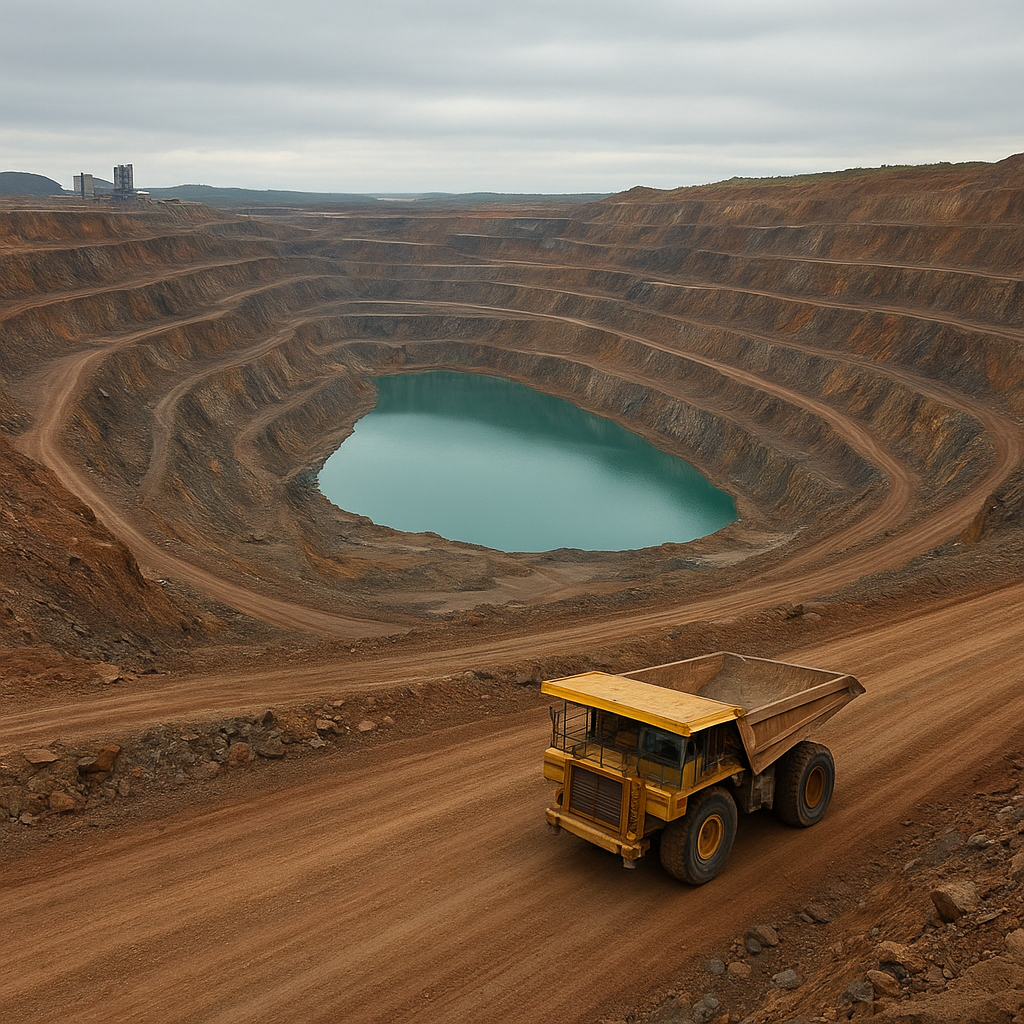
The Aitik mine, set against the stark landscapes of northern Sweden, is a landmark of modern mineral extraction. As one of the most important European sources of copper, it combines large-scale open-pit mining with contemporary approaches to processing, logistics and environmental management. This article explores where the mine is located, what is extracted there, its broader economic role and several aspects that make Aitik noteworthy in the global mining conversation.
Location and geological setting
The Aitik mine lies in Lapland, in the municipality of Gällivare in Norrbotten County, northern Sweden. The region is characterized by boreal forests, lakes and a subarctic climate with long winters and short, bright summers. The mine site itself is a large scar on the landscape — a characteristic feature of large-scale open-pit operations — and can be seen from considerable distances, serving as a visible sign of industrial activity in an otherwise sparsely populated area.
Geologically, the deposit exploited at Aitik consists primarily of disseminated sulphide mineralization hosted in crystalline basement rocks. The ores are mined as bulk sulphide material and then processed to produce a marketable copper concentrate, with valuable precious metal by-products. The mineralization is typically fine-grained and disseminated rather than occurring in large, easily separable veins, which is why large-scale bulk mining and flotation processing are the most effective industrial approaches.
Mining operations and production
Operationally, the Aitik mine is organized as an extensive open-pit operation. Large fleets of haul trucks, shovels and crushers move tens of millions of tonnes of rock each year. The mined material is processed on-site through crushing, grinding and flotation to separate the sulphide minerals that contain copper from the gangue. The resulting concentrate contains the bulk of the copper and is then transported to smelters and refineries where the metal is recovered and refined.
Processing and by-products
- The primary product is copper concentrate, which is shipped for smelting and refining.
- Gold and silver often occur as valuable by-products and are recovered as part of the concentrate stream, contributing to the overall economic value of the operation.
- Because the ore is a sulphide type, flotation is the dominant processing method, producing a high-grade concentrate that is attractive to downstream smelters.
To maintain consistent throughput, the mine has undergone several rounds of investment and expansion to increase capacity and modernize equipment. These upgrades typically target increased crushing and milling capacity, improvements in flotation efficiency and enhancements to material handling and tailings management systems.
Ownership, logistics and downstream connections
The mine is operated by a major Scandinavian mining company, which integrates Aitik into a wider portfolio of mining and metallurgical assets. Concentrate logistics typically rely on rail and road links from the mine site to ports or directly to smelters. Because the concentrate must be treated in high-temperature smelting facilities, Aitik’s output is a crucial feedstock for both domestic and international metallurgical plants. This integration into downstream supply chains strengthens the mine’s role in the national and regional industrial landscape.
Economic and social significance
The Aitik mine plays a prominent role in the economy of northern Sweden and contributes to national export revenues. The direct economic benefits are manifold:
- Local employment: The mine provides a significant number of jobs, both on-site (technical, operational and administrative) and in related services (transportation, maintenance, hospitality).
- Regional development: Investments in infrastructure such as roads, rail links and energy supply have positive spillovers for local communities.
- Tax and royalty contributions: Fiscal revenues associated with mining activity support public services at municipal and national levels.
- Supply chain activity: Suppliers of equipment, chemicals, and professional services across Sweden and beyond benefit from long-term procurement contracts.
Beyond direct economics, the mine is a major source of industrial copper, a metal critical for electrical infrastructure, renewable energy systems, electric vehicles and general industrial applications. Copper produced at Aitik thus contributes to sectors that underpin modern economies and decarbonization efforts.
Labour, community relations and cultural considerations
Operating in the north of Sweden means interacting with small towns, rural communities and indigenous groups. The company running the mine engages in ongoing dialogue with local stakeholders, including municipalities and Sámi communities, to address land use, reindeer herding rights and environmental concerns. The balance between mineral development and traditional livelihoods is a continuing conversation in the region, and consultation, compensation and adaptive management are important chapters in the mine’s social license to operate.
Environmental management and innovation
Large mines inevitably have environmental impacts, and the Aitik operation has invested in mitigation measures to reduce the footprint and manage risks. Areas of focus include tailings management, water treatment, dust control and progressive reclamation of disturbed land. Modern mining practice emphasizes monitoring and continuous improvement:
- Treatment plants on site help ensure water leaving the operation meets regulatory standards for suspended solids and dissolved metals.
- Tailings handling systems are designed to reduce the risk of accidental release and to enable long-term stability of storage facilities.
- Dust suppression, noise control and progressive rehabilitation of worked-out benches are used to limit impacts on local ecosystems.
Equipment modernization is another thread: the mine has pursued greater energy efficiency and reduced greenhouse gas emissions through fleet upgrades and by trialing new technologies. Investments in automation and electrification of haulage and processing systems aim to reduce fuel consumption and improve safety by removing personnel from hazardous tasks. Such transitions are important both for operational efficiency and for meeting broader corporate sustainability commitments.
Technological features and operational scale
What distinguishes Aitik is not only its product but the scale and degree of mechanization. The operation uses large-capacity crushers, semi-autogenous grinding (SAG) mills, conventional flotation circuits and thickening systems to produce a consistent concentrate. Materials handling involves high-capacity conveyors and truck fleets. The mine’s size and throughput mean that decisions about scheduling, ore blending and mill performance have substantial leverage over overall productivity.
Data-driven operations
Like many modern mines, Aitik uses data analytics, process monitoring and operational modelling to optimize performance. Real-time monitoring of mill throughput, flotation performance and reagent consumption helps metallurgists and engineers make quick adjustments to maximize recovery and concentrate quality. Geotechnical monitoring of pit walls, as well as condition-based maintenance of heavy equipment, improves safety and reduces unplanned downtime.
Notable and interesting aspects
Several features make Aitik particularly interesting beyond its economics:
- Scale and visibility: The pit’s size makes it one of the most conspicuous industrial features in northern Sweden. Its large benches and terraces demonstrate the massive scale of contemporary bulk mining.
- Role in the green transition: As demand for copper surges with electrification and renewable energy buildouts, Aitik’s production plays a strategic role in supplying raw material for low-carbon technologies.
- Technological modernization: The push toward automation and electrification at the site is an example of how traditional extractive industries adapt to environmental and economic pressures.
- Integrated value: The value chain—from ore at the pit through concentration to downstream smelting and refining—demonstrates how a single mine can be central to wider industrial ecosystems in a country.
- Community interface: The ongoing dialogue with indigenous and local communities shows the social complexities of modern resource development and the necessity of corporate responsibility.
Challenges and forward-looking considerations
Operating a major mine in subarctic conditions presents unique challenges. Seasonal extremes demand reliable logistics and resilient infrastructure. The long-term sustainability of the operation depends on responsible tailings management, maintaining community trust and adapting to evolving regulatory standards for emissions and land use. Exploration and resource conversion activities are ongoing to sustain production over future decades — ensuring that the mine remains productive as easy-to-mine resources are depleted.
Economic cycles also influence operations: copper prices, global demand, and geopolitical shifts in supply and trade affect profitability and investment decisions. In response, the mine’s management focuses on cost control, efficiency, and value maximization through by-product recovery and improved metallurgical performance.
Concluding remarks on significance
The Aitik mine is emblematic of modern, large-scale mineral extraction: an industrial hub that produces essential raw materials, supports regional economies and navigates complex environmental and social landscapes. Its role in supplying copper makes it directly relevant to sectors driving the global energy transition, while continuous investments in processing, expansion and cleaner, more automated technologies aim to reduce impacts and improve productivity. For observers of mining, Aitik provides a useful case study in how mature operations evolve to meet 21st-century demands for metals, sustainability and community engagement.

