
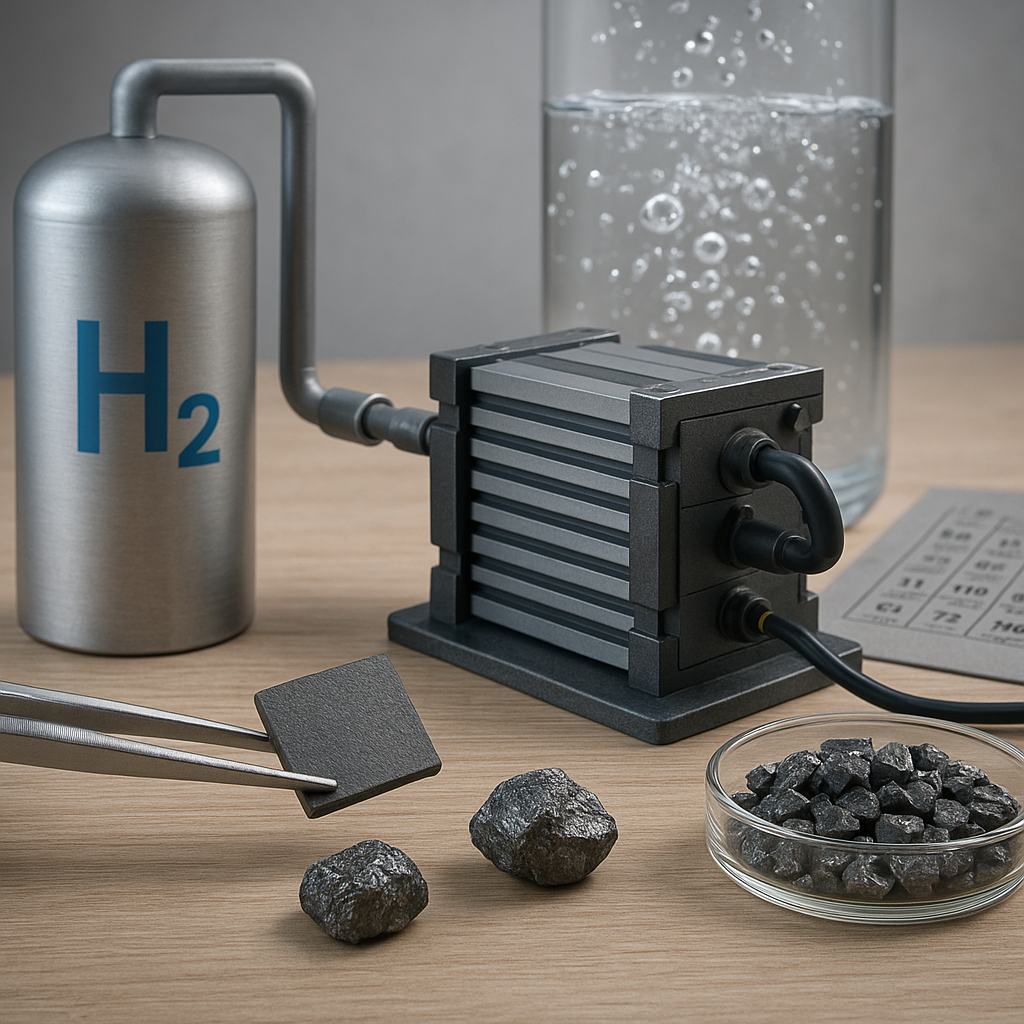
The transition to a low-carbon energy system positions hydrogen as a cornerstone of future energy vectors, enabling long-duration storage, decarbonization of heavy industry, and zero-emission mobility. Behind many hydrogen technologies lies a group of critical elements whose unique chemical and physical properties enable efficient reactions, long service life, and compact device design. This article examines the contribution of rare metals to hydrogen production, conversion and storage, discusses supply-chain and sustainability challenges, and reviews technological strategies to minimize dependence on scarce resources.
Fundamental roles of rare metals in hydrogen technologies
Rare and noble metals play central roles in catalytic processes and electrochemical devices. The proton exchange membrane (PEM) electrolyzers and PEM fuel cells, the most commercially mature technologies for distributed hydrogen production and hydrogen-powered transport respectively, rely heavily on the catalytic activity and corrosion resistance of platinum group metals. Materials such as platinum, palladium, iridium and ruthenium are prized because they catalyze the hydrogen evolution reaction (HER), oxygen evolution reaction (OER), and oxygen reduction reaction (ORR) with high activity and acceptable durability under acidic conditions.
Two principal electrochemical processes illustrate the dependence on rare metals:
- Electrolysis: In low-temperature PEM electrolyzers the cathode HER commonly uses platinum-based catalysts for efficient hydrogen generation, while the anode OER is often catalyzed by iridium or ruthenium oxides due to their corrosion resistance under acidic conditions.
- Fuel cells: Hydrogen oxidation and oxygen reduction in PEM fuel cells require catalysts that combine activity and resistance to sintering and poisoning. Platinum and palladium are the standard choices for electrodes because of their balanced properties.
Beyond catalyst function, rare metals are used in key supportive roles: membranes and bipolar plates often incorporate coatings or alloying elements that prevent corrosion; current collectors and sensors use noble metals for stable electrical contacts; and hydrogen compression or storage systems may require catalytic or surface treatments involving rare elements to control sorption kinetics.
Material-specific contributions and mechanisms
Understanding why certain elements are indispensable requires a look at atomic-scale mechanisms. For the HER and ORR, catalytic activity correlates with the binding energy of hydrogen and oxygenated species on the metal surface. Metals that bind intermediates neither too weakly nor too strongly provide optimal turnover frequencies. This „volcano” relationship places platinum near the top for many hydrogen-related reactions.
Platinum and palladium
-
Platinum exhibits excellent catalytic activity for both HER and ORR and offers high tolerance to electrochemical corrosion in PEM environments. It is also used in alloy form (e.g., Pt–Co, Pt–Ni) to tune activity and reduce noble metal loading without sacrificing performance.
-
Palladium absorbs hydrogen into its lattice and is used in hydrogen purification membranes and selective sensors. Pd-based alloys can improve permeability and mechanical stability, making them valuable for niche applications in hydrogen handling.
Iridium, ruthenium and rhodium
-
Iridium and ruthenium oxides stand out as OER catalysts in acidic electrolyzers because they resist oxidative degradation better than most alternatives. Iridium is scarce and expensive, prompting intensive research into lowering its required mass through nanostructuring and support interactions.
-
Rhodium and other platinum-group metals find specialized roles in catalyzing hydrogenation/dehydrogenation reactions in chemical processes, as well as in reforming catalysts where robust thermal and chemical stability are needed.
Other contributors
Beyond PGMs, elements such as ruthenium (again), molybdenum and tungsten are exploited in specific contexts like catalyst promoters, support dopants and electrode materials in high-temperature electrolysis (SOECs). For alkaline electrolyzers, non-precious transition metal oxides and hydroxides can sometimes replace PGMs, but they bring trade-offs in compactness and performance under dynamic operation.
Challenges: scarcity, cost and supply risk
Widespread deployment of hydrogen technologies at gigawatt scales presents tensions between material performance requirements and raw material availability. The combined market for platinum group metals is small relative to the annual metal demand if hydrogen-based energy systems scale rapidly. This creates several interconnected issues:
- Geopolitical concentration: Production of PGMs and related rare metals is geographically concentrated, exposing supply chains to political risks and export controls.
- Price volatility: Market tightness and speculative dynamics can produce price spikes, increasing capital expenditures for electrolyzers and fuel cells and slowing adoption.
- Recycling limitations: While PGMs are highly recyclable, current recycling infrastructure is optimized for automotive and jewelry sectors; scaling up for electrolyzer and fuel-cell components requires design-for-recycling and improved recovery pathways.
These challenges incentivize two broad responses: technological substitution and resource efficiency.
Technological strategies to reduce reliance on scarce metals
Research and industrial efforts focus on maintaining performance while reducing rare metal content or replacing them altogether. Strategies include:
- Catalyst minimization — Using high-surface-area nanostructures, core-shell particles and single-atom catalysts to maximize active sites per unit mass of precious metal.
- Alternative chemistries — Developing alkaline membrane electrolyzers (AEM) and anion-exchange membrane fuel cells that permit use of non-precious metal catalysts like nickel, cobalt and iron.
- Support and promoter engineering — Anchoring tiny PGM clusters to conductive oxides or carbons to enhance activity and durability, enabling lower loadings.
- Advanced manufacturing — Precision ink formulations, atomic layer deposition and electrodeposition that produce thin, uniform catalyst layers minimize wasted material.
- Hybrid systems — Combining small amounts of PGMs with abundant catalysts to balance cost and performance.
For the OER in acidic electrolyzers, finding stable, non-iridium alternatives remains a major scientific challenge because few materials resist oxidative dissolution at low pH while maintaining activity. High-temperature electrolysis (solid oxide) and alkaline approaches offer pathways to reduce or eliminate iridium and platinum dependence, at the expense of different engineering and materials trade-offs.
Design for longevity, recyclability and circularity
Maximizing the effective lifetime of components reduces the need for primary metal extraction. Durable design encompasses contamination control, operating-window optimization, and protective architectures that mitigate sintering and dissolution. Specific measures include:
- Poisoning mitigation: Designing feed purification systems and tolerant catalysts to prevent deactivation by CO and sulfur species.
- Coatings and corrosion barriers: Applying thin protective layers that preserve electrical contact while blocking corrosive species.
- Modularity and disassembly: Enabling ease of recovery for catalyst layers and bipolar plates at end-of-life to facilitate efficient recycling.
Improved recycling processes tailored to electrolyzer and fuel-cell modules can recover a high fraction of PGMs. Hydrometallurgical and pyrometallurgical flowsheets are being adapted to treat membrane electrode assemblies (MEAs) and mixed-material stacks, with an eye toward minimizing energy usage and secondary waste.
Economic and policy implications
Public policy can accelerate the shift toward less PGM-dependent hydrogen technologies through targeted actions:
- Investment in R&D for non-precious catalysts and alternative electrolyzer architectures.
- Procurement standards that reward durable, low-critical-material designs.
- Support for recycling infrastructure and material tracking systems to close loops for precious metals.
- Strategic stockpiling or diversification of supply sources to reduce geopolitical exposure.
Market mechanisms such as carbon pricing and subsidies for green hydrogen can change the economic calculus, making investments in new materials and recycling economically viable. However, policymakers must balance short-term scaling needs with long-term material sustainability goals.
Outlook: balancing performance, cost and sustainability
The role of rare metals in hydrogen technologies will evolve as the industry matures. Near-term deployments of PEM electrolyzers and fuel cells will likely continue to rely on platinum and iridium because they deliver unmatched performance in compact, dynamic applications. At the same time, intensive materials research, systems-level optimization and circular-economy measures aim to reduce the mass of precious metals per kilowatt and recover metals at high yield.
Longer-term pathways could lean on hybrid and alternative technologies: alkaline and high-temperature systems in stationary, large-scale electrolysis; AEM electrolyzers for cost-sensitive applications; and non-precious catalysts where acceptable performance can be engineered. The interplay of catalysts, cell architecture, stack design and system operation will determine how quickly dependence on rare metals declines.
Successful scaling of hydrogen infrastructure will depend on integrating materials science advances with supply-chain planning and policy measures that promote durability, efficient use and full lifecycle management. The value of rare metals lies not only in their scarcity but in the unique functionalities they enable; the objective for industry and researchers is to capture those functionalities while minimizing ecological and economic costs through smart design and circular practices.
