
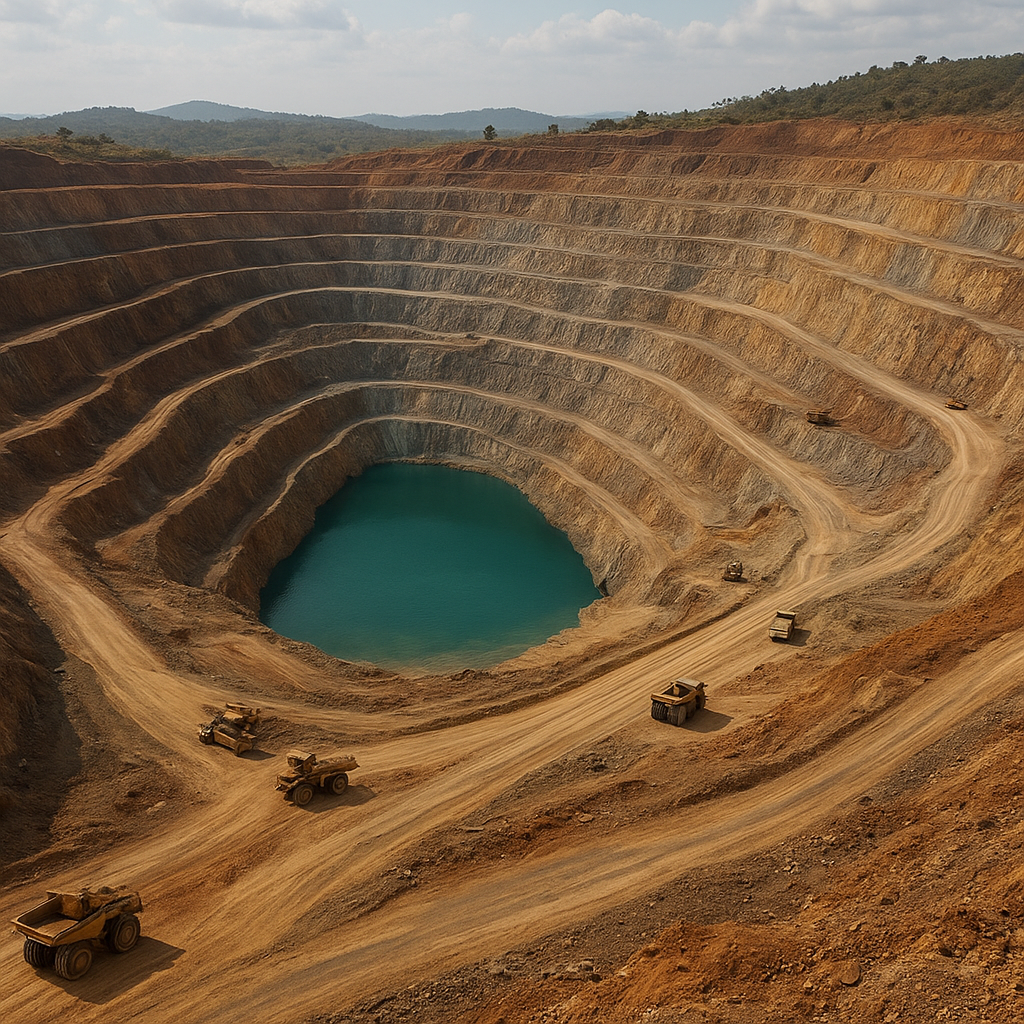
The KOV Open Pit, located in the mineral-rich heart of the Democratic Republic of Congo, is one of the most important surface mining operations in the Central African copper-cobalt belt. As a modern open-pit operation it exemplifies the intersection of geology, large-scale industrial mining, global commodity demand and the social-environmental challenges that accompany mineral extraction in one of the world’s most strategically significant mining regions. This article examines where the KOV Open Pit sits on the map, what it produces, how it operates, its broader economic impact, and a selection of notable and sometimes surprising facts that highlight its importance.
Location and geological setting
The KOV Open Pit is sited in the vicinity of Kolwezi, a city in the southern part of the Democratic Republic of Congo, within what is today Lualaba Province. Kolwezi lies at the core of the Central African copper–cobalt belt, a continuous geological province that extends across the border into Zambia. The district is famous for its thick, stratiform, and laterally extensive mineralized horizons, which host both sulphide and oxide ores.
Geologically, the deposits around Kolwezi (including KOV) are associated with sediment-hosted stratiform copper-cobalt mineralization. These deposits formed hundreds of millions of years ago and were later modified by weathering and supergene enrichment, which produced economically attractive layers of oxide and mixed oxide-sulphide ores near surface. The presence of near-surface oxide mineralization makes open-pit mining feasible and often economically preferable, enabling large-scale extraction with conventional surface-mining methods.
The regional infrastructure—roads, rail links to points of export, and existing processing facilities—has historically grown up around Kolwezi because of the concentration of high-grade mineral resources. While the KOV Open Pit is only one operation among many in the area, its proximity to existing processing plants and transport corridors enhances its logistical and commercial viability.
What is mined at KOV: copper and cobalt, and how they are produced
The primary products of the KOV Open Pit are copper and cobalt, two metals whose global importance has surged in recent decades. Copper is indispensable for electrical wiring, industrial machinery and infrastructure. Cobalt, once a niche metal used in high-performance alloys, has become a critical input for rechargeable batteries used in electric vehicles and portable electronics.
Typical mining and processing flows at a large open-pit operation like KOV include:
- Drilling and blasting of the oxide and mixed ores with heavy equipment.
- Loading and hauling using large earthmoving trucks to bring ore to the primary crushing and grinding circuits.
- For oxide ores, hydrometallurgical routes such as heap leaching followed by solvent extraction-electrowinning (SX-EW) are often used to produce high-purity copper cathode, because these processes are cost-effective and suited to oxidized copper minerals.
- Cobalt is commonly recovered either as a by-product of copper processing or through dedicated hydrometallurgical circuits that produce intermediate concentrates or refined cobalt products such as cobalt hydroxide or cobalt carbonate, which are feedstock for battery precursor production.
- Sulphide portions of the ore may be routed through flotation to create a concentrate that is smelted or processed further by hydrometallurgy depending on the operator’s metallurgical strategy.
Because cobalt typically occurs together with copper in the Kolwezi ores, operations like KOV are particularly valuable: they recover two commodities from the same material stream, improving project economics and supplying essential raw materials to diverse industries.
Economic and strategic significance
KOV’s importance stems from both local and global factors. Locally, the operation provides jobs directly in mining, processing and logistics, and indirectly through service sectors. For the DRC government and provincial authorities, mining royalties, taxes, and profit-sharing arrangements can represent a substantial portion of public revenue—revenue that in principle can fund infrastructure, healthcare and education. At a national scale the DRC’s position as the world’s dominant source of cobalt and a major supplier of copper renders operations like KOV strategically important for export earnings.
Globally, the KOV Open Pit sits at a pivotal point in the commodity value chain. The surge in demand for electric vehicles, grid storage, and portable electronics has dramatically increased demand for cobalt. Meanwhile, accelerating electrification and renewable energy deployment has sustained long-term demand for copper. Consequently, any reliable, large-scale supplier in the DRC contributes to the stability of supply chains for high-tech and industrial economies worldwide.
Beyond raw materials, operations in the Kolwezi area—because of their scale—support downstream industries, including concentrate processing, refining and battery precursor production. The region has been targeted for investment in integrated processing complexes designed to increase local beneficiation, moving from simple ore exports toward the production of higher-value refined metals and battery materials.
Social and environmental considerations
Large open-pit mines like KOV exert strong social and environmental footprints. The extraction process involves removal of overburden and creation of expansive pits and waste dumps, which can alter landscapes and hydrology. Tailings and process waters must be managed carefully to prevent contamination of surface and groundwater with heavy metals and processing reagents.
On the social side, mine development creates both opportunities and tensions. Employment, local procurement and community investment projects can deliver tangible benefits—improved roads, clinics or schools—yet there are frequent concerns about adequate compensation for land, disruption to livelihoods, and whether revenues are equitably distributed. In the broader Kolwezi district, artisanal and small-scale mining (ASM) is widespread; ASM miners often operate informally on or near industrial concessions, creating safety risks, regulatory challenges and social conflict over access to resources.
International attention on ethical sourcing has pressured major industrial players to implement more rigorous environmental, social and governance (ESG) controls. Companies and regulators increasingly focus on reducing environmental risks, formalizing ASM where possible, improving health and safety standards, and enhancing transparency in revenue flows and ownership structures.
Operational challenges and risk factors
Operating in the DRC presents a specific set of challenges that influence any mine’s performance. These include:
- Political and regulatory risk: changes in mining laws, contract renegotiations and shifting fiscal regimes can affect project returns.
- Infrastructure limitations: although Kolwezi is comparatively well-served, power supply, roads and rail capacity can be bottlenecks, especially during wet seasons or periods of regional instability.
- Security and social conflict: local grievances, artisanal miners’ incursions and regional unrest can disrupt operations.
- Commodity price volatility: copper and cobalt prices fluctuate with global markets, affecting revenue and investment decisions.
- Technical complexity: processing mixed oxide-sulphide ores efficiently requires flexible metallurgy and capital investment.
Successful operations manage these risks through robust community engagement, investment in local infrastructure, flexible contracts and technical adaptability in processing methods.
Interesting facts and broader context
Several aspects of the KOV Open Pit and the Kolwezi mining district are notable and underscore their broader significance:
- Cobalt dominance: The DRC produces a disproportionate share of the world’s cobalt—often cited as over 60%—making mines in Kolwezi crucial for the battery industry. This centrality has geopolitical and industrial implications as countries and companies seek secure, ethical supplies.
- Historic continuity: Mining around Kolwezi has a long history, with modern industrial-scale operations layered on top of small-scale and artisanal extraction that in some areas dates back generations.
- From oxide to battery: The path from near-surface oxide ore at KOV to a finished battery material involves many stages—mining, hydrometallurgy, refining and chemical conversion—highlighting the complex value chain linking Congolese mines to consumer electronics and electric cars sold worldwide.
- Local beneficiation ambitions: There have been sustained efforts, both commercial and political, to boost local processing capacity so more value is retained in-country rather than exported as raw materials.
- Name origins and cultural notes: The very name „cobalt” derives from the German word kobold—an old miners’ term for troublesome underground spirits—reflecting the long human fascination and struggle with mineral extraction. This cultural layer sits quietly alongside the modern industrial narrative in Kolwezi.
Technological and market trends that matter
Several technological and market developments will shape the future of KOV and similar operations:
- Battery chemistry shifts: if global battery chemistries move away from cobalt-intensive cathodes, the demand dynamics for cobalt could change—but copper demand is expected to remain strong with electrification.
- Automation and efficiency: adoption of modern fleet management, remote operations and process automation can reduce operating costs and improve safety.
- Traceability and ESG: buyers increasingly demand traceability down to mine of origin and assurance of responsible practices, pushing mines to adopt third-party audits, chain-of-custody systems and community commitments.
- Local value addition: expanding refining and chemical processing capacity in the region increases the potential economic benefits retained locally and lowers the carbon footprint associated with transporting intermediate products long distances.
Why KOV matters beyond its fences
The significance of KOV reaches far beyond the borders of the mine. It represents a crucial node in global supply chains for metals that underpin modern digital life and the transition to low-carbon transport. The operation exemplifies the balance—often a delicate one—between extracting critical raw materials and ensuring that extraction leads to sustainable development outcomes for host communities and countries.
For engineers, policy-makers and investors, KOV and its peers in the Kolwezi district are laboratories in which to test new approaches to mining—technical innovations, ESG practices, benefit-sharing models and downstream industrialization. For consumers and companies in distant markets, the KOV Open Pit is a reminder that the metals inside phones, computers and cars originate in a complex social and geological landscape.
Understanding the KOV Open Pit therefore requires looking not only at ore grades and production rates, but at the web of economic, environmental and human factors that surround modern mining in the Democratic Republic of Congo.

