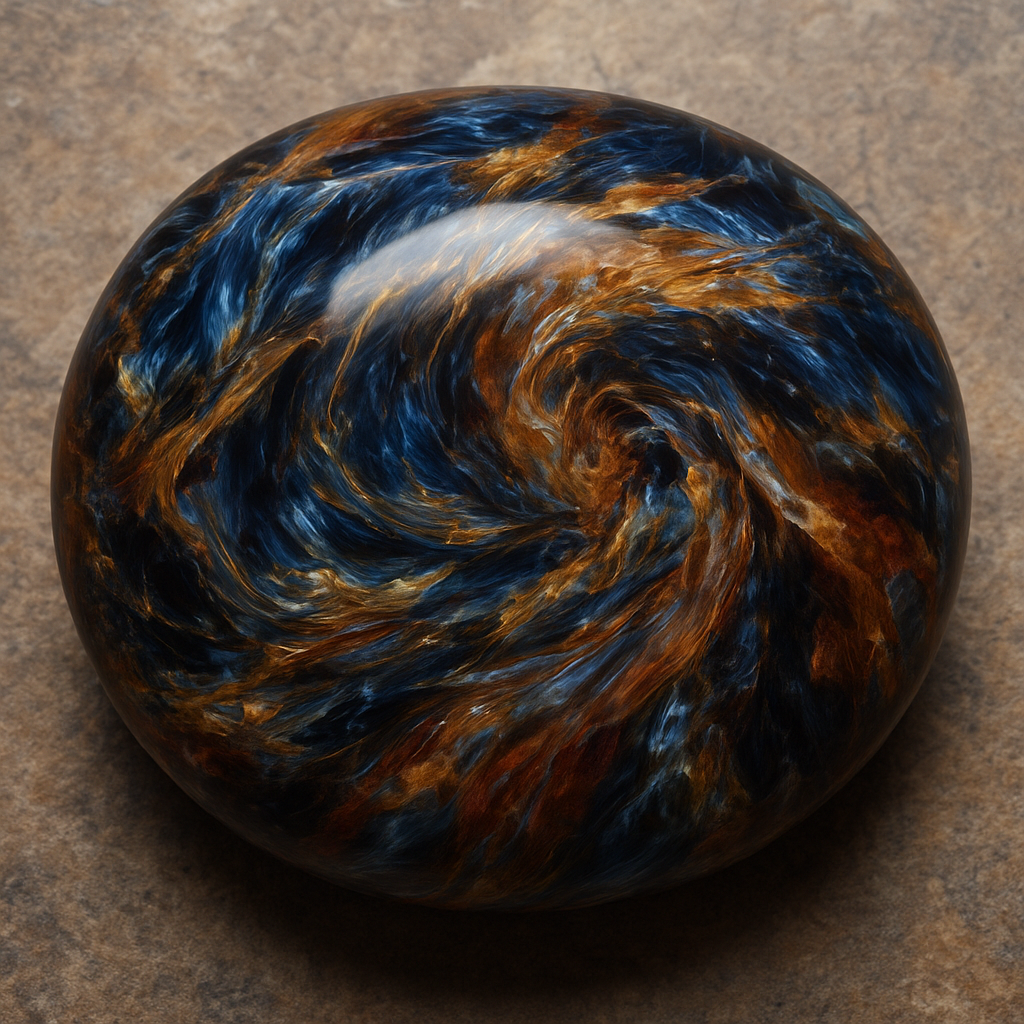
Pietersite is a striking and relatively rare variety of chalcedony-bearing quartz known for dramatic, swirling bands of chatoyant fibers that seem to capture the motion of a storm. Collectors and jewelers prize its vivid patterns and color contrasts, which can include deep blues, golds, browns and even reds. This article explores the geology and formation of pietersite, the main deposits where it is found, its uses in jewelry and decorative arts, lapidary and care considerations, plus cultural and metaphysical associations and a selection of interesting facts that showcase why pietersite continues to fascinate gem enthusiasts.
Geology and Formation: What Makes Pietersite Unique
Pietersite is best understood as a brecciated form of fibrous quartz in which the original fibers—often crocidolite (an amphibole mineral)—have been partially replaced by silica, principally in the form of chalcedony and microcrystalline quartz. The process that creates pietersite combines the same basic ingredients responsible for tiger’s-eye and hawk’s-eye, but with an added history of mechanical fracturing and re-cementation that produces its signature chaotic, swirling patterns.
Key geological processes involved:
- Replacement: The original fibrous amphibole (crocidolite) becomes replaced by silica while preserving the parallel fibrous structure that produces chatoyancy (the cat’s-eye effect).
- Brecciation: Tectonic or local geological stress breaks the fibrous masses into angular fragments; subsequent silica-rich fluids re-cement the fragments as a matrix, producing a brecciated texture.
- Reorientation: Because fragments are rotated and reassembled during cementation, the parallel fibers are no longer uniformly aligned; instead they crisscross and swirl, producing the tempest-like banding pietersite is famous for.
The resulting rock is still dominantly silica and generally registers a hardness close to that of quartz (around Mohs 6.5–7). The chatoyant effect appears as shimmering bands that seem to move when the stone or light source is rotated, and it is intensified by the curving, kaleidoscopic arrangement of the fibrous inclusions.
Primary Localities: Where Pietersite Is Found
While pietersite remains far less common than many other gem materials, there are a few well-known localities that supply most of the material available to the lapidary and gem markets.
Namibia
The type locality for pietersite is in southwestern Africa, in Namibia, where the material was first identified and named. Namibian pietersite tends to show rich golden and brown tones mixed with streaks of blue-gray and is often considered the classic or original pietersite in many collections.
China
Another important source is China, particularly deposits in the Ningxia region. Chinese pietersite often displays cooler blue and indigo tones and can be more dramatically chatoyant. The Chinese material brought pietersite to broader attention in jewelry markets because of its strong color contrasts.
Other occurrences
- Small, sporadic occurrences have been reported in parts of South Africa and a few other localities, but production from these areas is limited.
- Because pietersite is a form of silica heavily associated with replacement and brecciation processes, it can appear wherever the right sequence of fibrous amphibole formation, silicification and fracturing occurs—but economic quantities are rare.
Uses and Applications: Jewelry, Carvings, and Decorative Objects
Pietersite is used primarily as an ornamental stone. Its dramatic appearance makes it especially suitable for pieces where a single eye-catching stone is the centerpiece.
- Cabochons: The most common jewelry application is as polished cabochons. Cutting a pietersite cabochon requires skillful orientation to maximize the chatoyancy and swirling effects; a slightly domed surface often presents the best visual dynamics.
- Beads and pendants: Beads and drop-shaped pendants take advantage of elongated chatoyant bands. Some designers prefer large, single-stone pendants that display the „storm” patterns.
- Carvings and ornamental objects: Larger pietersite nodules can be carved into small sculptures, boxes, or decorative slices. When polished, these objects reveal the internal complexity of the brecciated structure.
- Collectibles: Unique slabs and specimens with particularly striking patterns are sought by mineral collectors and can be displayed as museum-quality specimens.
Because of its relative rarity and distinctive look, pietersite is often marketed at a premium compared with more common chatoyant stones. High-quality pieces with strong, contrasting colors and a dramatic „storm” appearance command the highest prices.
Cutting, Lapidary Techniques, and Care
Working with pietersite presents both opportunities and challenges for lapidaries. Maximizing the visual impact requires attention to fiber orientation, surface shape and polishing techniques.
Cutting tips
- Orientation: Before cutting, evaluate the piece under a directional light to find the best axis for the chatoyant bands. The lapidary will usually cut with the bands parallel to the dome of the cabochon to produce the moving effect.
- Cabochon shape: Slightly higher domes often highlight the chatoyancy best. For „storm” patterns, irregular shapes and freeform cuts can enhance the swirling visual effects.
- Fragility and inclusions: Because pietersite is brecciated, internal fractures and weak planes may be present. Slow, careful grinding and the use of water to minimize heat are important.
- Polishing: Diamond abrasives and cerium oxide or tin oxide can achieve a high luster. A careful final polish brings out the depth and movement of the pattern.
Care and cleaning
- Cleaning: Mild soap and lukewarm water with a soft brush are safe for regular cleaning. Rinse thoroughly and dry with a soft cloth.
- Avoid harsh chemicals: Bleach, acids and strong alkalis can damage any surface treatments or weaken the silica matrix.
- Ultrasonic and steam cleaners: Because pietersite can contain micro-fractures, avoid ultrasonic or steam cleaning for valuable or fracture-filled specimens.
- Storage: Store pietersite jewelry separately to prevent scratching. While quartz-based and fairly hard, the surface polish can be abraded by contact with harder stones like diamonds.
Identification and Imitations
Because pietersite’s visual appeal can be replicated in less expensive materials, buyers should be aware of common imitations and how to identify genuine pietersite.
- Natural features: Under magnification, natural pietersite shows a fibrous or brecciated structure with microcrystalline silica matrix and occasional mineral remnants—features that are difficult to mimic in glass.
- Refractive index and specific gravity: As a quartz-rich material, pietersite typically exhibits refractive indices close to those of chalcedony/quartz (about 1.54–1.55) and a specific gravity around 2.6–2.7. Glass and resin imitations often differ measurably.
- Treated or dyed materials: Some sellers may dye chalcedony or agate to imitate certain colors. Look for unnatural color zoning or concentrated color in fractures which suggests dye.
- Stabilized or composite stones: Low-quality or highly fractured pietersite may be stabilized with resin. Stabilized pieces will often show different luster in fractures or under magnification.
Metaphysical and Cultural Significance
Pietersite has gained a following in metaphysical and crystal-healing communities. While such claims are not scientifically supported, they form part of the stone’s cultural role and marketing appeal.
- Nickname: Pietersite is often called the „Tempest Stone” because of its swirling, storm-like appearance.
- Emotional and energetic associations: Enthusiasts describe pietersite as a stone of transformation and clarity, useful for releasing old patterns and integrating change.
- Uses in meditation: Its visual movement is said to aid mental focus and visualization exercises; some practitioners use pietersite during meditation to explore emotional storms and find calm.
- Cultural adoption: While not linked to ancient traditions the way some gemstones are, pietersite has been incorporated into contemporary spiritual practices and artisan jewelry that emphasizes symbolism.
Market, Collecting, and Value Factors
The value of pietersite depends on color, pattern, size and quality of polish. Collectors prize specimens with intense chatoyancy, dramatic storm-like patterns and unusual color combinations.
- Color and contrast: Specimens that combine vivid blues with warm golds or reds typically command higher prices due to their striking visual contrast.
- Pattern uniqueness: Because of its brecciated nature, each pietersite slab or cabochon is unique. Large, eye-catching patterns that present a continuous „scene” are especially desirable.
- Size: Larger, crack-free cabochons and slabs are more valuable; large display specimens for collectors can fetch significant sums.
- Source: Some buyers ascribe added value to material from the type locality in Namibia, while others prefer the intense blues of China—personal preference and market trends both influence prices.
Interesting Facts and Lesser-Known Details
- Origin of the name: Pietersite was named after Sid Pieters, who discovered the material in Namibia in the mid-20th century.
- Storm imagery: The stone’s swirling patterns are often likened to storms seen from above, cloud formations, or turbulent seas—an imagery that jewelers exploit in product naming and design.
- Versatile aesthetics: Pietersite bridges the visual language of both chatoyant gems like tiger’s-eye and the micro-patterned beauty of agate, making it appealing to a wide audience of designers.
- Because pietersite results from a two-step process—fiber formation followed by silicification and then mechanical brecciation—each specimen can tell a complex geologic history that gemologists find fascinating.
- Stability: Despite being brecciated, pietersite’s silica dominance gives it good long-term durability when properly cared for; this contrasts with more fragile, porous stones.
Practical Tips for Buyers and Collectors
- Inspect under directional light to see how the chatoyancy behaves; the best pieces will show moving bands and depth rather than flat reflections.
- Ask sellers about treatments or stabilization. Honest sellers will disclose dyes, resins or other interventions.
- Compare pieces from different sources. Namibian and Chinese pietersite can display distinct color palettes; choose based on personal preference.
- For jewelry, check setting security—avoid exposed edges on highly fractured slabs, and consider bezel settings that protect the stone.
Closing Note
Pietersite remains a gem that appeals on multiple levels: geologic intrigue, striking aesthetics, and symbolic resonance. Whether admired as a collector’s specimen, used as the centerpiece of a handcrafted pendant, or carried as a talisman in spiritual practice, pietersite stands out for its dramatic movement and the sense of energy captured within its microcrystalline matrix. For lapidaries and gem enthusiasts, each piece is an opportunity to showcase a small but powerful example of nature’s ability to produce complex beauty through time, stress and mineral transformation.