Prehnite is a captivating and often understated green silicate mineral that fascinates collectors, lapidaries and geologists alike. With its soft, leafy tones and frequently botryoidal growths, it occupies a special place between everyday gemstones and scientifically important indicator minerals. This article explores the mineral’s chemistry and crystal habits, the geological environments and notable locality occurrences where it forms, its diverse uses from jewelry to research, and some cultural and metaphysical stories that surround it. Along the way you will find practical guidance for identification, cutting and caring for this attractive stone, plus suggestions for collectors and anyone curious about one of the more accessible yet scientifically meaningful secondary minerals.
What Prehnite Is: Composition, Structure and Appearance
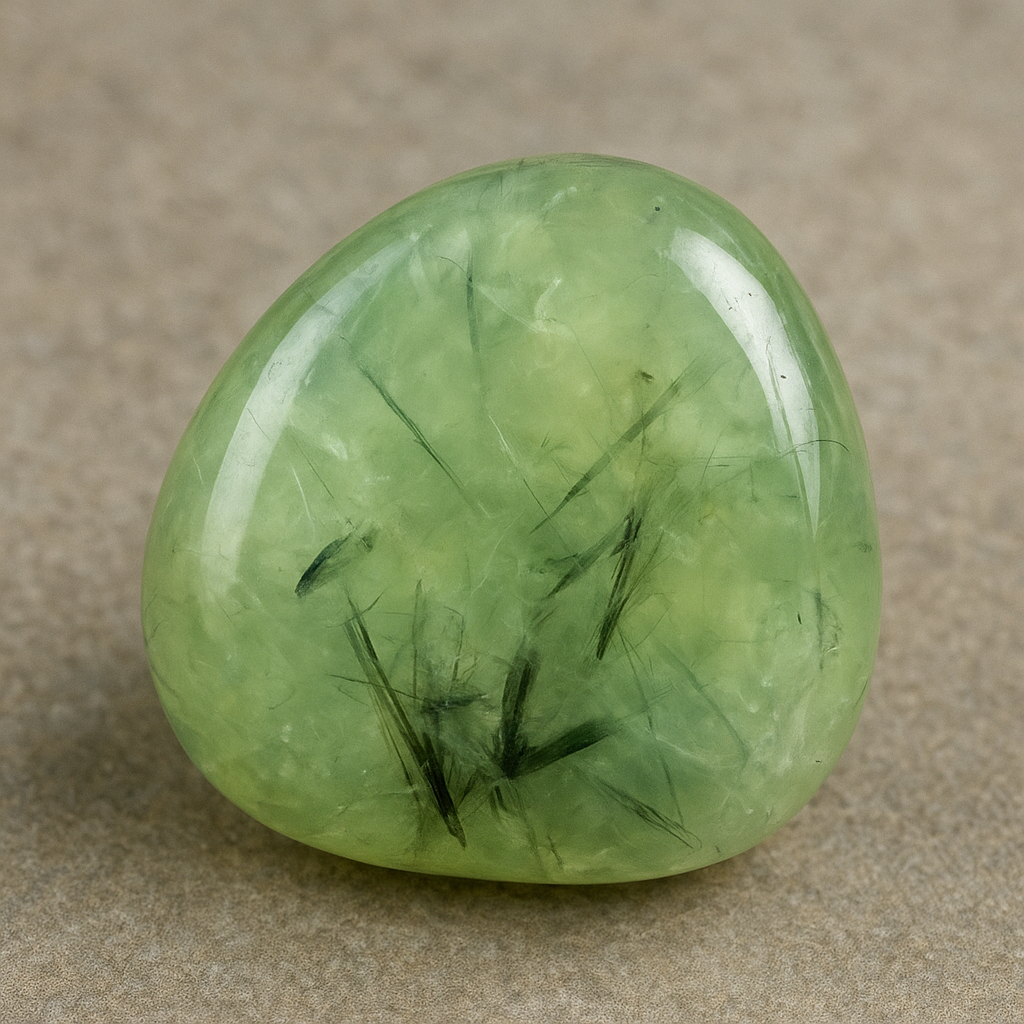
At the chemical level, prehnite is a calcium aluminium silicate hydroxide with a common formula written as Ca2Al2Si3O10(OH)2. It typically crystallizes in the orthorhombic system and most often occurs as radial, fibrous or globular masses rather than large isolated euhedral crystals. The surface may display a vitreous to pearly luster, and the stone’s most characteristic colors range from pale apple-green to yellow-green, although white, gray, bluish and even rare pinkish varieties are known.
One striking morphological habit of prehnite is its tendency to form botryoidal or globular aggregates and stalactitic crusts. These textures make specimens look almost like bunches of grapes or rolled waxy crusts lining vesicles in volcanic rock. Thin slices and polished cabochons frequently display a gentle translucency; light often diffuses through the stone creating a soft internal glow. This combination of habit and translucency is part of what makes it appealing as both a collector’s mineral and a lapidary material.
Physical and Optical Properties
- Hardness: Typically between 6 and 6.5 on the Mohs scale, making it usable in many types of jewelry but requiring some caution for rings or bracelets exposed to rough wear.
- Specific gravity: Moderate, usually around 2.8–2.95.
- Cleavage and fracture: Exhibits imperfect cleavage and conchoidal to uneven fracture; this affects how it is cut and shaped.
- Optical behavior: Prehnite is usually translucent to semi-translucent with refractive indices commonly reported in the range near 1.61–1.64 and is biaxial in optical character.
Because of its moderate hardness and often subdued color, prehnite is sometimes overlooked in favor of more vibrant gems. Yet its subtle, pearly gleam and delicate hues provide a different aesthetic — understated elegance rather than flashy brilliance.
Geological Settings and Where Prehnite Occurs
Prehnite most commonly forms as a secondary mineral in the cavities and vesicles of low-temperature basaltic and other mafic volcanic rocks. It is frequently found with a suite of minerals that precipitate from hydrothermal fluids at relatively low temperatures: zeolites, apophyllite, calcite, epidote, and quartz among them. In metamorphic terrains it is an important constituent of the prehnite-pumpellyite facies, representing low-grade metamorphism of mafic rocks and providing geologists with clues about the pressure-temperature conditions experienced by the rock.
Typical Environments
- Basaltic cavities and amygdales: Hydrothermal fluids circulating through basaltic lava flows deposit prehnite along with zeolites and other secondary minerals.
- Vein and vug fillings in altered volcanic host rocks.
- Low-grade metamorphic zones: As part of the prehnite-pumpellyite facies, it marks a specific metamorphic grade in regional metamorphism of mafic sequences.
Notable Localities
Prehnite has a global distribution — it is neither extremely rare nor mundane. Some of the best-known and most historically important sources include:
- South Africa — The type locality is in the Cape of Good Hope region; prehnite was first recognized and named in the 18th century after Colonel Hendrik von Prehn. South African material historically brought attention to the mineral.
- India — Regions such as Maharashtra (Jalgaon) produce translucent green botryoidal prehnite that is commonly cut and polished for cabochons and beads, often intergrown with acicular epidote.
- China — Several provinces yield attractive prehnite used both as specimens and in the lapidary trade.
- United States — Prehnite occurs in vesicular basalts and hydrothermal zones; notable occurrences are reported in the mid-Atlantic and New England states, and in the Pacific Northwest.
- Australia, Scotland, Germany, France and New Zealand — Each provides important specimen localities, often associated with zeolite-bearing basaltic sequences.
Collectors prize locality-specific pieces because the habit and color can vary: stalactitic crusts, botryoidal clusters, and intergrown prehnite-epidote combinations each tell a different geological story.
Uses: From Jewelry and Ornament to Scientific Applications
Prehnite finds a range of practical and aesthetic applications that span jewelry, ornamental use, and scientific study. The most visible use is as a lapidary material: many cabochons, beads, and carved objects are produced from attractive translucent varieties, especially those displaying a pleasing green shade.
Jewelry and Lapidary Work
Because prehnite is moderately hard and often translucent, it is well-suited to cabochons, beads and carved pieces. It is less often faceted because its luster and optical properties yield a better aesthetic as polished rounded surfaces rather than brilliant facets. In jewelry, prehnite is commonly used for pendants, earrings and brooches, and by designers who favor organic, earthy palettes.
Designers and consumers should keep in mind that prehnite’s durability is fair: it resists scratching better than softer minerals but can be chipped or fractured if struck sharply. Setting the stone in protective mounting styles and avoiding exposure to harsh chemicals helps preserve its appearance.
Ornamental and Decorative Uses
Beyond wearable forms, prehnite is carved into small sculptures, figurines and ornamental objects. Its gentle green can complement wood and metal in interior design contexts. Larger botryoidal specimens often serve as attractive display pieces in collections or as natural décor.
Scientific and Geological Importance
To geologists, prehnite is far more than a pretty rock: it is an important indicator of specific hydrothermal conditions and low-grade metamorphism. The presence of prehnite (often with pumpellyite) defines the prehnite-pumpellyite metamorphic facies. This informs researchers about the pressure-temperature path of metamorphosed basaltic sequences and helps reconstruct regional metamorphic histories.
Additionally, studies of fluid inclusions, trace element chemistry and stable isotopes in prehnite provide insights into the composition and evolution of hydrothermal fluids. Because it commonly coexists with zeolites, prehnite-bearing assemblages are also studied in the context of secondary mineral paragenesis and low-temperature geochemistry.
Identification, Cutting and Caring for Prehnite
How to Identify Prehnite
- Color and habit: Look for pale green to yellow-green masses, often botryoidal or stalactitic; translucency is common.
- Hardness: Test that it scratches glass but is not as hard as quartz (Mohs 6–6.5).
- Associations: Occurs with zeolites, epidote, apophyllite and calcite — the company it keeps is a useful diagnostic clue.
- Optical properties: Biaxial optical behavior and refractive indices around the low 1.60s are typical.
Laboratory techniques such as X-ray diffraction (XRD) and electron microprobe analysis definitively identify prehnite, but hand specimen identification is routinely achievable by experienced collectors using the features above.
Lapidary Considerations
When cutting prehnite, lapidaries must account for its imperfect cleavage and variable internal structure. Radial aggregates and globular patterns can produce attractive cat’s-eye or soft internal sheen effects when oriented properly, so skilled cutters can accentuate the stone’s natural textures. Because prehnite is not usually faceted, polishing to a silky or waxy finish often yields the best aesthetic results.
Care and Maintenance
To keep prehnite looking its best:
- Clean with mild soap, warm water and a soft brush. Rinse and dry thoroughly.
- Avoid strong acids, bleach and prolonged exposure to high heat which can damage or alter color.
- Do not use steam cleaners or ultrasonic cleaners on fragile or heavily included material.
- Store prehnite separately from harder gemstones to prevent abrasion; use padded compartments or soft pouches.
Collecting and Notable Specimens
For collectors, prehnite is rewarding because of its variety of forms and its compatibility with other attractive secondary minerals. A well-displayed cabinet will often include botryoidal green crusts, stalactitic specimens with drusy surfaces, and combinations with glittering apophyllite crystals or contrasting epidote needles.
Collecting Tips
- Provenance matters: Specimens from well-documented localities fetch higher interest and value.
- Examine the specimen for stability: porous or heavily fractured pieces may delaminate or crumble over time.
- Look for distinctive textural contrasts: prehnite over quartz, or prehnite intergrown with epidote or calcite make striking cabinet pieces.
Collectors often prize specimen groups where the mineral growth vividly records the mineralizing conditions: sequential drusy layers, color zonation, or delicate floral-like radiating aggregates all add scientific and aesthetic worth. A museum-quality example may come from classic basaltic locales where large vugs produced dramatic, intact crusts of prehnite.
Cultural, Historical and Metaphysical Themes
Prehnite’s human story begins with its naming: the mineral was named after Colonel Hendrik von Prehn, who collected specimens in the Cape of Good Hope region during the 18th century. Over time, its delicate green hue led to associations with growth and renewal in various cultural and metaphysical practices.
In modern crystal-healing and New Age traditions, prehnite is often associated with calming energy and inner knowledge. Practitioners claim it helps with visualization, dream recall and a strengthened connection to nature. It is commonly linked to the heart chakra and sometimes used in meditation to foster forgiveness and emotional balance.
As with all metaphysical claims, these uses are cultural and anecdotal rather than scientific. Nonetheless, they form a meaningful part of how many people value the stone, and they contribute to its market demand in beadwork, pendants and small carved talismans.
Scientific Research, Varieties and Synthetic Treatments
Recent mineralogical research has explored prehnite’s crystal chemistry, trace element distribution and the details of its formation in hydrothermal systems. Studies of fluid inclusions trapped within prehnite give direct evidence of the temperature and composition of mineralizing fluids, while isotopic work (oxygen and hydrogen) helps reconstruct water-rock interaction histories.
Varieties of prehnite include those with distinctive inclusions (for example, needles of epidote or microscopic sulfide crystals) that produce a special visual effect. Some translucent material may display a soft internal glow that is prized by designers. To date, prehnite is not commonly synthesized for the gem trade and is seldom subjected to routine color treatments; most market material is natural, though polishing and heat exposure during cutting can influence surface appearance.
Practical Advice for Buyers, Sellers and Enthusiasts
If you are buying prehnite as jewelry or a specimen:
- Ask for provenance: locality and whether the stone was stabilized or treated.
- Examine it under varied lighting: prehnite’s translucency can look different in daylight versus incandescent light.
- Consider the setting: for jewelry, choose protective mountings that minimize exposure to impact.
- For specimens, prefer intact crusts and pieces that display the natural habit clearly; pairing with associated minerals often enhances value.
Sellers should clearly disclose treatments and provide care recommendations. Small information cards with locality, habit description and typical care instructions enhance the appeal of a specimen or a piece of jewelry.
Interesting Anecdotes and Lesser-Known Facts
Prehnite occupies a niche where geology and human culture meet in subtle ways. A few lesser-known points worth noting:
- It often forms after the primary minerals in basalt have altered, recording the last stages of hydrothermal activity; in this sense, it is a geological storyteller of the rock’s cooling and alteration history.
- Collectors sometimes find prehnite in abandoned basalt quarries or old zeolite-collecting sites where vugs have been exposed by erosion or mining activity; responsible collecting practices are essential to preserve such sites.
- When associated with pumpellyite, prehnite marks a metamorphic facies that is specifically useful in mapping the low-temperature metamorphic history of an orogenic belt.
Because of its accessibility and range of forms, prehnite is an excellent mineral for teaching basic concepts in mineralogy and petrology: crystal habit, secondary mineralization, metamorphic facies and mineral associations are all visible in a single attractive specimen.
Concluding Notes on Appreciation and Continued Study
Prehnite’s combination of gentle beauty, geological significance and lapidary potential ensures it remains a favored mineral among diverse audiences. Whether admired as a warm, translucent cabochon hanging on a cord, studied in thin section by a graduate student, or displayed as a botryoidal crust on a shelf, prehnite encourages a closer look at the processes that create mineral diversity. For collectors, jewelers and scientists alike, it is a reminder that even modest-looking minerals can hold deep stories about Earth’s history and human creativity.