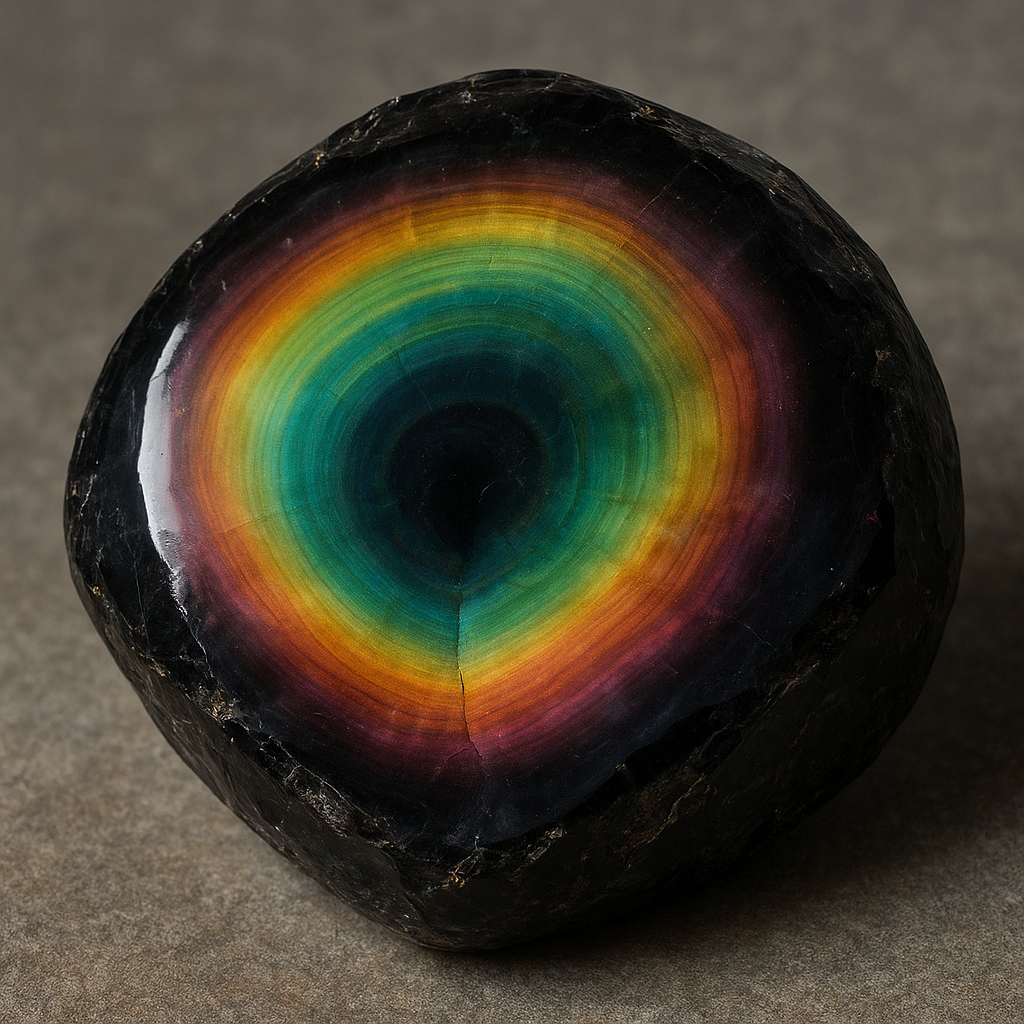
Rainbow obsidian is a striking variety of volcanic glass prized for its subtle iridescence and banded flow patterns. When light strikes a polished surface at certain angles, delicate rainbow-like reflections appear, often in concentric or wavy bands that seem to float beneath a black or dark-brown surface. This stone combines the raw geological story of rapid volcanic cooling with an aesthetic that has inspired toolmakers, artisans, and spiritual practitioners for millennia.
Formation and Geological Characteristics
At its core, rainbow obsidian is simply a form of volcanic glass—molten rock that cooled so quickly it did not crystallize. The principal chemical component is silica, generally with high silica content typical of rhyolitic lavas. What sets rainbow obsidian apart is the internal microstructure: microscopic layers, tiny gas bubbles, or minute mineral inclusions can scatter and diffract light to create a visible sheen. These micro-structures often form during the flow and cooling of the lava, producing distinct concentric patterns and flow banding that reveal the dynamics of the eruptive event.
Another key physical trait of obsidian is its conchoidal fracture. When struck, it breaks with smooth, curved surfaces that were historically valuable to make sharp-edged tools and blades. Under magnification, the iridescent effects of rainbow obsidian can be linked to light interacting with layers or inclusions on the scale of nanometers to micrometers; different physical mechanisms—thin-film interference, diffraction from inclusions, and scattering from microcavities—may combine to create the characteristic rainbow play of colors.
Where It Occurs: Major Localities and Geological Settings
Rainbow obsidian forms wherever silica-rich lavas erupt and cool rapidly. It is most commonly associated with rhyolitic domes, spines, and flows. The best-known sources are concentrated in volcanic regions with abundant high-silica magmas.
Notable Regions
- Mexico — One of the most famous sources of rainbow obsidian, with well-documented deposits across regions such as Hidalgo and Oaxaca. Mexican rainbow obsidian is often used in local lapidary work and is widely exported as cabochons and spheres.
- Western United States — Field locations in Oregon (notably Glass Buttes and other obsidian-rich areas), Utah, and Arizona produce various sheen and flow-banded types; rainbow varieties can be found in these deposits.
- Central and South America — Guatemala and parts of the Andes host obsidian flows that have produced sheen and banded varieties used historically by indigenous peoples.
- Iceland, Japan, Italy and other volcanic regions — While less famous for rainbow obsidian specifically, these countries contain rhyolitic or high-silica volcanic centers where similar types of obsidian may form.
Because obsidian forms on the surface and near-surface during volcanic eruptions, its distribution is patchy and often restricted to individual outcrops or domes. That makes each deposit geochemically unique, which is useful for geological sourcing studies.
Historical and Cultural Uses
Obsidian has a rich cultural history. Ancient peoples quickly learned how to exploit its glassy fracture to make artifacts—arrowheads, blades, scrapers, and ritual objects with edges often sharper than modern steel scalpels when freshly knapped. Rainbow varieties, with their visual allure, often assumed added symbolic and ceremonial value.
Mesoamerican Context
In Mesoamerica, obsidian was a highly prized exchange good and an essential material for everyday tools and warfare. The iridescent forms were used for ornamental items, masks, and inlay work. Rainbow obsidian, when found in archaeological contexts, sometimes appears in elite burials or ceremonial caches, suggesting it held aesthetic or symbolic power beyond utilitarian function.
Traditional Craft and Adornment
Across cultures that had access to obsidian, polished specimens were fashioned into beads, amulets, and decorative objects. The play of color in rainbow obsidian made it especially appealing for jewelry and decorative inlays, producing items that catch light in subtle ways rather than the bright flash typical of faceted gemstones.
Modern Uses: Jewelry, Lapidary, and Decorative Arts
Today, rainbow obsidian is popular among lapidaries and designers who appreciate its understated coloration and internal sheen. Skilled workers cut and polish the stone into cabochons, beads, spheres, and carved sculptures that emphasize the layered reflections. Because the effect is angle-dependent, artisans often shape pieces to maximize the display of internal banding and rainbow flashes.
- Cabochons and pendants — Smooth domes reveal the iridescence best and are commonly set in silver or other metals.
- Beads and bracelets — Small polished rounds and ovals allow the color play to appear subtly with movement.
- Sculptural pieces — Larger specimens can be carved into decorative forms where flow-banding creates dynamic visual textures.
The stone’s relative softness and tendency to fracture must be respected during cutting and polishing, so experienced lapidaries use specialized techniques to avoid cracking and to bring out the maximum optical effect.
Metaphysical and Contemporary Beliefs
In modern crystal and holistic communities, rainbow obsidian has acquired a set of attributed properties. Practitioners value it for grounding and protective energies, often citing its volcanic origin as symbolic of transformation and strength. Many believe rainbow obsidian helps to reveal hidden emotions and supports the release of negative patterns. While such claims are not supported by scientific evidence, they are culturally meaningful to practitioners and part of the stone’s contemporary appeal.
Commonly ascribed uses include:
- Protection and psychic shielding
- Emotional healing and clarity
- Aid during meditation and shadow work
- Enhancing introspection and personal transformation
These practices often pair rainbow obsidian with other grounding stones like hematite or with reflective practices such as journaling and guided meditation. Whether used symbolically or ritually, the stone’s visual depth lends itself well to contemplative contexts.
Scientific Interest and Archaeological Applications
Outside of aesthetics and spiritual use, rainbow obsidian is valuable to scientists. Because individual obsidian flows are geochemically distinct, researchers can use geochemistry—trace-element fingerprinting—to link archaeological artifacts to specific geological sources. This has revolutionized our understanding of prehistoric trade and exchange networks, especially in regions like Mesoamerica and the western United States.
Obsidian hydration dating is another method where the rate of water diffusion into a freshly exposed surface provides an approximate age since the piece was created. Although hydration rates depend on local conditions, the technique, combined with sourcing, helps archaeologists reconstruct timelines of human activity.
From a materials science perspective, obsidian serves as a natural analog for studying glass behavior, nucleation processes, and fracture mechanics. Rainbow obsidian’s internal features also offer insight into how minute inclusions and nanostructures affect optical properties—knowledge relevant to engineered glass and photonic materials.
Identification, Care, and Ethical Considerations
Identifying rainbow obsidian is usually straightforward for a trained eye: a dark, glassy stone with characteristic flow lines and angle-dependent iridescence. However, synthetic glasses and dyed materials can mimic some effects, so sourcing and provenance should be considered when purchasing high-quality specimens.
Practical Tests and Tips
- Examine luster and fracture: natural obsidian has a vitreous luster and conchoidal fracture patterns; look for curved, glassy surfaces on broken edges.
- Angle light to reveal sheen: the rainbow effect appears strongly under oblique light—if it never shows under varying angles, it may be treated or imitation material.
- Check for tooling marks: natural pieces worked by hand often retain subtle signs of knapping or polishing.
Care and Maintenance
Obsidian is relatively durable but can chip or cleave if dropped. Clean with mild soap and lukewarm water; avoid ultrasonic cleaners and harsh chemicals that might affect any resin or stabilizer used on porous carvings. Store polished pieces wrapped separately to prevent scratches.
Ethical Sourcing
Because some obsidian localities are in indigenous or ecologically sensitive areas, it is worth asking vendors about provenance and ethical practices. Supporting artisans and suppliers who obtain material responsibly and who respect local land rights helps preserve both natural and cultural heritage.
Curiosities and Lesser-Known Facts
Some intriguing aspects of rainbow obsidian include:
- Chemical micro-layers that produce color — tiny variations in oxide content or inclusions can create different optical outcomes even within a single piece.
- Variability with polish — a particular facet cut can either mute or amplify the rainbow effect, so lapidary choices matter a great deal.
- Use in high-precision experimental archaeology — historically accurate replicas of obsidian blades demonstrate how sharp and efficient knapped obsidian tools can be for cutting tasks.
- Collectibility — because the phenomenon depends on subtle structures, collectors prize specimens that show strong, multi-hued iridescence under normal lighting.
Rainbow obsidian sits at an intersection of geology, art, history, and belief. Its beautiful yet understated appearance makes it versatile: a scientific sample in a laboratory, a polished pendant on a necklace, or a ritual object on a meditation altar. Whether appreciated for its natural story or its shimmering surface, the stone continues to fascinate and inspire.