
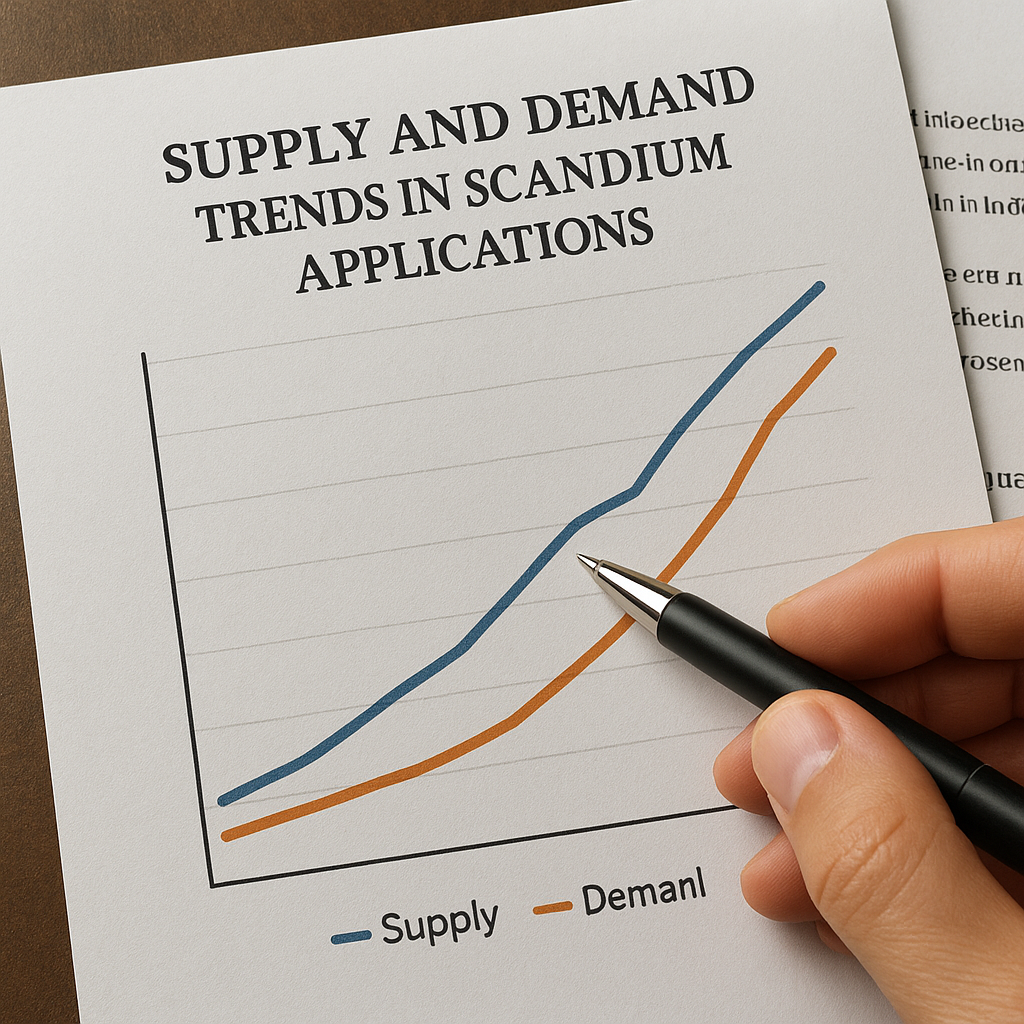
The global market for scandium is at a pivotal moment. Once a niche specialty metal recovered in tiny quantities, scandium is increasingly visible across advanced industries due to its unique properties. This article examines the evolving balance of supply and demand, the production constraints and opportunities, and how technological advances, policy shifts, and recycling strategies shape future applications. The aim is to offer a comprehensive view of the trends that will determine whether scandium becomes a widely adopted industrial material or remains a strategic, limited-resource input reserved for select high-value uses.
Market dynamics and demand drivers
Several intersecting trends are driving interest in scandium. Its ability to significantly strengthen and refine the grain structure of aluminum-scandium alloys makes it attractive for a range of sectors seeking better strength-to-weight ratios and improved weldability. Key demand drivers include:
- Aerospace and defense programs pursuing lighter, more fuel-efficient structures and components.
- Emerging fuel cells technologies and high-performance energy systems where scandium-stabilized materials can enhance performance.
- High-end sporting goods, automotive applications, and specialty electronics where premium properties justify higher material costs.
- Research and development into additive manufacturing and advanced metallurgy, which uncover new use cases for scandium-enhanced materials.
Beyond technical advantages, market adoption is influenced by price volatility, supply security concerns, and the readiness of industries to redesign products around a relatively scarce element. For instance, the aerospace sector tends to adopt new materials cautiously due to stringent certification and lifecycle testing requirements, while consumer-facing industries may be faster to take on premium materials if performance and branding benefits are clear.
Supply landscape and production challenges
The supply of scandium is fundamentally different from many common metals. It is rarely mined as a primary commodity; instead, it is typically recovered as a by-product of rare earth mining, uranium processing, or bauxite refining. This has several implications:
- Production volumes are small and often tied to the economics of unrelated primary metals, making supply inflexible.
- Geographic concentration of recovery facilities and primary sources creates potential geopolitical risks.
- Processing and purification to produce high-purity scandium oxide, sulfates, or metal are specialized and capital intensive.
Large deposits of scandium-bearing minerals exist in various regions, but developing dedicated scandium mines is rarely economical because scandium grades tend to be low and extraction costs high. Some newer projects and pilot plants aim to change this calculus by optimizing recovery streams and leveraging co-production with other minerals. Advances in ore-processing technology, solvent extraction, and hydrometallurgical techniques can boost recoveries and reduce unit costs, but they require significant investment and time to scale.
Key constraints
- Limited refining capacity: Few facilities worldwide can produce high-purity scandium compounds at scale.
- Supply inflexibility: Because scandium is often secondary to other commodities, its output does not respond readily to price signals.
- High production costs: Complex extraction and purification steps make scandium one of the more expensive specialty metals.
These constraints help explain the metal’s historical niche status and highlight why industrial adoption depends as much on supply-side improvements as on demand-side needs.
Applications shaping demand
Understanding specific applications clarifies the paths through which demand might grow. Several sectors stand out:
Aerospace and defense
Aerospace is a natural fit for scandium-enhanced materials due to the premium placed on weight reduction and structural performance. Aluminium-scandium alloys offer improved fatigue resistance and weldability, enabling designers to reduce part counts and overall structural mass. For defense, these alloys can provide tactical advantages through lighter vehicles and aircraft, but adoption is moderated by strict certification requirements and the need for reliable supply chains.
Energy systems and fuel cells
Scandium-stabilized materials can improve the durability and efficiency of solid oxide fuel cells and other high-temperature energy devices. Progress here depends on successful integration into complete systems and cost reductions that make scandium-containing components competitive with incumbent technologies.
Automotive and consumer goods
Performance automotive components and premium consumer goods (e.g., bicycles, tennis rackets, and electronic casings) can absorb higher material costs for performance gains. Mass-market automotive penetration, however, requires substantial price declines or the emergence of abundant, low-cost scandium sources.
Emerging technologies
Researchers are exploring scandium’s role in additive manufacturing, specialty coatings, and catalysis. Each new viable application broadens demand but also raises questions of whether supply can adapt to episodic and concentrated growth spurts.
Price outlook and economic considerations
Scandium’s market price has historically been volatile, influenced by tight supply, small trade volumes, and episodic speculative activity. Pricing dynamics are shaped by a few critical factors:
- Production scale: Small increases in output can have outsized effects on the market balance.
- Contractualization: Long-term contracts between producers and strategic consumers can stabilize prices but require upfront commitments and trust in supply continuity.
- Substitution and innovation: The development of cost-effective substitutes or alternative alloying strategies could cap long-term price growth.
From an economic perspective, potential investors evaluate the total cost of ownership for scandium-enabled products. For industries where life-cycle energy savings or performance gains translate directly into economic benefit (e.g., aviation fuel savings), the premium for scandium may be justified. For lower-margin sectors, even modest price increases can deter adoption.
Policy, recycling and sustainability
Policy choices and sustainability initiatives will increasingly influence scandium’s trajectory. As nations classify certain elements as critical for economic and security reasons, scandium could attract strategic stockpiling, targeted mining incentives, or R&D funding to diversify supply. Key elements in this domain include:
- Regulatory support for domestic recovery and processing facilities, reducing reliance on imports.
- Research grants to improve extraction efficiency from unconventional sources such as tailings, red mud from bauxite refining, and low-grade ores.
- Standards and certification programs encouraging the adoption of scandium alloys in safety-critical applications.
Recycling emerges as a crucial lever to enhance supply security. Although currently minimal due to the small volume of end-of-life scandium-bearing products, targeted recycling programs and the design of products for material recovery could become important as market volumes grow. Recovering scandium from scrap aluminum alloys and industrial residues offers a path to circularity, potentially lowering environmental impacts and insulating industries from raw-material shocks.
Environmental and social considerations
Scaling scandium production must also address environmental and social governance (ESG) factors. Hydrometallurgical processes, waste streams, and energy consumption in refining require careful management. Producers who can demonstrate low-impact extraction, transparent supply chains, and fair labor practices will be better positioned to win long-term contracts from environmentally conscious customers.
Strategic scenarios and industry responses
Forecasting scandium’s future involves multiple scenarios depending on how quickly supply-side innovations mature and how rapidly demand signals intensify. Three broad scenarios illustrate possible futures:
- Constrained but steady growth: Incremental improvements in recovery and more long-term contracts lead to modest, sustained demand growth concentrated in high-value sectors.
- Supply expansion and market broadening: Breakthroughs in extraction or the startup of dedicated production facilities lower costs, enabling wider adoption in automotive and industrial applications.
- Disruptive demand spike: Rapid policy shifts, strategic stockpiling, or a major technological application drives sudden demand increases that outpace supply, causing price spikes and prompting accelerated investment.
Industry actors can adopt several approaches to navigate these scenarios: securing long-term offtake agreements, investing in recycling and recovery technologies, partnering across the supply chain to share risk, and engaging with policymakers to support responsible domestic production.
Concluding perspectives
The outlook for scandium is shaped by a complex interplay of technical advantages, supply limitations, economic calculus, and policy choices. If producers, consumers, and governments coordinate to expand responsible production, invest in recycling, and develop robust supply chains, scandium could transition from a specialty mineral to a more widely used industrial input. However, without meaningful increases in refining capacity and cost reductions, scandium’s role may remain confined to strategic, high-value niche applications. Stakeholders across sectors should monitor advances in extraction technologies, policy developments, and early adopters’ experiences to make informed decisions about integrating scandium into future products and infrastructure.
