
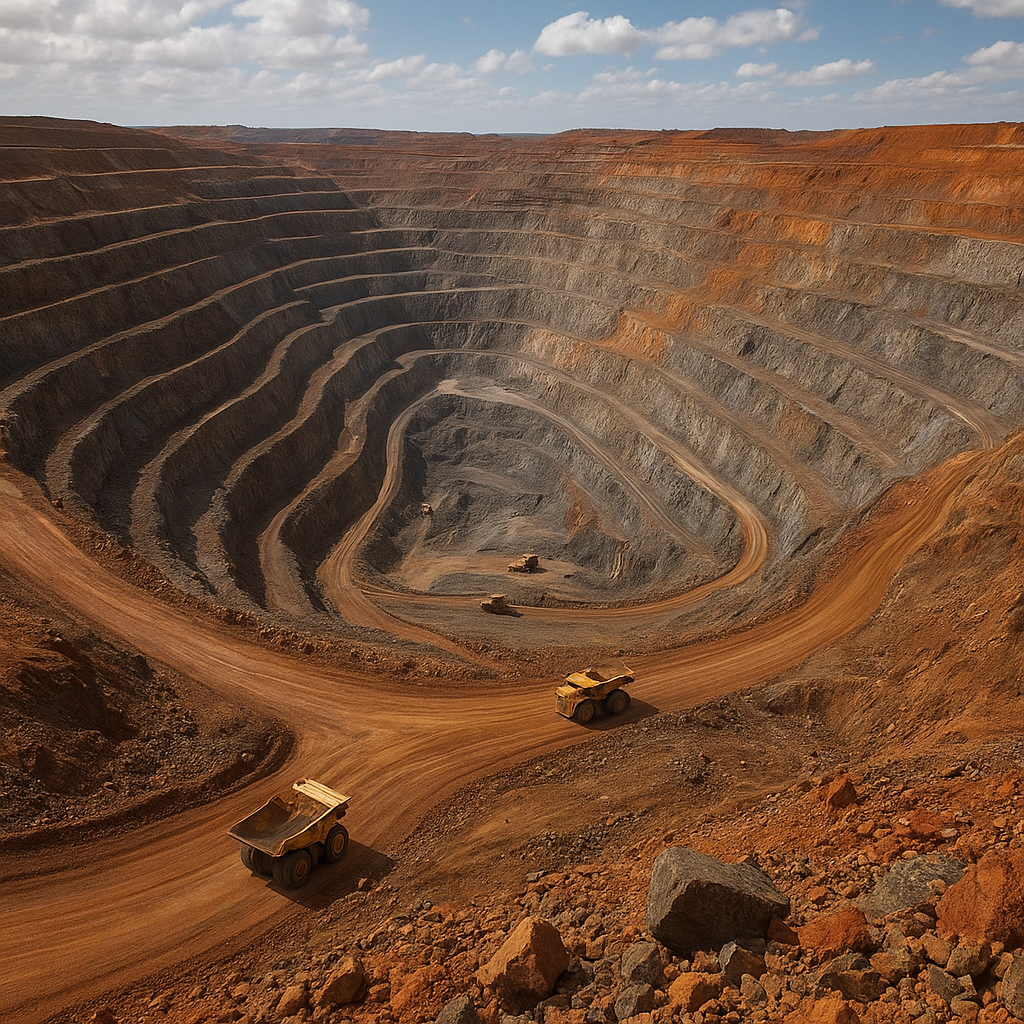
The Boddington mine, located in the south-west of Australia, is one of the country’s most important mineral operations. As a large-scale open-pit complex producing both gold and copper, Boddington has shaped regional development, contributed significantly to export revenues, and become a focal point for debates on modern mining practice, environmental management and community engagement. In the following sections I examine its location and geology, the technical aspects of extraction and processing, its economic footprint, and a number of noteworthy aspects that make Boddington a mine of global interest.
Location and geological setting
The mine is situated in the Darling Range, roughly southeast of Perth in Western Australia. Its proximity to major transport corridors and the state capital gives it logistical advantages: access to skilled labour, services and export facilities. The mine site lies near the township of Boddington, which has grown in importance and scale in direct response to the mine’s development and operations.
From a geological perspective, the deposit is notable for being a large, hydrothermal mineral system hosting both gold and copper. These metals occur in association with extensive alteration of host rocks, creating a deposit that is economically attractive for bulk mining. The geology reflects a long and complex geological history in which intrusive and volcanic sequences were affected by multiple phases of fluid flow, mineralisation and structural deformation. While the detailed scientific classification can be expressed in specialist literature, in practical terms the deposit’s size, grade continuity and metallurgy make it ideally suited to the large-scale open-pit mining methods used at Boddington.
Mining methods, processing and infrastructure
Open-pit operations and mine planning
Boddington is operated as a large-pit mine using conventional truck-and-shovel fleets combined with extensive drilling and blasting. Modern mine planning at the site uses high-resolution geological models, block modelling and optimisation techniques to balance ore extraction with waste stripping, ensuring safe pit walls and efficient mine sequencing. The scale of the operation demands a continuous logistics chain: explosives supply, heavy equipment maintenance, fuel management, and haul-road engineering to support high-frequency truck movements. Overburden management and progressive rehabilitation are planned alongside extraction to reduce long-term environmental footprint.
Processing plant and metallurgy
Ore from the pit is delivered to a processing plant that combines comminution, concentration and gold recovery circuits. Initial stages include crushing and grinding to liberate valuable minerals. Copper and gold values are recovered through a combination of flotation and gravity/CIP (carbon-in-pulp) methods, depending on mineralogy. The flotation concentrates copper-bearing minerals for further treatment, while gravity and leaching circuits recover free-milling gold. Finished products typically include gold doré and copper concentrate, both of which are prepared to market specifications and transported to smelters or refineries.
Supporting infrastructure
Large mines like Boddington require substantial ancillary infrastructure. This includes tertiary roads, worker accommodation and camp facilities, power supply systems, water management and tailings storage. Tailings storage facilities (TSFs) are engineered basins for fine process residues; at Boddington, these structures are subject to ongoing monitoring, design review and regulatory oversight. Water management is critical in the region — process water, stormwater control and strategies to protect local catchments are integral elements of site engineering. The mine also relies on reliable power and fuel logistics, and it contributes physically to local infrastructure improvements such as road upgrades and community facilities.
Economic importance and regional impact
Boddington is a significant contributor to the Western Australian and national economies. As a high-volume producer of gold and a meaningful supplier of copper, it generates export earnings that flow into government revenue through royalties and taxes, and into the balance sheets of its owners and contractors. The mine has created employment during construction and steady roles during operation — not only for direct mining and processing staff but also for a wide network of contractors, suppliers and service providers.
Beyond direct employment, the mine stimulates secondary economic activity in the region. Local businesses benefit from increased demand for accommodation, retail, transport, maintenance and professional services. Skills development programs and training initiatives often accompany large operations; apprenticeships, onsite training and partnerships with technical institutions raise the local workforce capability. The mine’s investments in community infrastructure — water, roads, recreation facilities — have lasting benefits for nearby towns.
Governments receive revenue through mining royalties, corporate taxes and employment taxes, and those funds support broader state services. Because Boddington produces commodity exports, it also contributes to the national trade balance. In boom periods, operations like Boddington can materially affect regional economic indicators such as local GDP, unemployment rates and household incomes.
Environmental management, community relations and social licence
Environmental controls and rehabilitation
Contemporary mining practice at Boddington emphasises environmental management across the life of the mine. Key concerns include water usage and quality, biodiversity impacts, air quality (dust and emissions), noise, and the design and monitoring of tailings storage facilities. Progressive rehabilitation — returning mined land to stable and productive post-mining landforms — is a regulatory and ethical obligation. Rehabilitation plans often include recontouring, topsoil replacement, revegetation with native species and long-term ecological monitoring to ensure recovery trajectories align with agreed outcomes.
Water stewardship is particularly important in the south-west of Australia, where surface and groundwater resources support diverse ecosystems and agricultural activities. The mine implements water recycling, controlled storage and monitoring to reduce net water demands and to safeguard downstream users. Regular environmental reporting, independent audits and engagement with regulators help maintain transparency about performance.
Community engagement and Indigenous partnerships
Large mines operate in a social context. Boddington has engaged with local communities and Indigenous groups to address concerns, offer opportunities and seek agreement on land use and heritage protection. Community investment programs typically support education, health, and local business development. Employment opportunities, supplier development initiatives and cultural heritage protection measures are essential parts of sustaining a social licence to operate.
Regulation and oversight
Mining operations in Australia are subject to rigorous regulatory frameworks at state and federal levels. Environmental approvals, mining leases, heritage clearances and workplace safety standards all establish conditions that operators must meet. Regular inspections, reporting obligations and community complaint mechanisms provide checks and balances. International investors and financiers also require adherence to environmental, social and governance (ESG) standards, making regulatory compliance part of broader corporate responsibility.
Interesting aspects and notable facts
- Boddington is often cited among the largest gold-producing operations in Australia when measured by annual output, and it is distinctive for combining significant copper output alongside gold. This dual commodity profile provides diversification benefits and has implications for how the mine responds to commodity price cycles.
- The mine’s engineering scale — the size of the pit, the tonnage moved annually, and the processing plant capacity — makes it a centre of technical excellence for large-pit mining operations. The logistical complexity involved in moving millions of tonnes of rock each year requires sophisticated planning and maintenance systems.
- Modern automation and digitalisation efforts at large mines like Boddington are changing how the work is done. Fleet management systems, condition monitoring, remote operations and advanced geological modelling are improving efficiency and safety. The adoption of new technologies also stimulates local skills development in data analytics, instrumentation and automation.
- Rehabilitation outcomes at Boddington are closely watched because successful return-to-use cases in a Mediterranean-type climate provide useful lessons for other operations. Efforts to re-establish native flora and fauna and to achieve stable landforms are part of a long-term commitment that extends decades beyond the active mining phase.
- As a significant landholder, the mine’s footprint interacts with regional planning, biodiversity corridors and water catchments. The site’s land-use planning and offsets for residual environmental impacts illustrate how modern mines navigate trade-offs between resource extraction and conservation.
Future prospects and strategic considerations
The future of a major operation like Boddington depends on multiple factors: remaining reserves and resources, operational costs, commodity prices for gold and copper, technological advances, regulatory settings, and stakeholder relationships. Exploration around existing operations can extend mine life by identifying new ore bodies contiguous with current pits or in nearby deposits that can be processed through existing plant capacity. In addition, continuous improvement programs aim to lower unit costs, improve recovery rates and reduce environmental impacts.
Market dynamics also play a role. Gold’s role as a monetary metal and hedge versus inflation can support stable demand, while copper’s centrality to electrification, renewable energy and electrification of transport underlines its strategic importance. The joint presence of both metals at Boddington gives the operation exposure to trends in both metal markets.
Operational decisions — such as whether to invest in further expansion, how aggressively to pursue exploration, and how to integrate evolving sustainability expectations — will determine the mine’s trajectory. Engagement with Indigenous stakeholders, regulators and communities remains critical as the mine seeks to sustain its social licence and meet modern ESG expectations.
Technical and educational contributions
Large mines serve as platforms for research, training and innovation. Universities and technical colleges often collaborate with operations on projects ranging from geology and metallurgy to environmental science and mine rehabilitation. Boddington’s experience in processing mixed gold-copper mineralisation, tailings management, and large-scale restoration can inform best practice elsewhere. Internships, scholarships and vocational training provided through industry partnerships help build the next generation of mining professionals.
Workforce transitions toward more technologically enabled roles create demand for skills in digital systems, environmental monitoring and advanced maintenance. This shift also provides pathways for local residents to gain careers that offer long-term prospects beyond the immediate life of operations.
Closing remarks
As a major mine in Western Australia, Boddington embodies many of the themes that define modern mining: scale and technical complexity, dual-commodity production, significant economic contribution, and intense focus on environmental and social performance. Its combination of gold and copper production, coupled with proximity to major markets and services, ensures that it will remain a reference point for industry observers, policymakers and communities interested in the intersection of resource development and sustainable regional growth.

