Moldavites occupy a fascinating intersection between geology, history and human culture. These distinctive olive to bottle green glasses — the most famous members of the tektite family — are prized for their unusual origin, striking appearance and the stories that surround them. In this article I explore where they occur, how they formed, what people use them for today, and several intriguing scientific and cultural aspects that make them stand out among natural minerals and glasses.
Geological origin and distribution
The story of how moldavites came to be starts with a violent extraterrestrial event. About 14.7 million years ago a large asteroid or comet struck what is now southern Germany, forming the Nördlinger Ries basin. The enormous impact released sufficient energy to melt and vaporize surface rocks. A fraction of the molten material was ejected, quenched in flight and rained down over a wide area. The splash of natural glass that solidified from this process is what we now call Moldavite.
Strewn field and main occurrences
Moldavites are principally found in Central Europe. The classic and richest localities are in the Czech Republic, particularly in South Bohemia and parts of Moravia, where they were historically collected from river deposits and the surrounding countryside. Smaller occurrences extend into adjacent areas of Austria and Germany. The name „moldavite” itself derives from the Moldau (Vltava) River in Bohemia, linking the material intimately to its Central European distribution.
- Primary concentration: South Bohemian and central Bohemian regions (Czech Republic).
- Secondary finds: eastern Austria and southern Germany within the Ries ejecta pattern.
- Associated strewn field: the Moldavite strewn field aligns broadly with the direction of ejecta from the Ries event.
Although moldavite is geographically restricted, it is not the only variety of tektite; other strewn fields exist worldwide (e.g., Australasia, Southeast Asia, North America). What makes moldavites special is their combination of colour, morphology and historic prominence in European collections.
Physical characteristics and chemical makeup
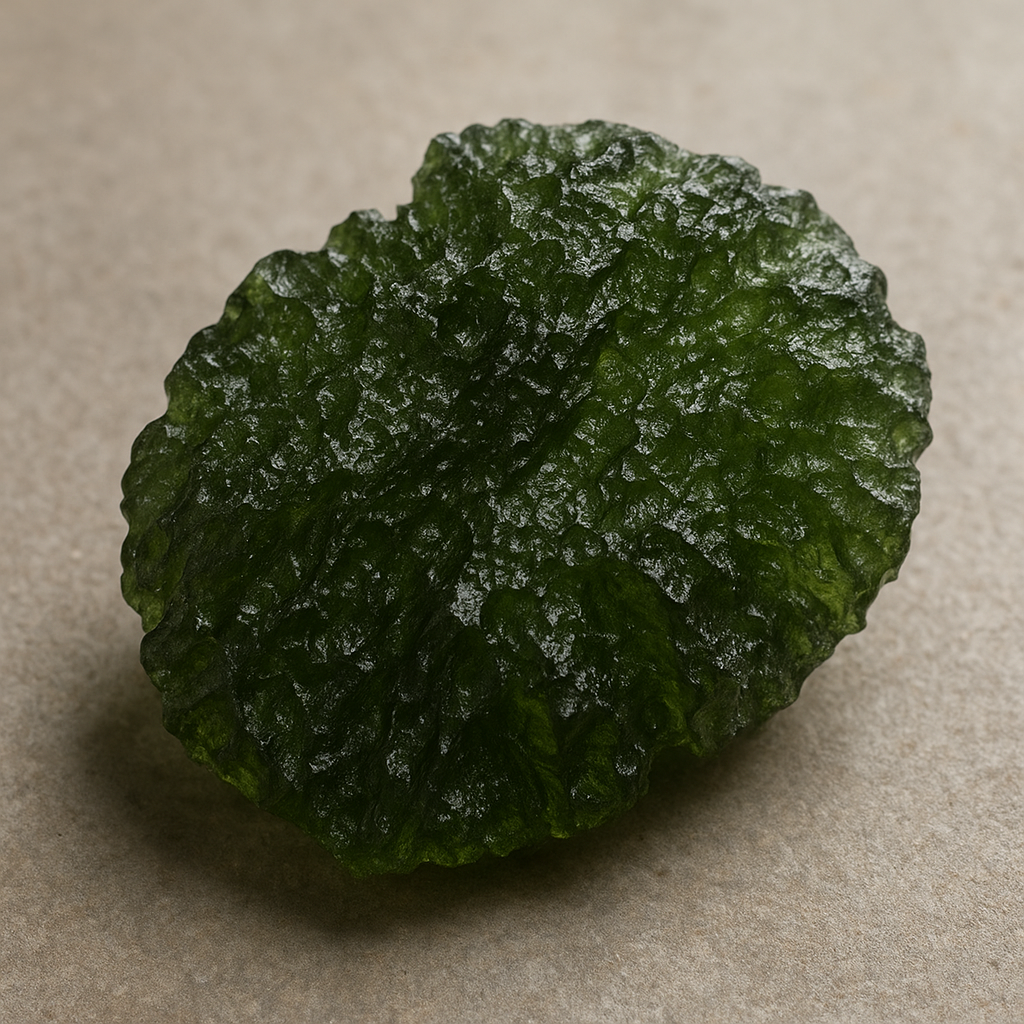
At first glance moldavites look like small, sculpted pieces of natural glass. They range in color from pale olive to deep bottle green, sometimes with brownish overtones. Surfaces are often etched or pitted, with characteristic flow lines and bubble-like inclusions that tell a story of rapid cooling and turbulent flight during formation.
Texture, morphology and sizes
Moldavites occur as nodules, drops, and irregular fragments. Many specimens display a textured exterior produced by chemical weathering during burial as well as the aerodynamic shaping that occurred while the droplets traveled through the atmosphere. Typical pieces used in jewelry weigh a few grams, while larger specimens — prized by collectors — can reach several tens of grams.
Chemistry and glass structure
These glasses are silica-rich relative to many impact-derived materials, and their composition reflects melted target rocks rather than direct meteoritic material. Moldavites are amorphous (non-crystalline) — essentially a natural instance of glass formed by rapid quenching. Common chemical characteristics include a high proportion of silica together with minor oxides such as aluminum, iron, magnesium and alkalis. Microscopic inclusions of lechatelierite (a form of glassy silica produced under extreme heating) and bubble structures are diagnostic of the extreme thermal history associated with their formation.
Physical properties useful for identification
- Appearance: translucent to transparent with distinctive green tones and flow textures.
- Density: relatively low compared to many gemstones (typical of natural silica glasses).
- Hardness: moderate (natural glass hardness ranges around 5–6 on the Mohs scale), so care is needed in cutting and wearing.
- Optical features: internal bubbles, swirls and conchoidal fracture patterns are common.
Uses: jewelry, collection and cultural traditions
Most contemporary uses of moldavite fall into three broad categories: gemstone and jewelry, scientific specimens for research, and objects of personal or spiritual significance.
Jewelry and decorative uses
Moldavite is a popular choice for pendants, rings and earrings because of its uncommon color and texture. Because its hardness is modest, jewelers often set it in protective designs (bezel settings, pendants that minimize abrasion). The most valued pieces are those with intense, even color, minimal inclusions and attractive natural surface sculpting that displays the glass’s flow patterns.
Collecting and specimen preparation
Collectors prize rare shapes, unusually large specimens and examples that preserve exceptional surface texture. Many pieces are sold in their natural, unpolished state; others are lightly cut and polished to reveal internal features. Because moldavite has a strong collector market, provenance and documentation (where a specimen was found) add to its value.
Cultural and metaphysical interest
Moldavite has an established place in modern spiritual and metaphysical communities, where it is often assigned special energetic or transformational qualities. While these beliefs are not scientifically substantiated, they explain part of the rock’s enduring popularity: for many people moldavite is not just a stone but also a symbol, amulet or tool for meditation. Its reputation for bringing change and insight has led to a steady market in spiritual jewelry and talismans.
Authenticity, fakes and identification
Because demand can exceed supply, the moldavite market has attracted imitations and fakes. Differentiating natural moldavite from manufactured green glass or treated materials requires attention to both macroscopic and microscopic features.
Common imitation types
- Commercial green glass cast or tumbled to mimic moldavite color and texture.
- Thermally or chemically altered glass to produce bubble patterns or surface etching.
- Composite or assembled items where a small piece of real moldavite is combined with common glass.
How experts authenticate specimens
Experienced gemologists and collectors use a combination of visual inspection, magnification and—when necessary—instrumental analysis. Hallmark indicators of authenticity include:
- Characteristic flow lines and aerodynamic shaping consistent with quenching in flight.
- Natural pitting and etching patterns produced by weathering over geological timescales.
- Internal inclusions such as lechatelierite and irregular bubble patterns that are difficult to reproduce in mass-market glass.
- Provenance records linked to known Czech localities, which add credibility.
When in doubt, laboratory techniques (e.g., geochemical fingerprinting) can distinguish natural moldavites from look-alike materials by comparing trace-element patterns and isotopic signatures to established references.
Mining, trade and conservation
Historically, moldavites were collected from surface deposits and river gravels. Today, many good specimens still come from artisanal digging in known localities, but commercial-scale extraction and unregulated collecting have raised environmental and legal concerns.
Regulatory and ethical aspects
Governments in the main producing regions regulate collecting to protect landscapes and cultural heritage. Some areas require permits for commercial digging, and illegal or destructive collecting can result in fines. Buyers should be mindful of provenance and prefer ethically sourced specimens to help discourage illicit activities.
Market trends and value drivers
Several factors influence moldavite prices:
- Size and weight — larger pieces command higher prices per gram.
- Color intensity and clarity — deep, clear green specimens are more desirable.
- Surface texture — interesting natural sculpting and intact surfaces appeal strongly to collectors.
- Rarity and provenance — specimens from well-known historic finds or unusual localities can attract premiums.
Because of their restricted geographic range and growing demand, the most collectible moldavites can fetch significant prices on the international market.
Scientific significance and open questions
Beyond their aesthetic appeal, moldavites are scientifically valuable as physical records of high-energy planetary processes. They provide insights into the dynamics of impact ejecta, high-temperature melting, atmospheric transport and rapid quenching of natural melts.
Research applications
- Reconstructing the geometry and energy of the Ries impact event by mapping the distribution of moldavites.
- Understanding glass formation mechanisms under extreme conditions through microstructural analysis.
- Comparative studies with other tektite fields to learn how target rock composition influences resultant glasses.
Questions still under investigation
Although the broad outline of moldavite genesis (Ries impact ejecta) is well supported, detailed questions remain about the flight paths of individual droplets, the cooling rates that produce varied morphologies, and the exact contributions of local target rock heterogeneity to chemical diversity among specimens. Modern analytical tools continue to refine the story, but new findings often raise further interesting questions.
Interesting cultural and historical notes
Moldavites have been woven into local lore for centuries. Their unusual appearance and origin stories led people to attribute supernatural or protective properties to the stones long before modern science linked them to an impact event. In the recent past they experienced renewed popularity during the 20th century with collectors and jewelers in Europe and beyond.
- Toponymic link: the name derives from the Moldau (Vltava) River, marking their historical collection sites.
- Collector culture: central European museums and private collections hold some of the most important historical molds and specimens.
- Modern spirituality: metaphysical communities ascribe emotional and transformative meanings to moldavite, contributing to contemporary demand.
Practical advice for buyers and enthusiasts
If you are considering acquiring moldavite for collection or jewelry, keep the following practical tips in mind:
- Buy from reputable dealers who can provide provenance and authentication when available.
- Examine photos and, if possible, the specimen in hand for natural flow texture, bubbles and characteristic etching.
- Understand care requirements: because moldavite is natural glass with modest hardness, avoid impacts and harsh abrasion; consider protective settings for rings.
- Be cautious of deals that seem too good to be true — low-price moldavite is commonly imitated by mass-produced green glass.
Collecting moldavite can be a rewarding pursuit that connects enthusiasts to an extraordinary geological event and to a long tradition of European natural history. Whether appreciated for scientific significance, decorative beauty or personal meaning, moldavites remain an enduring object of fascination.