
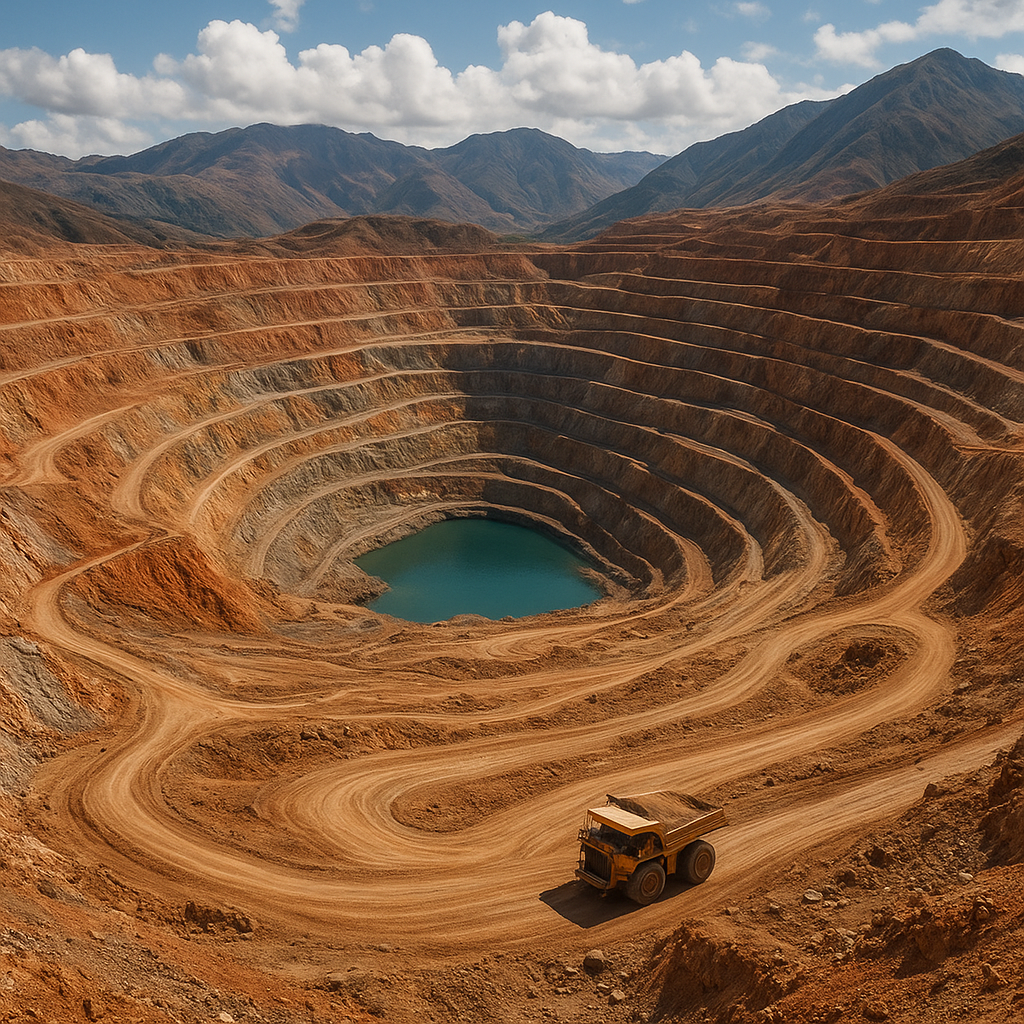
Cerro Verde is one of the most important mining complexes in southern Peru, known above all for its large-scale production of copper. Located on the high Andean plateau near the city of Arequipa, the site has grown from a regional mine into a modern industrial operation that shapes local economies, contributes substantially to national exports, and exemplifies both the opportunities and challenges of contemporary mining. This article examines its location and geology, the nature of extraction and processing, its economic footprint, and several intriguing aspects that make Cerro Verde noteworthy.
Location and geological setting
Cerro Verde lies roughly 20 kilometers west of Arequipa, perched on the western escarpment of the highlands above the coastal plain. The mine occupies a semi-arid, rugged landscape framed by volcanic features and deep canyons. Its elevation and proximity to the city make Cerro Verde geographically prominent: it can be seen from many neighborhoods of Arequipa and is part of the region’s industrial skyline.
Geologically, Cerro Verde is a classic example of a porphyry copper system. Porphyry deposits are large, disseminated bodies of mineralization where copper and other metals are hosted in fractured and altered rock surrounding intrusive igneous bodies. These deposits are typically of low to moderate grade but enormous tonnage, making them viable when mined at scale using open-pit methods. In addition to copper, Cerro Verde contains associated metals such as molybdenum and traces of gold and silver, which are recovered as by-products.
The geology of the area includes multiple phases of hydrothermal alteration and mineral deposition. Weathering and erosion over geological time have left a mineralized cap and an accessible oxide-sulfide interface in places, although most of the economically mined rock is sulfide-dominated and is treated via flotation and concentrate production. The deposit’s size and disseminated character make it well-suited for bulk mining operations rather than selective underground methods.
Mining operations and what is produced
Cerro Verde operates as an open-pit mine. Large shovels and haul trucks remove overburden and ore, which is then crushed and processed in a concentrator. The primary product is copper concentrate, a compact, transportable material that carries most of the copper contained in the mined rock and is sold to smelters and refiners in Peru and abroad. The site also recovers molybdenum as a co-product, generally as a concentrate suitable for sale to the global molybdenum market.
Processing at Cerro Verde uses established mineral processing techniques: crushing, grinding, and flotation. In flotation, finely ground ore is mixed with water and reagents so copper-bearing minerals attach to bubbles and rise as a froth, producing a concentrated product. This concentrate typically contains a much higher percentage of copper than the original ore and is the feedstock for smelting and refining operations that produce cathode copper or other refined products.
Modern expansions and upgrades at the facility have included installation of large-capacity concentrators, tailings handling systems, and supporting infrastructure such as power supply, roads, and water management systems. The aim of such investments is to increase throughput and overall metal output while improving efficiency and safety. As with many major mines, economies of scale govern Cerro Verde’s design: modest grades are compensated by processing huge volumes of rock, producing significant quantities of copper and molybdenum each year.
Economic importance and contribution
Cerro Verde ranks among the most significant mining investments in Peru in recent decades. The mine’s output places it among the country’s leading copper producers, and because copper is one of Peru’s top export commodities, Cerro Verde plays a vital role in national trade balances, public revenues, and foreign exchange earnings. Large mining operations such as Cerro Verde contribute to government coffers through taxes, royalties, and special mining-related levies, and they often form a substantial portion of regional GDP.
Beyond direct fiscal contributions, Cerro Verde’s economic footprint includes employment, procurement, and local development. The mine provides thousands of jobs, both directly in mining, processing, and administration, and indirectly through contractors, suppliers, and service providers. Local businesses—transport companies, equipment suppliers, construction firms, catering, and accommodation services—benefit from long-term contracts and steady demand associated with mine operations and expansion projects.
Capital investment during expansion phases injects vast sums into the local and national economy. A multi-billion-dollar expansion program in the 2010s transformed Cerro Verde’s capacity and had multiplier effects: construction employment, contracted engineering services, and purchases of equipment and materials. These large investments also attract international financing and partnerships, integrating Peru more deeply into global commodities markets.
On the export side, copper concentrate shipped from Cerro Verde supports downstream industries worldwide, from electrical infrastructure to electronics and renewable energy systems. In this way, a ton of copper produced in the Peruvian Andes becomes a part of global value chains, linking a highland mine to manufacturing and end-use markets across continents.
Environmental management and social relations
Large-scale mining in an arid environment raises important environmental and water-management issues. Cerro Verde has needed to address water sourcing, tailings disposal, dust control, and other impacts typical of open-pit operations. Responsible mines implement integrated environmental management plans that include monitoring, mitigation measures, and regular reporting to regulators and communities.
Tailings management is a priority. Tailings—the processed residue from flotation—must be stored securely to avoid contamination and failure risks. Cerro Verde’s expansion involved upgrades to tailings facilities and operational practices to meet modern standards. Water recycling and efficient usage are also central to operations, because the region’s limited freshwater resources mean that mining and urban uses must coexist without depleting supplies.
Community engagement is another critical dimension. The mine’s proximity to Arequipa and to rural communities requires ongoing dialogue, investment in social programs, and attention to local concerns. Mining companies typically develop community relations programs that fund education, health, infrastructure, and training projects. These programs can improve local quality of life and create pathways for local workers to gain employment in the mine and related businesses.
Environmental and social performance is increasingly scrutinized by investors, regulators, and civil society. Cerro Verde’s experience illustrates the balancing act between achieving productivity and maintaining a social license to operate. Transparent communication, participatory planning, and independent monitoring are common features of efforts to address this balance.
Interesting aspects and historical notes
Cerro Verde’s story is not only one of geology and economics but also of engineering scale and regional identity. One intriguing aspect is how the mine’s presence has reshaped perceptions of the Arequipa landscape. From many vantage points within the city, the mine’s terraced benches, conveyor lines, and piling equipment create an industrial skyline that contrasts with Arequipa’s colonial architecture and the volcanic peaks that frame the city.
The mine’s transition from smaller-scale operations to a modern complex involved substantial foreign and domestic partnerships. Large-scale expansions required coordination among engineering firms, financiers, governments, and local stakeholders. These processes illustrate how contemporary mining projects operate at the intersection of technology, finance, and diplomacy.
Another interesting point is the role of technology in modernizing Cerro Verde. Advances in drilling, blasting, haulage, automation, and process control have made it possible to manage very large operations more efficiently and safely than in previous decades. Remote monitoring, fleet management systems, and improved metallurgical practices have reduced costs and increased recoveries, demonstrating how innovation drives resource development.
Cerro Verde also highlights the global nature of mining investment. Equipment, expertise, and capital flow across borders: heavy mining equipment originates from global manufacturers, finance may come from international banks and investors, and concentrate buyers are found in multiple countries. This international linkage both stabilizes and exposes operations to global market dynamics—copper prices, currency fluctuations, and geopolitical developments all influence the mine’s economics.
Finally, the mine’s coexistence with agriculture and traditional livelihoods in the surrounding valleys presents a microcosm of broader development challenges. While the mine provides jobs and infrastructure, it also competes for land, water, and labor. Efforts to reconcile these competing needs—through water conservation projects, joint planning, and benefit-sharing—are part of the ongoing narrative of Cerro Verde and similar large mining projects worldwide.
Future prospects
Looking ahead, Cerro Verde’s future will be shaped by a combination of resource characteristics, commodity markets, technology, and social license. Continued investment in processing efficiency, environmental safeguards, and community programs can extend the mine’s productive life while reducing impacts. At the same time, global trends—such as rising demand for copper driven by electrification and renewable energy—may bolster the mine’s strategic importance.
However, future expansion or prolonged operation will require careful management of environmental risks, adaptive strategies to water scarcity, and sustained engagement with local communities and authorities. The interplay between technical feasibility and social acceptance will determine the trajectory of Cerro Verde in the decades to come, as Peru continues to balance resource development with broader national priorities.

