Iolite is a fascinating blue-to-violet gemstone with a long geological and cultural story. Often admired for its striking color and dramatic optical behavior, this mineral occupies a special place both in the world of jewelry and in certain industrial applications. The text below examines iolite from several angles: its mineralogy and optical phenomena, where it is found, how it is used in jewelry and industry, and the cultural and historical contexts that make it one of the more intriguing gemstones collectors and designers turn to today.
Origins and Geological Formation
Iolite is the gem-quality variety of the mineral cordierite, a silicate whose general formula can be written as (Mg,Fe)2Al4Si5O18. It typically forms during medium- to high-grade metamorphism of aluminous rocks and in some igneous settings. Under geological processes that involve heat and pressure, aluminum- and magnesium-rich protoliths reorganize into new mineral assemblages; in such environments, cordierite crystals grow together with minerals like garnet, staurolite, kyanite, and sillimanite. Iolite can also appear as phenocrysts in rhyolitic and other felsic volcanic rocks, where it crystallizes from silica-rich melts.
The crystal structure of cordierite is orthorhombic and can form tabular or prismatic crystals. Chemical substitutions are common—iron (Fe) readily replaces magnesium (Mg) in the lattice—leading to chemical and color variability across localities. Because of these substitutions and its layered structure, cordierite exhibits a suite of optical and physical properties that are both scientifically interesting and practically useful.
Physical and Optical Properties
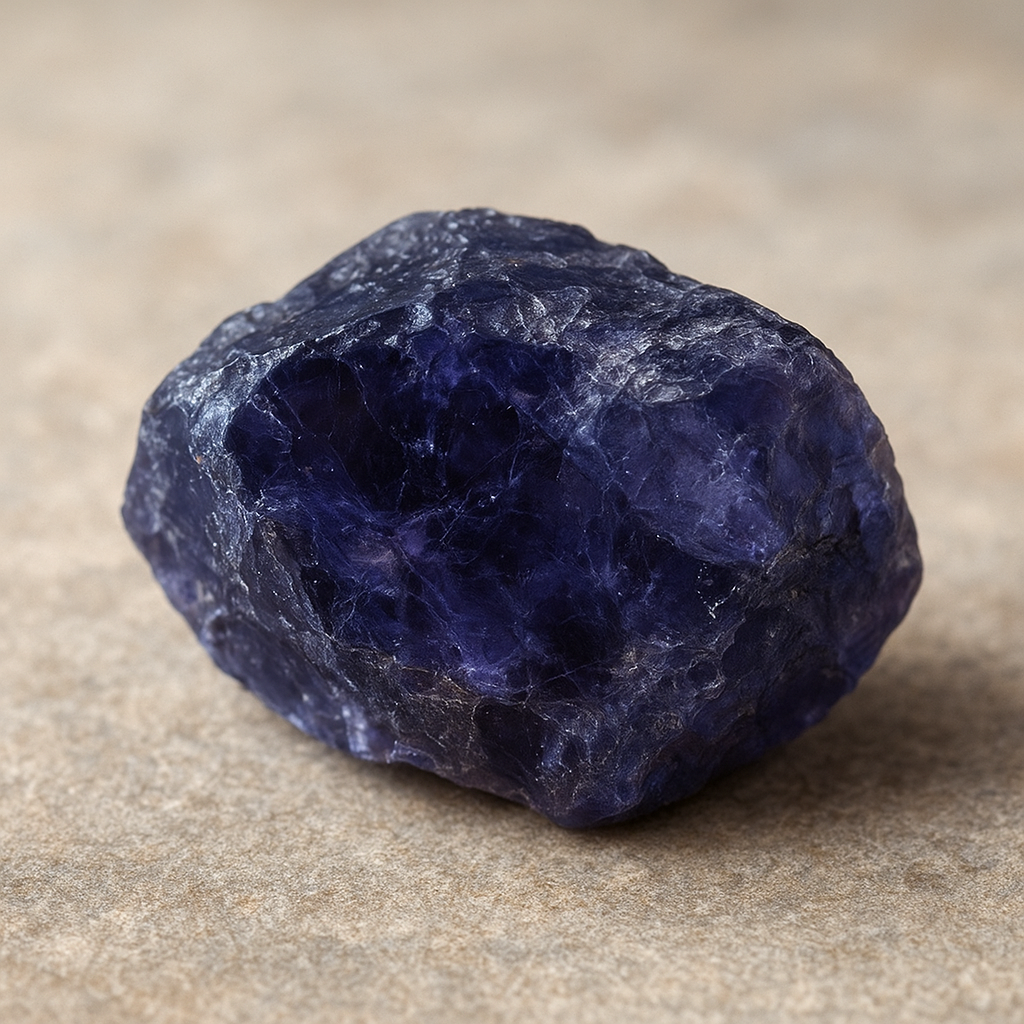
Iolite is prized primarily for its intense and variable coloration and its dramatic optical effects. The gemstone commonly ranges from pale blue through intense violet-blue to grayish or yellow-brown tones. What truly sets iolite apart is its strong pleochroism: the stone shows different colors depending on the direction of observation and the orientation of light passing through it. Typical pleochroic colors include shades of blue, violet, and yellow-brown, and gem cutters orient rough stones to maximize the desirable blue-violet face-up color.
Key physical properties include a Mohs hardness of roughly 7.0 to 7.5, making iolite fairly durable for everyday wear if properly set. Its specific gravity typically ranges from about 2.5 to 2.7. Optical properties such as refractive indices vary slightly with composition; cordierite generally displays low to moderate refractive indices and weak to moderate birefringence. These parameters, combined with pleochroism, help gemologists identify iolite in the laboratory.
Pleochroism: How and Why It Matters
Pleochroism in iolite arises from its crystal structure and the presence of transition metals like iron. Light traveling through the crystal is absorbed differently along different crystallographic axes, so an iolite oriented one way may look deep blue, while the same stone rotated 90 degrees may appear yellowish-brown. Because pleochroism can be so marked, the cut and orientation of an iolite gem are crucial: a stone cut to show its deepest blue from the table will display the color most consumers expect, whereas a poorly oriented cut can reveal undesirable brown or gray tones when viewed face-up.
Geographic Distribution and Mining Locations
Iolite and gem-quality cordierite are found in a variety of geologic settings worldwide. Some localities are renowned for producing large, clean, and vividly colored stones that enter the gem market; others supply materials better suited for industrial use. Notable sources include:
- Madagascar – Produces high-quality blue-violet gems that are often well suited for jewelry.
- Sri Lanka – Historically important as a source of gem-grade iolite and other blue gemstones.
- India – Several districts produce gem material and rough used in faceting.
- Tanzania and Mozambique – African deposits that contribute to global supply.
- Myanmar (Burma) – Producer of some intense-hued stones, though quantities may be limited.
- Brazil – Source of various gem-quality minerals including iolite.
- Norway and other parts of Scandinavia – Known localities for cordierite occurrences in metamorphic terrains.
- United States & Canada – Several localities yield cordierite specimens used for collection or occasionally cut into gems.
Production volumes fluctuate with market demand, accessibility of deposits, and challenges of mining in remote regions. Small-scale operations and artisanal miners often extract iolite from alluvial deposits, while larger deposits may be mined from bedrock exposures in metamorphic terrains.
Uses in Jewelry and Gemology
Iolite’s primary and most visible role is as a gemstone. Its vivid blues rival other popular stones, and its relative affordability compared to sapphire or tanzanite makes it an attractive option for designers and consumers seeking a distinctive look without the higher price tag. Here are several aspects of iolite in jewelry:
- Cutting: Gem cutters orient iolite to showcase the best face-up color, typically using oval, cushion, or round cuts. Step cuts and mixed cuts are common, but the cutter’s knowledge of pleochroism determines final appeal.
- Settings: Due to its hardness, iolite can be used safely in rings, pendants, and earrings. Prong and bezel settings are both common; bezel settings can protect the girdle and edges.
- Color variations: Blues and violets command higher prices, while stones showing strong brown or gray tones tend to be less sought after unless heat treatment or reorientation improves color.
- Affordability: Iolite often fills a price niche between commercial semi-precious stones and more costly sapphires or tanzanites, appealing to buyers who value color and optical intrigue.
Market and Cutting Considerations
Because pleochroism changes the apparent color depending on facet orientation, experienced cutters spend extra time determining the best orientation of the rough to produce the most desirable face-up color. Unlike some stones that are frequently heat-treated or irradiated to enhance color, high-quality iolite is commonly sold untreated; its natural color and optical behavior are part of the appeal. Iolite’s stability under typical jewelry-wearing conditions means it can be used with confidence, provided standard care recommendations are followed.
Industrial and Scientific Applications
Beyond its role as a gemstone, cordierite—the mineral underlying iolite—has important **industrial** applications because of its physical properties. While gem-quality iolite is a small part of the overall cordierite output, synthetic and natural cordierite materials are used where low thermal expansion and strong resistance to thermal shock are required.
- Kiln furniture: Cordierite ceramics are widely used to make supports, shelves, and other components that must withstand rapid temperature changes without cracking.
- Catalytic converters: Historically, cordierite honeycomb substrates have been used in automobile catalytic converters because they tolerate rapid temperature changes and provide a stable support for catalytic coatings.
- Refractories and thermal insulation: Cordierite’s thermal stability makes it useful in specialized refractory applications where resistance to thermal shock reduces failure rates.
- Research: Natural cordierite offers a model system for studying phase equilibria and metamorphic reactions in aluminum-rich rocks; its chemistry helps geologists interpret pressure-temperature histories of metamorphic terrains.
These industrial uses highlight how a mineral prized for its beauty at the gem scale also contributes substantially to engineering and research. In many cases, the cordierite used industrially is synthesized or processed to achieve specific textural properties suited to the application.
Cultural, Historical, and Mythical Associations
Iolite has accumulated a number of cultural stories and historical associations that add to its mystique. The name iolite derives from the Greek ios, meaning “violet,” a nod to its characteristic color. Historically, smaller quantities of blue cordierite were used in jewelry and ornamental objects across different cultures.
One of the more evocative claims found in popular accounts is that some navigators used specially oriented crystals—possibly iolite—to locate the position of the sun on cloudy days. This has led to the romanticized label Viking sunstone for certain transparent, strongly pleochroic crystals. Laboratory and experimental studies have demonstrated that some pleochroic minerals can polarize light or allow finding the sun’s direction under certain conditions, but the identification of iolite as the historical material used by Vikings is still debated among researchers. The story persists as part of the lore around iolite and captures how optical properties can influence human use and myth.
Identification, Imitations, and Treatments
Identifying iolite relies on a combination of visual inspection and gemological testing. Key diagnostic features include:
- Strong pleochroism—typically blue, violet, and colorless or yellow-brown shades.
- Moderate hardness (about 7–7.5 on the Mohs scale).
- Characteristic refractive index and low to moderate birefringence observable under proper instrumentation.
- Typical inclusions: two-phase inclusions, fine needles, or characteristic growth zoning in some specimens.
Iolite is sometimes compared to or substituted for other blue stones such as sapphire and tanzanite. While imitations (e.g., glass or synthetic spinel) exist, straightforward gemological tests can distinguish these materials. Iolite is rarely artificially colored or treated because its natural color and pleochroic properties are what buyers typically seek. Heat treatments common for stones like tanzanite are uncommon with iolite.
Distinguishing from Similar Gems
A gemologist will note pleochroism as the simplest visual clue: iolite’s three-way pleochroism is often more pronounced than that of sapphire, and its refractive indices are lower. Instruments such as a refractometer, polarizing filter, and microscope make identification reliable. Because iolite is not frequently synthesized for the gem market, encountering a laboratory-grown iolite is rare, simplifying provenance questions for many buyers.
Care and Practical Recommendations for Wearers
Iolite’s moderate hardness makes it suitable for many jewelry forms, but prudent care will prolong its life and beauty. Follow these general guidelines:
- Clean with warm soapy water and a soft brush. Rinse thoroughly to remove soap residue.
- Avoid strong acids and prolonged exposure to harsh chemicals (household bleach, concentrated acids) that could damage settings or affect inclusions.
- While generally stable to heat, avoid sudden extreme temperature changes which could stress the stone—especially important for specimens with internal fractures or inclusions.
- Store separately or wrapped to minimize scratching other gems or being scratched by harder stones like diamond or corundum.
For jewelry repair or resizing, it is advisable to remove iolite rings because soldering and heating could subject the gem to thermal stresses. Professional jewelers can advise on safe working procedures that protect the stone.
Collecting, Value, and Market Trends
Iolite occupies a market niche between commonly affordable semiprecious stones and higher-priced blue gems such as sapphire. Several factors influence its value:
- Color intensity and uniformity—clean deep blue-violet stones command higher prices.
- Clarity—transparent, eye-clean stones fetch premium prices compared to included specimens.
- Cut quality and orientation to maximize pleochroic effect.
- Carat weight—large, well-colored pieces are rarer and increasingly valued.
Collectors often prize particularly fine specimens for their color and optical show; museum pieces and large, gem-quality crystals from notable localities can become sought-after for cabinet collections. Designers value iolite for its ability to offer an alternative blue that balances beauty and affordability.
Interesting Scientific and Aesthetic Notes
Iolite is a fine example of how subtle changes in crystal chemistry and structure yield striking optical phenomena. Its pleochroism has practical implications for gem cutting, navigational lore, and scientific study. In addition:
- The mineral’s response to pressure-temperature paths helps geologists reconstruct metamorphic histories of terrain where it occurs.
- Its layered structure and compositional variability make cordierite a subject of interest in mineralogy and materials science, particularly where thermal properties are important.
- Aesthetically, the gem offers designers a palette that shifts with movement: an iolite ring will play different blues and violets as the wearer moves in light, creating a dynamic visual experience.
For anyone interested in a gemstone that combines geological significance, practical industrial relevance, and visual intrigue, iolite represents a compelling choice. Its story spans rocks deep in the Earth, the hands of gem cutters who coax out its best face-up colors, and even the imaginations of those who see in it the possibility of lost navigational tools once used by mariners of old.