Kyanite is an intriguing and versatile mineral that captivates both geologists and industry professionals. Known for its distinctive blade-like crystals and striking colors, it occupies a special place among the three Al2SiO5 polymorphs along with andalusite and sillimanite. This article explores the mineral’s geological setting, physical and chemical characteristics, practical applications in modern industry and jewelry, and several interesting aspects that highlight why kyanite remains an important subject in earth sciences and technology.
Geology and Global Occurrence
Kyanite is a member of the aluminosilicate group, with the chemical formula Al2SiO5. It typically forms under conditions of relatively high pressure and low-to-moderate temperature during regional metamorphism. Because its stability field overlaps with those of andalusite and sillimanite, finding kyanite in a rock is a valuable indicator of the pressure-temperature (P–T) path that the rock experienced. Geologists frequently use the presence of kyanite as an index mineral to help reconstruct metamorphic histories.
Typical Geological Environments
- Regional metamorphic terrains where pelitic (clay-rich) protoliths have been subject to high pressures, often in collisional orogenic belts.
- Metamorphosed sedimentary rocks such as schists, gneisses and some migmatites.
- Veins and pockets within high-pressure metamorphic rocks, occasionally associated with quartz and mica.
Notable Deposits and Countries
Kyanite occurs around the world. Some important localities include:
- United States: notable deposits in North Carolina, Virginia and Georgia—important historically and currently for industrial kyanite.
- Brazil: several high-quality gem and industrial deposits, with some gem-grade blue material exported for lapidary use.
- India: major producer of kyanite for ceramic and refractory use.
- Nepal: source of gem-quality crystals, sometimes cut for collectors.
- East Africa: occurrences in Tanzania and Kenya with both gem and industrial potential.
- European localities: Austria, Czech Republic and Switzerland historically produced kyanite specimens.
In natural settings, kyanite is commonly associated with minerals such as garnet, staurolite, staurolite, muscovite, biotite and quartz—part of the mineral assemblages typical of medium- to high-pressure metamorphism.
Physical and Chemical Properties
Kyanite’s properties are distinctive and often cited in mineralogy teaching because of its unusual anisotropy. Its crystals are typically bladed or columnar and may reach several centimeters in length. Key physical and chemical attributes include:
- Chemical formula: Al2SiO5 (an aluminosilicate).
- Crystal system: triclinic, which produces elongated, bladed habits.
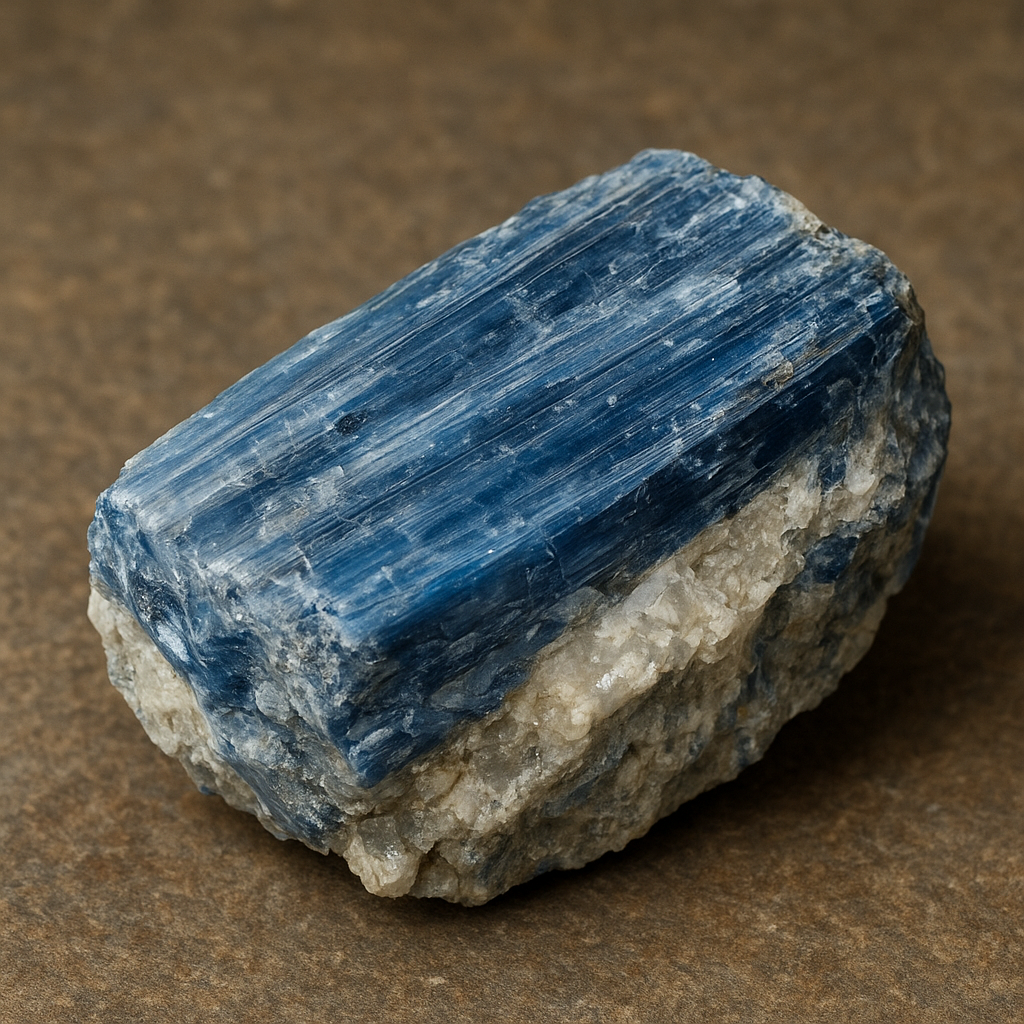
- Color: most commonly blue (ranging from pale to intense), but also white, gray, green, or nearly colorless; darker shades arise from iron or other impurities.
- Luster: vitreous to pearly on cleavage surfaces.
- Hardness: highly anisotropic — hardness varies with crystallographic direction, typically about 4.5 parallel to the long axis and about 6.5 perpendicular to it. This makes cutting and handling gem-quality material challenging.
- Cleavage: pronounced in one direction; the mineral displays perfect to distinct cleavage, which is important for both gem cutters and industrial users.
- Specific gravity: roughly 3.6 to 3.7, depending on composition and impurities.
The name kyanite derives from the Greek word kuanos, meaning dark blue, reflecting the classic color that often attracts gem collectors. Structurally, the mineral’s anisotropic properties stem from the arrangement of aluminum and silicon polyhedra within the crystal lattice—this influences mechanical strength, thermal behavior, and transformation reactions when heated.
Polymorphism: Kyanite, Andalusite, and Sillimanite
Kyanite is one of three polymorphs with the composition Al2SiO5. The three minerals—kyanite, andalusite, and sillimanite—are stable under different P–T conditions. Their relationships are crucial for geologists:
- Kyanite forms at high pressure and lower temperatures relative to sillimanite.
- Sillimanite forms at higher temperatures and lower pressures relative to kyanite.
- Andalusite forms at lower pressures and moderate temperatures.
Because of these defined stability fields, transitions among these polymorphs (or their presence/absence in a rock) provide direct clues to metamorphic conditions and tectonic settings.
Industrial Uses and Applications
Kyanite’s thermal behavior and alumina content make it an important raw material in several industrial processes. When heated, kyanite undergoes a transformation to mullite (3Al2O3·2SiO2) and free silica; this reaction is accompanied by volume changes that are exploited in manufacturing.
Major Industrial Applications
- Refractories and high-temperature ceramics: Kyanite is used to produce heat-resistant bricks, kiln furniture and castables. Upon heating, the formation of mullite gives excellent high-temperature strength and thermal shock resistance. This makes kyanite valuable in steel, glass and cement industries.
- Foundry and investment casting: Kyanite-containing molds can withstand high thermal stresses and provide excellent dimensional stability during metal casting.
- Ceramic bodies and porcelain: Kyanite contributes to the development of thermally stable ceramics and electrical insulators.
- Abrasives and grinding: lower-grade kyanite can be used as an abrasive component where hardness and chemical stability are needed.
- Concrete and refractory aggregates: as a filler and aggregate that improves high-temperature performance.
Industrial kyanite is typically valued on parameters such as alumina content, silica proportions, and freedom from deleterious impurities (iron oxides, titanium, etc.). Purity affects both the processing behavior and the final mechanical properties of refractory products.
Manufacturing Considerations
Kyanite processing involves crushing, grinding and sizing. In many production chains, the mineral is beneficiated by washing and gravity separation to remove gangue. The finer size fractions are used in ceramics and refractories, while coarser lumps may be sold directly for specialized applications. The thermal expansion behavior of kyanite must be carefully managed: its expansion during conversion to mullite can be useful (controlled expansion of refractory shapes) but problematic if unpredictable expansion leads to cracking.
Gemology and Jewelry
Though more commonly an industrial mineral, kyanite can be fashioned into attractive gemstones when gem-quality crystals are available. Gemological interest centers on the mineral’s striking blue varieties and on rarer colors such as blue-green, violet, and orange.
Gem Characteristics and Cutting Challenges
- Optical properties: kyanite often displays pleochroism (color change depending on crystal orientation), which can be a feature exploited by lapidaries to maximize color. It may show strong dichroism and variable brilliance.
- Hardness anisotropy: because the hardness varies drastically with direction, cutting and faceting require great skill. A cutter must orient the stone to reduce chipping and to make use of the best color plane.
- Clarity and inclusions: gem-quality kyanite can be relatively clean, though typical specimens may include rutile needles or other inclusions that can enhance or diminish visual appeal.
- Settings and wearability: due to directional hardness and pronounced cleavage, kyanite is best suited to pendants and earrings rather than rings for everyday wear—though protective settings can mitigate risk.
Kyanite is sometimes marketed as an affordable blue gemstone alternative to tourmaline or aquamarine, prized by collectors for its typically vivid coloration and unique crystal habit. High-quality transparent blue kyanite is relatively rare and commands higher prices in the gem market.
Synthesis, Transformation and Related Materials
Understanding kyanite’s high-temperature behavior is important for both geology and industry. When heated, natural kyanite transforms irreversibly into mullite and crystalline silica (or glassy silica depending on conditions). This transformation has been harnessed in engineering:
- Mullite products: by firing kyanite-containing ceramics under controlled conditions, manufacturers produce mullite-based ceramics prized for their thermal stability and mechanical durability.
- Artificial alumino-silicate refractories: alternatives such as synthetic alumina or fused cast refractory products sometimes compete with kyanite-based materials, but natural kyanite remains an economical option in many regions.
- Experimental synthesis: researchers can synthesize kyanite in laboratory settings to study phase relations among Al2SiO5 polymorphs, often using high-pressure apparatus to recreate metamorphic conditions.
Environmental and Economic Considerations
The commercial extraction and processing of kyanite bring both economic benefits and environmental responsibilities. Mining operations create local employment and supply raw materials for critical high-temperature industries, but they also raise questions about land disturbance, water usage and energy consumption during processing.
Economic Role
- Markets: demand for industrial kyanite correlates with steel, glass and refractory markets; demand for gem-quality kyanite depends on aesthetic trends and collector interest.
- Producers: countries such as India, Brazil and the United States are among key suppliers; price differentiation exists between industrial-grade material and gem-grade crystals.
Environmental Impact and Mitigation
- Environmental impact: like other mined minerals, kyanite extraction can cause habitat disruption, dust and water runoff if not properly managed.
- Mitigation strategies: modern mines often implement progressive rehabilitation, water treatment, dust suppression and reclamation programs. Efficient beneficiation reduces waste and increases the yield of valuable material.
- Recycling and substitution: in certain industrial contexts, engineered materials can partly substitute for natural kyanite, affecting long-term demand and enabling more sustainable supply chains.
Interesting Scientific and Cultural Notes
Kyanite occupies a unique niche at the intersection of pure science and practical application. A few points of interest:
- Geothermobarometry: the presence of kyanite vs. sillimanite or andalusite provides an accessible way for students and researchers to infer metamorphic pressures and tectonic histories of mountain belts.
- Crystal habit and aesthetics: blade-like kyanite crystals are highly prized by collectors for display specimens, especially when transparent and vividly colored.
- Historical names: kyanite has been known by older names such as disthene (from Greek meaning “two strengths,” reflecting anisotropic hardness), a nod to its unusual properties.
- Scientific research: kyanite and its polymorphs remain subjects for experimental petrology, mineral physics and materials engineering studies focusing on phase transitions and high-temperature ceramics.
Practical Advice for Collectors and Users
If you are a collector, lapidary or industrial user considering kyanite, the following points are useful:
- For collectors: look for sharp, lustrous blades with minimal surface damage and good color saturation. Blue specimens from well-known localities often command collector interest.
- For gem buyers: ask about orientation and cutting direction; pleochroism and anisotropic hardness mean that two stones of similar color can behave very differently in wear.
- For industrial buyers: evaluate chemical purity, grain size and thermal behavior; test firing is often done to check for expansion and conversion to mullite under production conditions.
Whether encountered in a thin section under the microscope, as a vivid blue gem on a display card, or as a key raw material in refractory manufacturing, kyanite demonstrates how a single mineral can bridge scientific insight and industrial utility. Its role as an indicator of metamorphic conditions, combined with practical applications that exploit its transformation into mullite, secures kyanite’s place as both a subject of study and a valuable commodity.