
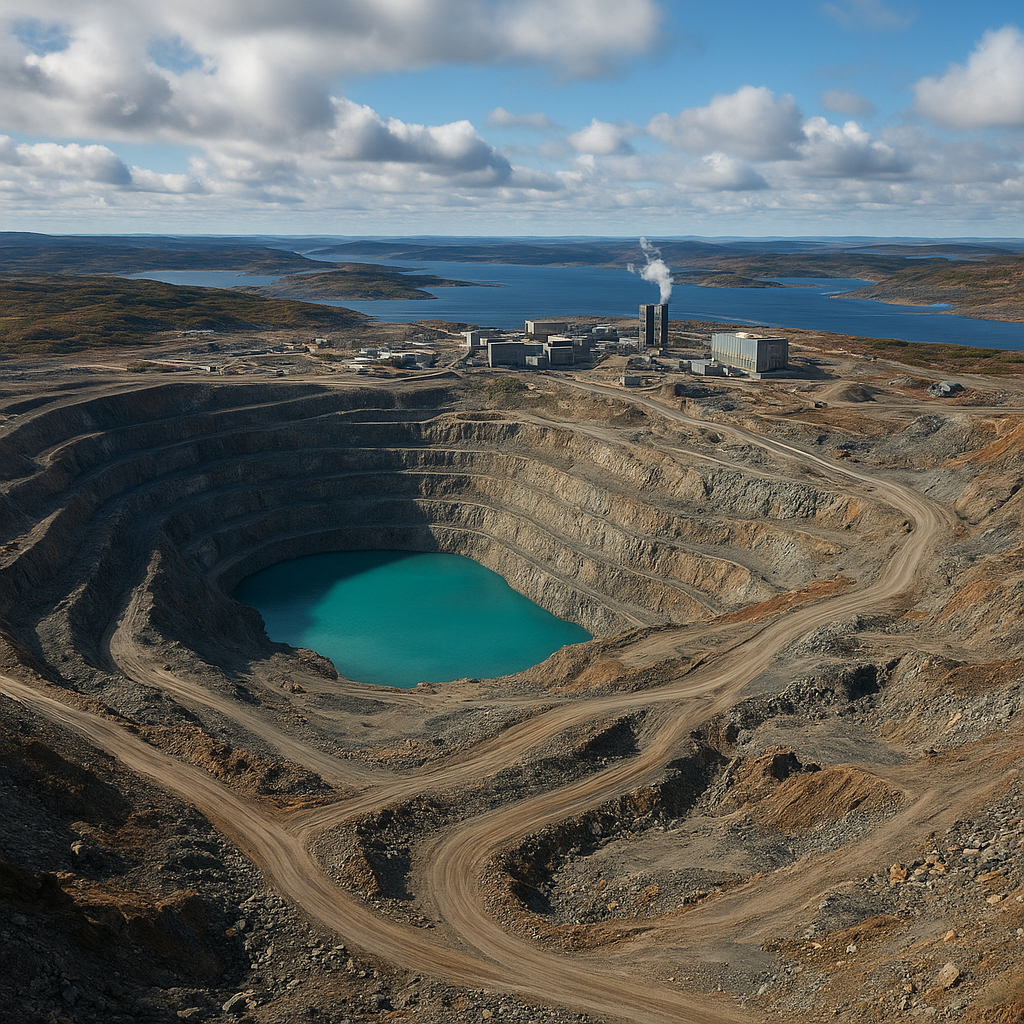
The Voisey’s Bay deposit, located on the northeastern coast of Labrador, is one of the most important modern discoveries of magmatic sulphide mineralization in North America. This remote coastal site has become synonymous with high-grade deposits of nickel, copper and cobalt and has had a lasting effect on regional development, Indigenous relations and the global supply of strategic metals. The following article explores where Voisey’s Bay is, what is extracted there, how the project affects the economy and communities, and several notable technical, environmental and historical aspects that make this site especially interesting.
Where Voisey’s Bay is located and its geological setting
Voisey’s Bay sits on the coast of Labrador in the province of Canada, north of the island of Newfoundland and relatively close to the small coastal communities that characterize the region. The deposit occupies a rugged, subarctic landscape where the sea meets exposed Precambrian bedrock. Accessibility is seasonal and largely by ship and air, emphasizing the remote character of the site.
Geologically, Voisey’s Bay is a classic example of an intrusion-hosted magmatic sulphide deposit. These deposits form when sulphide liquids segregate from a mafic–ultramafic magma and scavenge chalcophile metals such as nickel, copper and cobalt as they accumulate in structural traps or at the base of an intrusion. The mineralization at Voisey’s Bay occurs in several orebodies and zones hosted within mafi c-ultramafic intrusions and associated country rocks. The sulphide mineral assemblage typically includes pentlandite, chalcopyrite and other nickel–copper sulphides, often with appreciable by-products including platinum-group elements and other trace metals.
The combination of high-grade sulphide minerals and relatively concentrated orebodies made Voisey’s Bay stand out to exploration geologists, and its coastal location, though remote, enabled practical shipping solutions that supported mine development once a workable plan was in place.
What is mined at Voisey’s Bay and how it is processed
The principal commodities produced from Voisey’s Bay are nickel, copper and cobalt, with by-products that can include platinum-group elements and other minor metals. Nickel is the dominant metal in terms of economic value and is the primary reason the deposit attracted high-profile corporate interest and investment.
Extraction at Voisey’s Bay has involved a mix of open-pit and underground mining techniques, adapted to the geometry of individual orebodies and local environmental constraints. On-site the mined ore is crushed and concentrated into a nickel–copper concentrate using flotation and conventional mineral processing techniques. Historically, concentrates have been shipped to downstream processing facilities that convert concentrates into refined metal products or precursor materials suitable for smelting and refining.
To add value and capture a larger portion of the supply chain, a hydrometallurgical processing facility was established at Long Harbour on the island of Newfoundland to treat Voisey’s Bay concentrates. This onshore plant enables the conversion of concentrate into nickel and cobalt intermediate products (such as mixed hydroxide precipitate or other refined intermediates) that are suitable for global markets, including stainless steel and battery supply chains. The integration of mine-site concentration and onshore processing represented a strategic move to increase local economic benefit and to reduce the logistics of sending raw concentrates long distances for refinement.
Economic significance at regional, national and global levels
Voisey’s Bay has considerable economic importance at multiple scales. At the provincial and regional level, the mine and its associated operations have provided direct employment, high-paying technical and trades positions, and indirect jobs through contractors, suppliers and local service industries. The project has driven infrastructure spending—ports, air links and support facilities—benefitting communities across Newfoundland and Labrador.
From a national perspective, Voisey’s Bay contributed to Canada’s standing as a supplier of strategic metals. Nickel is essential to the stainless steel industry and is increasingly important to growing battery technologies for electric vehicles and grid storage. The availability of domestic supplies reduces dependence on imports and strengthens industrial security for critical supply chains.
Globally, the deposit helped to influence nickel markets in the late 20th and early 21st centuries by adding material to world supplies at a time when demand was rising. The presence of cobalt—a key battery metal—enhanced Voisey’s Bay’s strategic value, since cobalt remains a sought-after element for energy storage technology and specialty alloys. Revenues from metal sales, royalties and taxes have contributed to public finances and have underpinned community investments and development funds.
History, ownership, and Indigenous agreements
The discovery and development of Voisey’s Bay is a story of exploration success, corporate transactions and negotiated community agreements. After its discovery, the deposit attracted major corporate interest due to its size and grade. The project was taken from exploration phase through feasibility and construction by major mining firms with the capital and technical capability to develop such a remote, high-value site.
Crucially, the Voisey’s Bay project involved extensive consultation and negotiated agreements with local Indigenous groups, particularly the Labrador Inuit and other regional stakeholders. These agreements covered employment, training, business opportunities for local suppliers, environmental monitoring and revenue sharing in various forms. Impact and benefit agreements (IBAs) and similar instruments aimed to ensure local communities had a voice in project design and operations and to secure tangible economic benefits for Indigenous populations affected by development.
Ownership of the operation has changed hands through time as corporate mergers and acquisitions reshaped the global mining industry. The asset eventually fell under the control of firms with international reach, who invested in both mine operations and downstream processing to maximize value creation in Canada.
Environmental and technical challenges
Operating a mine in a northern coastal environment presents specific environmental and technical challenges. Permafrost, harsh winters, short construction seasons and sensitive marine and terrestrial ecosystems require carefully designed engineering and mitigation measures. Tailings management, water treatment, and protection of fisheries and coastal habitats are central concerns for regulators and stakeholders.
At Voisey’s Bay, modern environmental practice has included measures for containment of tailings, treatment of process water, progressive reclamation of disturbed areas and continuous environmental monitoring. Shipping concentrate along marine routes requires careful timing and safeguards to minimize risks to marine life and fisheries, which are important to local livelihoods.
Technical innovation also plays a role. The project has made use of advances in underground mining, remote operations management, and ore-processing methods to reduce energy use and increase recovery rates. The Long Harbour hydrometallurgical facility, for example, uses processes designed to recover nickel and cobalt in forms that meet modern market specifications and environmental standards.
Social impacts and community development
Beyond direct employment, Voisey’s Bay influenced education, training and long-term economic planning for Labrador. Project owners and governments invested in skills development programs and community-based employment initiatives designed to ensure that local residents could access the jobs created by the mine and processing plant. Small-business opportunities—transport, accommodation, catering and maintenance—also grew in response to project demand.
Equally important were the cultural and social dimensions: the influx of workers, the construction of facilities, and heightened economic activity changed community dynamics. Sustained investment in community programs, infrastructure and health services is often required to manage rapid change. Agreements that include clauses for local hiring, training scholarships and business development funds help align mining benefits with community priorities, although there are always ongoing debates about long-term sustainability and post-mine economic transitions.
Interesting technical and historical points
- Voisey’s Bay is widely regarded as one of the most significant nickel discoveries in recent Canadian history; its discovery re-energized exploration efforts in similar geological terrains.
- The deposit highlights the science of magmatic sulphide systems: a single intrusion can concentrate multiple valuable metals in economically recoverable grades, illustrating how geology and tectonics combine to create world-class deposits.
- Integration of mine-site concentration with an onshore hydrometallurgical plant demonstrates a strategic approach to capture more value within the host country rather than exporting raw concentrates overseas.
- Voisey’s Bay brought together corporate, governmental and Indigenous stakeholders in complex negotiations that set precedents for benefit-sharing and environmental agreements in northern resource projects.
- The site’s remote location created logistical challenges that were met with innovative solutions for transport, seasonal scheduling and modular construction techniques tailored for the Arctic-subarctic environment.
Market context and future perspectives
The metals extracted at Voisey’s Bay—most notably nickel and cobalt—remain critical to both traditional industrial markets and emerging technologies. Nickel is indispensable for stainless steel and specialty alloys, and certain nickel chemistries are increasingly relevant for batteries in electric vehicles. Cobalt, although the subject of supply-chain diversification efforts, continues to be an essential component in many battery cathode chemistries.
Market dynamics—prices, demand for battery metals, regulatory trends and environmental policy—will influence the future scale and character of production at Voisey’s Bay and at similar deposits worldwide. Investments in downstream processing, recycling and alternative battery chemistries could reshape demand, but high-quality primary orebodies will remain important for decades.
From a regional perspective, the legacy of Voisey’s Bay will depend on long-term planning: whether revenues are invested in diversified economic activities, education and infrastructure that remain after mine life concludes. Projects that pair responsible environmental stewardship with robust community development planning are more likely to leave positive and lasting legacies.
Notable names and infrastructure connected to the project
A number of corporate and local actors have been central to Voisey’s Bay’s development and continued operation. Major mining firms with global reach provided the capital and technical expertise to move from discovery to production. The development of a downstream processing hub at Long Harbour (on Newfoundland’s Avalon Peninsula) exemplifies efforts to add value within the province and to create industrial capacity beyond extraction.
Engagements with local and regional Indigenous organizations, notably the Labrador Inuit and related institutions, shaped project frameworks for employment, environmental monitoring and benefits. These collaborations showcase evolving approaches to resource development in Canada’s North where respect for Indigenous rights and shared decision-making are increasingly integral to project success.
Closing observations
Voisey’s Bay stands as a significant chapter in Canadian resource history: a high-grade nickel–copper–cobalt deposit developed in a challenging environment, linked to downstream processing to capture greater value, and shaped by complex social, environmental and economic negotiations. Its role in supplying strategically important metals and in advancing approaches to northern development and Indigenous partnerships ensures that Voisey’s Bay will be studied and referenced for years to come.

