
Ytterbium is a quietly influential member of the lanthanide series whose properties and applications touch fields from precision timekeeping to high-power industry lasers and cutting-edge quantum research. Found only in trace amounts in rare-earth minerals, this soft, silvery metal and its ions have a disproportionate impact on modern technology, materials science, and fundamental physics. The following sections explore where ytterbium occurs, how it is processed, what makes it chemically distinctive, and the varied applications that turn a relatively obscure element into a strategic resource.
Origins, geology and occurrence
The element with atomic number 70 belongs to the group commonly called the rare-earths, a family of chemically similar elements that are actually widespread but rarely concentrated in economically exploitable deposits. Ytterbium takes its name from the village of Ytterby in Sweden, the same locality that lent its name to several other elements. It was first recognized as distinct in the late 19th century and later separated from the complex mixtures in rare-earth ores.
Ytterbium is not found as a free element in nature. Instead it is dispersed within minerals such as monazite, bastnäsite, xenotime, euxenite, and gadolinite, often substituting for other lanthanides due to similar ionic radii. These host minerals are mined in several regions worldwide, including China, Brazil, India, the United States, and some African countries. Global production of rare-earth elements is concentrated in a few countries, with processing infrastructure that determines the availability of specific elements like ytterbium.
Economically recoverable concentrations of ytterbium are typically a small fraction of the total rare-earth content of an ore. Extraction is therefore generally part of a broader rare-earth refining chain: after initial beneficiation, the rare-earth mixture is separated into individual elements using solvent extraction, ion-exchange, and fractional crystallization techniques. Converting separated ytterbium compounds into metallic ytterbium usually requires chemical reduction of halides or oxides, often using agents such as calcium or lithium under controlled conditions to produce the soft metallic form.
Chemistry and physical properties
As a member of the lanthanide series, ytterbium exhibits characteristic behavior of the 4f-block elements. Its ground-state electron configuration is [Xe]4f14 6s2, which means the 4f shell is filled in the divalent state. This leads to a notable propensity for two oxidation states: the +3 state, which is the most common for lanthanides, and the +2 state, which is relatively more stable for ytterbium than for many other lanthanides because of the stability of the full 4f14 configuration.
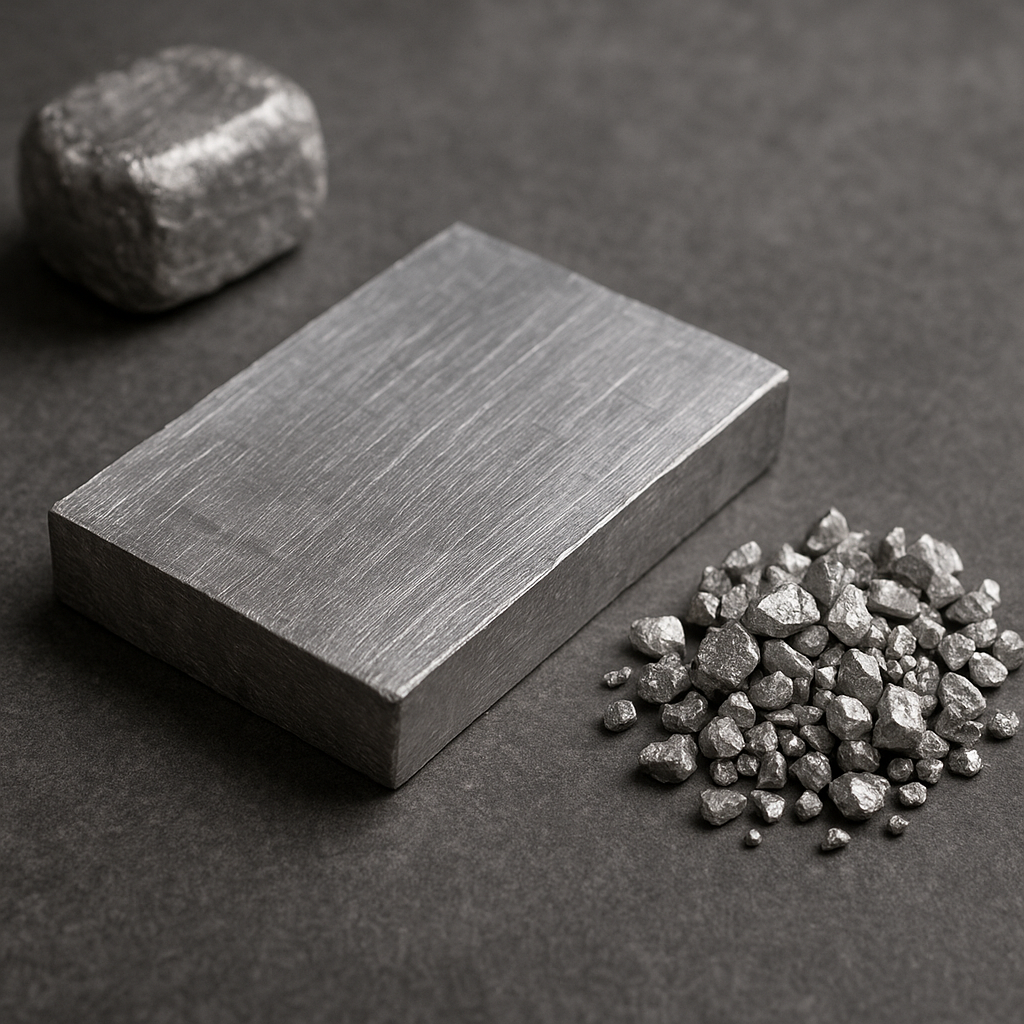
- Physical appearance: a silvery, soft, ductile metal that oxidizes slowly in air.
- Electrical and thermal behavior: like other lanthanides, it is a good conductor; in certain alloys or intermetallic compounds ytterbium displays exotic low-temperature phenomena such as valence fluctuations and heavy-fermion behavior.
- Chemical reactivity: reacts slowly with oxygen and water at room temperature, more readily with acids; forms compounds such as oxides (Yb2O3), halides (e.g., YbCl2, YbCl3), and triflates used in organic synthesis.
Ytterbium ions are characterized by well-defined spectroscopic lines, especially in the trivalent state (Yb3+). These spectral properties underpin numerous optical and photonic applications: Yb3+ has a simple energy-level scheme compared to many other lanthanides, with a strong absorption band in the near-infrared and emission centered near 1 µm when used in laser host materials.
Industrial and photonic applications
One of the most commercially significant uses of ytterbium is as a dopant in laser materials. Ytterbium-doped fiber lasers and solid-state lasers have become dominant in applications demanding high efficiency, excellent beam quality, and robust operation. Yb-doped fiber lasers typically emit around 1,030–1,080 nm and are favored for metal cutting, welding, medical procedures, and certain military systems because they combine high power with good conversion efficiency from pump diode light.
- Yb:YAG and Yb-doped fibers: Yb-doped yttrium aluminum garnet and ytterbium-doped silica fibers allow efficient energy conversion and can be pumped by semiconductor lasers, which reduces system complexity and cost.
- Materials processing: high-power ytterbium lasers are widely used in industry for precision cutting and joining of metals, often replacing CO2 and older solid-state lasers.
- Medical uses: short-pulse ytterbium lasers are used in dermatology and dentistry for procedures where controlled ablation or coagulation is required.
Another major photonic role for ytterbium is as a sensitizer in upconversion phosphors: Yb3+ ions absorb near-infrared photons (commonly at 980 nm) and transfer energy to activator ions like erbium or thulium, producing visible emission. These upconversion materials are exploited in bioimaging, security printing, and research into extending solar-cell performance by converting sub-bandgap photons into usable wavelengths.
Precision timekeeping and fundamental physics
Ytterbium has played a pivotal role in the development of next-generation atomic clocks. Neutral ytterbium atoms confined in an optical lattice, and ytterbium ions trapped in electromagnetic fields, form the basis of some of the most accurate and stable optical frequency standards today.
The advantages of ytterbium-based clocks include narrow optical transitions, well-characterized systematic shifts, and the availability of isotopes with convenient nuclear-spin properties. Optical lattice clocks using thousands of neutral Yb atoms and single-ion clocks based on the ytterbium ion offer measurement precision that surpasses the traditional cesium microwave standard by orders of magnitude. These clocks are not merely academic: they enable more precise global timekeeping, tests of fundamental constants, and applications in geodesy where tiny differences in gravitational potential lead to measurable frequency shifts.
Ytterbium in quantum information
In the field of quantum computing and quantum simulation, the ytterbium ion (especially Yb+, and notably the isotope 171) is a widely used qubit platform. Reasons include accessible laser wavelengths for state preparation and detection, long coherence times, and an internal level structure that facilitates high-fidelity quantum gates. Ion-trap quantum computers based on ytterbium have been used to demonstrate small-scale error correction, entanglement generation, and fundamental tests of quantum mechanics.
Chemical synthesis and catalysis
Beyond photonics and precision measurement, ytterbium finds use in chemistry. Ytterbium triflate (Yb(OTf)3) and other salts act as Lewis acids in organic synthesis, catalyzing reactions such as Friedel–Crafts acylations, Diels–Alder cycloadditions, and various condensation reactions. These catalysts are valued for their relatively high activity, tolerance to moisture, and recyclability in some reaction schemes.
Metallurgically, small amounts of ytterbium can be added to alloys to influence grain structure or optical properties in specialty materials. In experimental condensed-matter physics, ytterbium-based intermetallic compounds (for example, YbRh2Si2) are studied for their unconventional superconductivity, Kondo lattice physics, and quantum critical points. These systems highlight the rich interplay between electronic correlations and magnetism that a seemingly modest dopant can produce.
Isotopes, radioisotopes and research uses
Natural ytterbium consists of several stable isotopes and a handful of longer-lived radioisotopes that are of interest in research. Certain isotopes are especially valuable for atomic physics experiments: isotopes with nonzero nuclear spin permit hyperfine structure and qubit encoding, while spin-zero isotopes are beneficial for simplified spectroscopy. The diversity of isotopes allows physicists to choose the one best suited to a particular experiment in precision measurement or quantum simulation.
Radioisotopes of ytterbium have niche uses in medical research and industrial applications, where the decay properties can be exploited for tracer studies or gamma sources. However, these are specialized uses and not the dominant economic drivers for the element.
Supply chain, economics and environmental impact
Ytterbium’s commercial supply is tied to the broader rare-earth market. Extraction and refinement of rare-earth elements involve environmental and social challenges: mining operations can generate radioactive waste when thorium-bearing monazite is processed, and solvent extraction plants can produce chemically contaminated tailings. The concentration of rare-earth processing capacity in a few regions of the world has led to strategic concerns for industries that rely on steady supplies of specific elements like ytterbium.
Recycling of rare-earth-containing devices and the development of alternative materials are active areas of research aimed at reducing dependency on primary extraction. For some applications—especially those demanding ultra-high purity or particular isotopic composition—recycling is difficult, so securing responsible supply chains and cleaner processing technologies is a policy and industry priority.
Safety, handling and environmental considerations
Metallic ytterbium and many of its compounds are of low to moderate chemical toxicity compared to heavy metals like lead or mercury, but they should still be handled with standard laboratory precautions. Fine powders and some salts can be irritants or hazardous if inhaled or ingested. Like other reactive metals, freshly cut ytterbium metal may oxidize and should be stored under inert atmosphere or appropriate oil.
Environmental concerns mainly arise from ore processing and waste streams rather than from elemental use. Proper management of effluents, tailings, and any radioactive byproducts (from thorium or uranium impurities in source ores) is essential to reduce environmental and public-health impacts. Regulatory frameworks and improved processing techniques aim to mitigate these risks over time.
Interesting scientific and cultural notes
The village of Ytterby has a remarkable legacy: it is the namesake of multiple elements—yttrium, ytterbium, erbium, and terbium—a rare distinction in the periodic table. Beyond nomenclature, ytterbium’s role in the modern era is disproportionately large relative to its crustal abundance. It has enabled technological advances in manufacturing, medical devices, and the rapidly evolving fields of atomic clocks and quantum information.
From a physics perspective, ytterbium compounds continue to reveal unexpected low-temperature phenomena, giving insight into electron correlations and emergent states of matter. In applied science, the capacity of Yb-doped lasers to deliver high power with compact, efficient designs has changed how industries approach precision cutting and material processing.
Practical considerations for researchers and engineers
- Choosing the right ytterbium compound: for optics, high-purity Yb3+ doped glasses or crystals are needed; for catalysis, stable salts such as Yb(OTf)3 may be appropriate.
- Isotope selection: experiments in quantum information and precision measurement typically require specific isotopes like 171Yb for their hyperfine properties.
- Material handling: implement inert atmosphere storage for reactive metal; follow chemical hygiene practices for soluble salts and powders.
- Supply risk mitigation: source from reputable suppliers, consider recycling where feasible, and keep abreast of geopolitical factors that affect rare-earth markets.
Emerging trends and future directions
Research into ytterbium is expanding in several directions. Advances in ytterbium-based optical clocks are pushing the frontier of timekeeping and will likely influence navigation systems, telecommunications synchronization, and tests of fundamental physics such as searches for variations in the fine-structure constant. In quantum technologies, ytterbium ions and neutral atoms remain strong candidates for scalable quantum processors and simulators.
Materials science continues to explore Yb-containing compounds for unconventional superconductivity and correlated-electron behavior, which may inform the design of future electronic devices. Photonics and additive manufacturing applications will probably see continued growth as ytterbium-doped lasers become more compact, efficient, and widely deployed.
The story of ytterbium illustrates how an element that is small in quantity but rich in useful properties can underpin a surprising range of technologies. Whether stabilizing an ultrastable optical clock, enabling a high-power industrial laser, or catalyzing a key organic transformation, this unassuming lanthanide remains an element of active scientific and industrial interest.