Tourmaline is a mineral that fascinates geologists, gemologists and collectors alike because of its extraordinary variety of colors, physical properties and geological settings. In this article we will explore where tourmaline forms, what gives it such dazzling hues, how it is used both as a precious gemstone and in scientific contexts, and some intriguing cultural and historical facets connected to this mineral. Expect detailed descriptions of its geology, physical and optical properties, uses, care and market considerations, as well as a few scientific curiosities that make tourmaline more than just a pretty stone.
Geology and Occurrence: Where Tourmaline Forms
Basic geological environments
Tourmaline belongs to a complex group of boron silicate minerals that occur in a variety of settings. It commonly forms in granitic pegmatites, metamorphic rocks such as schists and gneisses, and in hydrothermal veins. Pegmatites — coarse-grained igneous bodies produced during the final stages of magma crystallization — are among the most important sources of gem-quality tourmaline because they concentrate rare elements and allow slow crystal growth that produces large and well-formed specimens. Tourmaline also appears as disseminated crystals in metamorphic terrains where boron-bearing fluids interact with host rocks.
Major global localities
Significant mining districts are scattered worldwide. Brazil has for decades been a dominant source, yielding a broad spectrum of colors and exceptionally large crystals. The pegmatites of Minas Gerais and Paraíba are famous — Paraíba produced neon-blue copper-bearing tourmalines that revolutionized market demand. Afghanistan and Pakistan deliver intense rubellite (pink-red) and indicolite (blue) material from alpine-type veins. Mozambique and Nigeria have become major suppliers of vibrant green and bicolored varieties. Madagascar produces both gem and collector material with interesting color zoning. In the United States, Maine and California are classic localities historically mined for gem tourmaline; Maine tourmalines are often prized for their clean, saturated colors and collector specimens.
Associations and paragenesis
Tourmaline commonly occurs with quartz, feldspar, mica (including lepidolite and muscovite), spodumene and other pegmatitic minerals. Its formation requires boron, so the presence of boron-bearing fluids is critical. In pegmatites, tourmaline crystallizes from residual melts enriched in volatile components; in metamorphic rocks, boron mobilized during dehydration reactions can precipitate tourmaline in pressure-temperature regimes conducive to recrystallization. These processes produce a remarkable variety of crystal habits, sizes and color zoning.
Crystal habits and notable physical forms
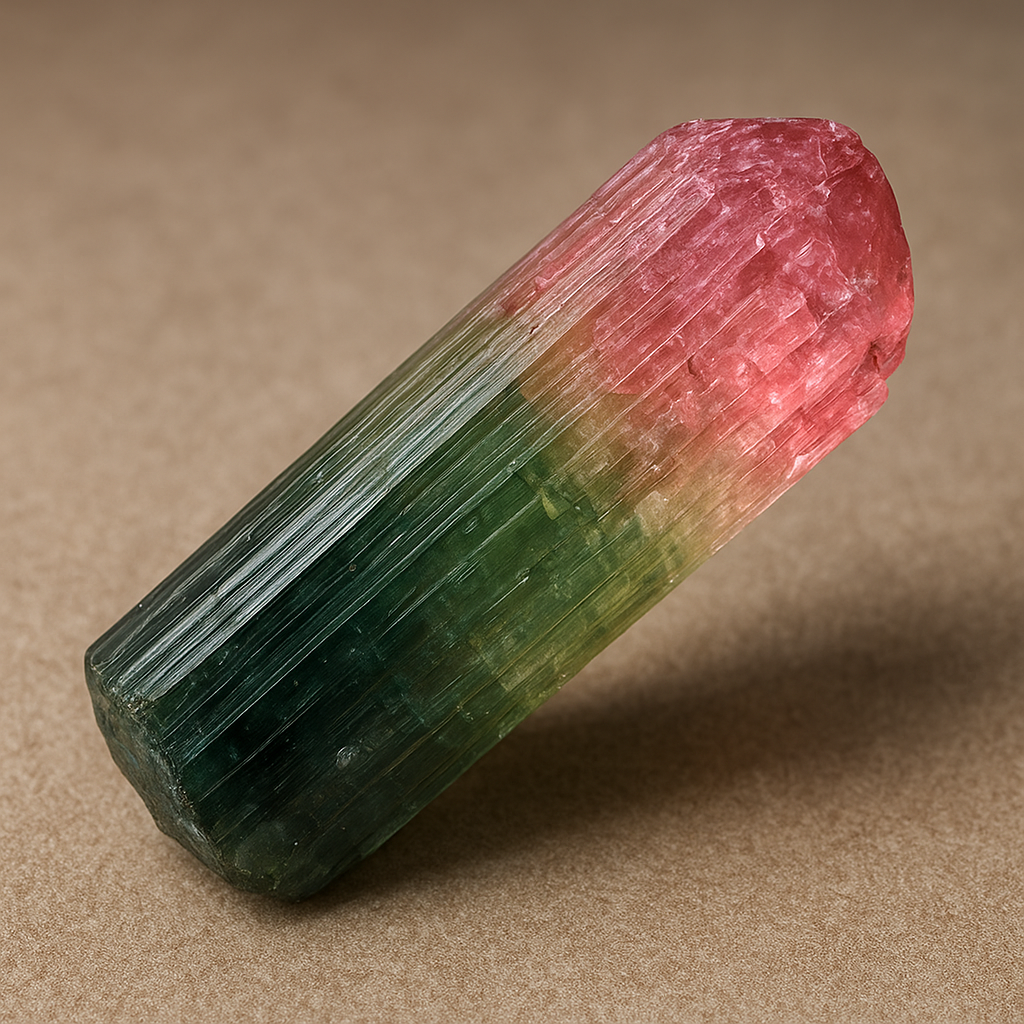
Tourmaline grows as trigonal-to-hexagonal-prismatic crystals often with vertical striations; terminations can be complex and pyramidal. Some specimens show elongated prismatic habit with well-defined faces prized by collectors. Tourmaline groups frequently exhibit multicolored banding when elements change during growth, producing „watermelon” tourmaline with green rims and pink cores — a spectacular natural phenomenon much sought after by gem buyers.
Chemistry, Structure and Optical Properties
Complex chemistry and classification
The tourmaline group is chemically diverse. A generalized formula is (XY)3Z6(T6O18)(BO3)3V3W, where X, Y, Z, T represent sites occupied by a range of cations such as sodium, calcium, potassium, lithium, magnesium, iron, manganese and aluminum, along with silicon and boron. This structural flexibility allows many species: for example, schorl (iron-rich), dravite (sodium-magnesium), elbaite (lithium-rich and the principal gem-bearing species) and liddicoatite (calcium-rich and often strongly zoned). The presence of trace elements dramatically affects the visual appearance of each crystal.
Origins of color
Color in tourmaline arises from trace amounts of transition metals and their oxidation states. Manganese tends to produce pinks and reds (rubellite), iron produces greens to blacks, and chromium or vanadium can create vivid greens. Copper is responsible for the striking blue to greenish-blue hues characteristic of Paraíba-type material. Other causes include color centers produced by irradiation and complex interactions between multiple trace impurities. Because the chemistry can vary during growth, many crystals show zoning and multiple colors within a single specimen — a feature exploited by lapidaries.
Physical and optical characteristics
Tourmaline has a hardness of about 7 to 7.5 on the Mohs scale, making it suitable for many types of jewelry. Specific gravity ranges from approximately 2.9 to 3.3 depending on composition. Optically, most gem-quality tourmalines are singly refractive with moderate birefringence in some species; they commonly display pleochroism — different colors when viewed from different angles — which is important when orienting rough for cutting. Electron microscope studies reveal a complex internal world of inclusions and growth structures that can affect clarity and value.
Unique electrical properties
One of the most intriguing aspects of tourmaline is its ability to become electrically charged when heated or mechanically stressed. It is both piezoelectric — generating an electrical charge under mechanical pressure — and pyroelectric — generating a charge when heated. These properties were scientifically significant in the 18th and 19th centuries, contributing to studies of electrostatics and, in some cases, early electrical devices. The pyroelectric and piezoelectric character also explains why finely powdered or freshly fractured crystals can attract small particles like dust or ashes.
Varieties, Treatments and Cutting
Named gem varieties and notable types
Collectors and gem dealers use several trade names to describe tourmaline colors and varieties. Rubellite describes pink to red elbaite, indicolite denotes blue varieties, and verdelite refers to green. Paraíba tourmaline — technically a copper-bearing elbaite — is known for its neon-like blue to green tones and commands premium prices. Watermelon tourmaline features distinctive concentric zoning with pink core and green rim. Black tourmaline or schorl is abundant, often opaque, and valued for specimen display and industrial uses rather than faceted gems.
Treatments and enhancements
Like many gemstones, tourmaline can undergo treatments to improve appearance. Heat treatment is sometimes used to modify or stabilize color, particularly to enhance blue or green tones or to reduce brownish overtones. Irradiation has historically been applied to deepen color in some specimens, but such treatments must be disclosed to buyers. Certain colors, especially Paraíba-like neon blues, are rarely treated and tend to be judged by provenance and natural color intensity. Buyers should seek disclosure and, for high-value stones, laboratory certification.
Cutting considerations
Because tourmaline commonly exhibits pleochroism and zoning, cutting requires careful orientation of the rough to maximize color and minimize undesirable optical effects. Well-cut tourmaline can display remarkable color consistency and brilliance. Cabochon cutting is popular for stones showing dramatic zoning or cat’s-eye effects (the latter being rare but present in some specimens). Large clean crystals can yield substantial faceted gems; smaller or included pieces are often fashioned into beads or cabochons.
Uses and Applications
Gem and jewelry market
Tourmaline is a mainstay of the colored gemstone market because of its wide palette, durability and availability in sizes ranging from tiny accent stones to large collector specimens. Popular uses include rings, earrings, pendants and beads. Color trends influence demand: vivid Paraíba-type blues and intensely saturated rubellites typically fetch the highest prices per carat. The presence of unusual colors or attractive multi-colored slices (watermelon) adds collector appeal. In addition to faceted gems, polished slices and mineral specimens are highly collectible.
Scientific and industrial uses
The piezoelectric and pyroelectric properties of tourmaline led to experimental and practical uses in early scientific apparatus. In modern times, synthetic piezoelectric materials have largely replaced natural tourmaline for commercial sensors and electronics, but tourmaline is still studied for its geological significance and unique physical behavior. Finely ground tourmaline powder appears in niche industrial applications and in certain cosmetic or wellness products marketed for supposed energy or ionizing properties. Scientific caution is needed: many claims about health benefits lack rigorous evidence.
Metaphysical and cultural uses
Tourmaline enjoys a prominent place in folklore and metaphysical practices. Black tourmaline, for instance, is commonly invoked in protective rituals and is said by practitioners to dispel negative energy. Pink and green varieties are associated with emotional balance and heart-centered healing. While such uses are culturally meaningful for many people, they do not substitute for medical or psychological treatment. Museums and collectors often display tourmaline in cultural contexts that reflect these beliefs, making the mineral a bridge between science, art and spirituality.
Care, Buying Advice and Market Considerations
Care and maintenance
With a Mohs hardness around 7–7.5, tourmaline is reasonably durable but not immune to damage. Surface-reaching fractures, cleavage directions and inclusions can make some stones vulnerable to impact. Ultrasonic cleaners may be acceptable for many intact, clean stones, but the safest cleaning method is warm, soapy water and a soft brush. Avoid sudden temperature shocks and prolonged exposure to high heat, which can alter color or induce cracks. Store tourmaline separately from harder stones like diamonds to prevent abrasion.
Evaluating value
Several factors determine tourmaline value: color intensity and desirability, clarity and transparency, cut quality, carat weight and provenance. Saturated, evenly distributed color with minimal brown or gray modifiers is highly prized. Large clean rubellites and Paraíba-type blues are often the most expensive. Conversely, heavily included or opaque black tourmaline has modest gem value but may be valuable as a mineral specimen. Certification from reputable gemological laboratories is useful for high-value purchases, especially when treatments or origin claims (e.g., Paraíba, Mozambique) influence price.
Buying tips and red flags
- Request proper documentation for high-value stones, including treatment disclosure.
- Inspect for color zoning and pleochroism: a stone may appear different when set in jewelry if orientation is poor.
- Be wary of undisclosed dyes, coatings or fracture-filling agents that can artificially intensify color.
- Consider provenance: certain localities add premium value but also carry market volatility.
- Buy from reputable dealers and, when possible, view stones in suitable lighting to judge true color.
Historical, Cultural and Scientific Anecdotes
Names and etymology
The word tourmaline is believed to derive from the Sinhalese term turamali or toramalli used by Sri Lankan gem traders to describe various multicolored stones. European gem merchants and naturalists adopted and adapted the name in the 18th century. Throughout history, tourmaline’s capacity to attract small particles when heated or rubbed gave it the reputation of an „electric stone,” and investigators like Sir David Brewster and others studied its electrostatic properties.
Famous finds and notable specimens
Some localities have produced spectacular crystals that entered museum collections or set records at auction. Paraíba tourmalines discovered in the late 20th century were notable not just for color but also for the role they played in reshaping price expectations for colored stones. Large, multi-hundred-carat gem-quality elbaite crystals and intricately zoned watermelon slices are showpieces in mineral exhibits, illustrating both geological beauty and the complexity of natural growth conditions.
Scientific insights from tourmaline
Geochemists use tourmaline as a robust recorder of metamorphic and magmatic conditions because its composition can capture the temperature, pressure and fluid composition of its formation environment. Boron isotopes preserved in tourmaline provide information about fluid sources, while trace-element zoning can chart the evolution of a pegmatite or metamorphic event. Because tourmaline resists alteration, it often remains a durable archive of geological history.
Collecting and museum display
Collectors prize exceptional tourmaline specimens for their color, crystal form and rarity. Museums display exquisite examples not only for aesthetic effect but to teach about mineral growth, geochemistry and the interplay of elements that produce color. Enthusiasts often seek well provenance-labeled specimens because locality can be crucial to scientific interpretation and market valuation.
Interesting Facts and Curiosities
- Watermelon tourmaline slices, when properly cut, reveal the concentric color zoning and are often fashioned into cabochons or display items.
- Paraíba tourmalines earned a separate trade identity due to their copper-induced neon hues; these stones redefined collectible standards for tourmaline.
- The pyroelectric effect of tourmaline can cause a charged crystal to attract small scraps of paper when heated, a phenomenon that delighted natural philosophers before the age of modern electronics.
- Many gem-grade tourmalines are varieties of elbaite, a species named after the Italian island of Elba, where early studies took place.
- Black tourmaline (schorl) is one of the most common tourmaline species and forms massive, opaque masses and prismatic crystals that are frequently used in mineral collections.
Tourmaline stands out among minerals for its remarkable diversity: from the deep blacks and earth tones of schorl to the neon blues of copper-bearing material and the pastel pinks of rubellite. Its combination of geological interest, physical quirks and aesthetic appeal ensures that it remains a subject of study and admiration across disciplines. Whether encountered as a collector’s specimen, a set gem in a ring, or a subject of scientific inquiry, tourmaline offers a vivid window into the complexity and beauty of Earth’s mineral processes.