
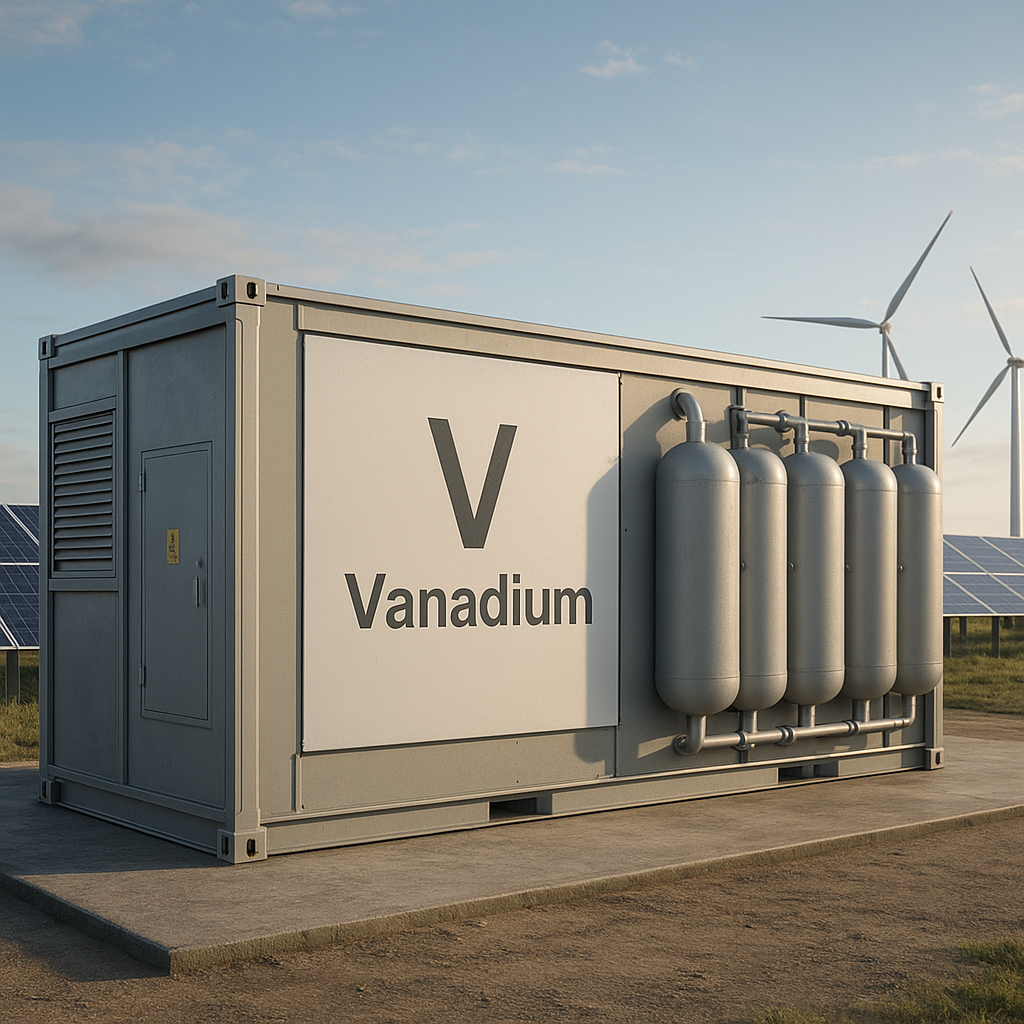
The transition to a low-carbon electricity system requires not only abundant renewable generation but also reliable, affordable methods to store energy at scale. Vanadium-based technologies, and in particular the vanadium redox flow battery, are attracting renewed attention because they offer a distinctive combination of characteristics valuable for grid-scale energy storage. This article examines the science behind vanadium systems, their competitive advantages, key challenges, real-world deployments, and the commercial and policy steps needed to realize their potential.
How vanadium redox flow batteries work
At the heart of a vanadium system is the chemistry that allows a single element to exist simultaneously in multiple oxidation states. A VRFB stores electrical energy in liquid electrolytes containing vanadium ions: different vanadium oxidation states occupy the positive and negative tanks. During charging and discharging, ions are oxidized and reduced while being circulated through a central electrochemical cell where energy conversion occurs.
Several features of this architecture make VRFBs particularly attractive for utility applications:
- Decoupling of power and energy: the rated power depends on the size of the cell stack, while the stored electrolyte volume determines duration. This enables tailored designs for applications ranging from short cycling to long-duration storage.
- Long calendar and cycle life: because active material is liquid and there is no structural intercalation as in many solid-state batteries, VRFBs offer exceptional cyclability and low degradation over tens of thousands of cycles.
- Intrinsic safety: aqueous electrolytes reduce fire risk compared with flammable organic electrolytes, simplifying siting and permitting for large installations.
Advantages for utility-scale applications
When evaluating storage technologies for the grid, several performance metrics matter: lifetime cost per kWh delivered, operational flexibility, environmental impact, and reliability. Vanadium flow systems have clear strengths in many of these areas.
First, because degradation is low and electrolyte can be rebalanced or replaced without discarding the entire system, VRFBs can achieve long operational lifetimes with predictable maintenance costs. This affects the levelized cost of storage favorably for long-duration use cases. Second, the ability to size energy separately from power makes VRFBs cost-effective for multi-hour and daily shifting services that are poorly matched by lithium-ion systems designed for shorter durations. Third, the non-flammable electrolyte and simple thermal behavior reduce project risk and insurance costs for large installations.
Use cases where vanadium systems excel include:
- Multi-hour shifting of solar and wind generation to meet evening demand peaks.
- Capacity firming for intermittent generation, providing predictable output over extended periods.
- Grid resilience and backup with long-duration discharge capability for outages.
- Frequent cycling for ancillary services with minimal capacity fade.
Technical and economic challenges
No technology is without trade-offs. The most frequently cited hurdles for vanadium flow batteries are related to material prices, supply chain dynamics, and system-level costs.
- Cost and market volatility: The price of vanadium, largely driven by steel alloy demand and the evolving dynamics of mining and refining, can be volatile. Because the electrolyte contains significant mass of vanadium, commodity price swings affect up-front capital costs.
- System capital intensity: While the electrolyte can be reused, the initial cost per kWh can be higher than short-duration lithium-ion systems when evaluated for applications under 2–4 hours. VRFBs become more cost-competitive as required duration increases.
- Balance-of-plant complexity: Pumps, tanks, and power conversion systems add to balance-of-plant costs and require careful engineering to minimize parasitic losses and maximize round-trip efficiency.
- Round-trip efficiency: Typical VRFB systems have round-trip efficiencies in the 65–80% range, lower than the 85–95% of lithium-ion systems. For some fast-cycling or short-duration markets, higher efficiency is crucial.
- Resource and environmental concerns: Expansion of vanadium production must manage environmental impacts associated with mining and processing. New feedstocks like oil residues, fly ash, and red mud are potential sources but require responsible extraction and refining strategies.
Innovations reducing costs and risks
Research and commercial innovation are targeting many of the obstacles listed above. Approaches include:
- Electrolyte optimization: increasing vanadium concentration and improving solvent chemistry to reduce tank volumes and lower electrolyte cost per kWh.
- Recovery and secondary sourcing: scaling vanadium recovery from industrial by-products or recycling spent electrolyte to stabilize supply and lower environmental footprint.
- Stack design improvements: reducing bipolar plate and membrane costs, improving flow field efficiency, and optimizing stack lifetime to cut stack replacement cycles.
- Hybrid configurations: combining flow batteries with other storage or generation assets to boost overall system efficiency and reduce capital intensity for specific applications.
Commercial deployments and case studies
VRFBs are already operating at utility scale in several countries, offering practical evidence of their strengths and limitations. China has driven a significant portion of early deployment, deploying multi-megawatt systems for renewable integration and industrial microgrids. Australia and parts of Europe are exploring vanadium projects for long-duration grid services and remote mining operations. In the United States, pilots demonstrate VRFBs for transmission-deferral projects and islandable microgrids.
These projects highlight important lessons:
- Site selection matters: applications with regular multi-hour discharge needs offer the best value proposition.
- Contract structure matters: fixed-duration procurement and performance-based contracts that remunerate long-duration capability help level the playing field versus short-duration batteries.
- Operation models: battery-as-a-service and electrolyte leasing models reduce capital hurdles for buyers and separate commodity risk from system performance.
Policy, financing and market mechanisms to enable scaling
Large-scale adoption of vanadium flow batteries depends less on a single technical breakthrough and more on creating favorable market conditions and investment pathways. Policy actions that can accelerate deployment include:
- Incentives or credits for long-duration storage that recognize services like seasonal shifting and extended outage protection.
- Support for R&D and pilot projects to drive down soft costs, standardize balance-of-plant components, and validate long-term performance.
- Measures to stabilize vanadium supply, for example through strategic reserves, recycled material incentives, or coordination with industries producing vanadium as a by-product.
- Market rules that allow stacking of revenue streams—frequency regulation, capacity, and energy arbitrage—to improve project economics.
Outlook: where vanadium fits in a decarbonized grid
Vanadium flow batteries are unlikely to displace lithium-ion for every application, but they occupy an important niche: long-duration, safe, highly cyclable, and flexible storage for utility-scale needs. As renewable penetration grows and the need for multi-hour and multi-day storage becomes more pressing, the comparative advantages of scalability, durability, and maintainable lifetime performance will increasingly matter.
Economic competitiveness will improve if vanadium supply chains mature, electrolyte costs fall through concentration and recycling advances, and policy frameworks reward the unique grid services flow batteries provide. With coordinated innovation across materials, manufacturing, project finance, and regulation, vanadium-based systems can be a central element of resilient, decarbonized power systems.
