
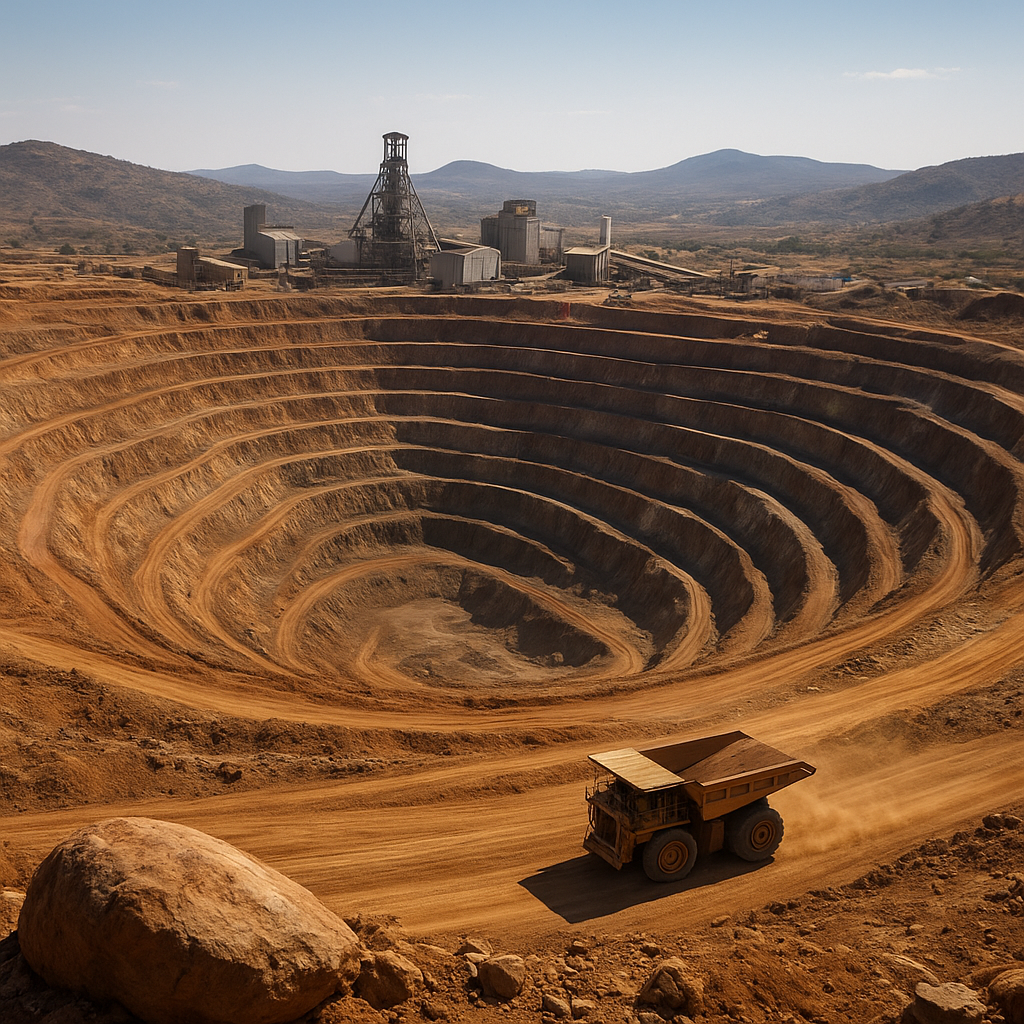
The following text explores the history, location, operations and wider significance of one of the most famous underground mines in the world. It focuses on the TauTona site in South Africa, a mine synonymous with extreme depths, complex engineering and the long economic shadow of gold mining on local communities and the national economy. The article examines what was extracted there, how the mine worked, the challenges it faced and a number of striking facts that capture why TauTona remains a point of reference for modern mining.
Where TauTona is located and the geological setting
TauTona is situated in the highlands west of Johannesburg, near the town of Carletonville in the Gauteng province of South Africa. It lies on the West Wits goldfield, part of the vast Witwatersrand Basin — a geological formation that has produced much of the world’s historic gold supply. The Witwatersrand sediments host multiple narrow, laterally extensive mineralized horizons or “reefs,” which have been worked for over a century.
The mine exploited deep portions of these reefs where ancient rivers and sedimentary processes concentrated gold particles. Unlike open-pit mines, operations here accessed ore through vertical shafts and a complex network of horizontal levels and drives, reaching considerable distances below the natural surface. The concentration of gold in the Witwatersrand, together with favourable geological continuity, made sites like TauTona economically viable despite extreme depth and cost.
What was produced and how the mining was organised
Primary commodity and ore characteristics
The primary commodity at the site was gold, recovered from narrow reef horizons within the Witwatersrand sequence. Ore bodies were often only a few centimetres to a few metres thick, requiring selective extraction techniques. Mining engineers relied on intense planning to maintain economic grades while minimising dilution — a particular challenge in very deep operations.
Underground layout and access
TauTona’s infrastructure included multiple vertical shafts, intermediate levels, decline ramps and extensive lateral development. The vertical shafts were the mine’s arteries, transporting personnel, equipment and ore between surface infrastructure and working faces. At full depth the workings extended several kilometres horizontally, with multiple production areas operating on different levels to maintain continuous output.
- Ore extraction: selective reef mining using stoping and mechanised drills.
- Rock handling: ore was crushed and transported to surface concentrators.
- Ventilation and cooling: critical systems to control heat and air quality.
- Water management: constant pumping to keep workings dry at extreme depths.
Workforce and shift patterns
A large, specialised workforce was required to keep underground operations running. Miners, engineers, geologists, electricians and support staff worked in rotating shifts to cover the round-the-clock production cycle. Travel time between surface and deep working levels was significant — journey times by cage could take close to an hour depending on depth and shaft scheduling — which influenced shift design, worker welfare planning and emergency response arrangements.
Economic importance and regional impact
Direct economic contributions
TauTona played a material role in the local and national economy. As a producer of gold, it contributed to export earnings, government revenues through taxes and royalties, and wage income for many households in the surrounding towns. Historically, deep gold mines in South Africa were cornerstones of regional economies: they sustained a web of suppliers, service companies and transport operations that amplified local employment beyond the mine’s direct payroll.
Indirect and long-term impacts
Beyond direct economic output, the mine drove significant investment in infrastructure such as roads, electrical networks and housing. The skills and technical knowledge developed in deep-level gold mining — from rock engineering to refrigeration and ventilation — fed into other sectors and helped build a corpus of specialised expertise within the national labour market.
At the same time, dependence on a single commodity and on ageing deep-mine assets made local economies vulnerable. When deep mines become uneconomic due to falling metal prices, rising costs or safety concerns, the social and economic consequences can be severe: job losses, reduced municipal budgets and challenges in repurposing former mining land.
Engineering challenges, safety and environmental management
Heat, rock pressure and ventilation
Working thousands of metres below the surface introduces extreme conditions. Rock temperatures rise with depth, so that the natural temperature of the rock at TauTona’s deepest levels approached levels that were uncomfortable or unsafe for human work without intervention. As a result, the mine required massive refrigeration and ventilation systems to cool incoming air to workable temperatures and to manage humidity. These climate-control systems were energy-intensive and represented a major portion of operating expense.
Ground control and seismicity
The combination of high stress at depth and the removal of rock can lead to seismic events and rockbursts. Rock engineering at extreme depth involves careful pillar design, controlled blasting, and real-time monitoring to detect and mitigate rock movement. Maintaining stable working areas and ensuring rapid evacuation routes were ongoing priorities for management and engineers.
Safety, health and labour issues
Deep mining has historically been dangerous work. Over decades the industry improved safety standards and reduced fatalities, but hazards related to falls of ground, entrapment, machinery, and occupational lung diseases remained. Mines implemented training programs, personal protective equipment protocols, and emergency response plans. Health concerns such as silicosis, respiratory ailments and chronic exposure to dust and noise have posed long-term problems for miners and communities, and contemporary operations have increasingly focused on medical surveillance and compensation mechanisms.
Management, ownership and operational transitions
For many years TauTona was associated with one of South Africa’s major gold producers and was emblematic of the country’s deep-level gold mining legacy. The operation attracted international attention because of its depth and the capital intensity required to keep it running. Over time, industry-wide pressures — declining ore grades, rising costs, fluctuating metal prices and regulatory and social demands — changed the economic calculus for many deep mines, prompting rationalisation, consolidation or closure in some cases.
Interesting and notable aspects
- Depth: TauTona was one of the world’s deepest mines, with workings reaching several kilometres below surface. Its depth made it a focal point of engineering achievement and public fascination.
- Logistics: The logistics of moving people, equipment and ore vertically at such depths required highly coordinated hoisting and shaft-scheduling systems.
- Cooling: The scale of refrigeration and ventilation needed to make deep-level working environments tolerable is rarely matched in other industries.
- Innovation: Many methods used to manage heat, pressure and seismic risk at TauTona informed best practices across the mining industry worldwide.
- Community links: Towns near the mine, including Carletonville, developed alongside mining activity; the social fabric and local economy reflected the mine’s presence for generations.
Wider reflections: the role of deep gold mines in South Africa
Operations such as TauTona are best understood within the broader story of South Africa’s mining era. The Witwatersrand gold rush transformed the country’s economy and urban geography, giving rise to large-scale industrial mining that required vast capital and technical competence. Over more recent decades, the global and national contexts shifted: metal prices fluctuate, regulatory expectations evolve, and environmental and labour standards have become more rigorous.
The legacy of deep gold mining includes both enormous economic gains and persistent social and environmental challenges. Mines contributed to national wealth and infrastructure, but also left a heavy footprint in the form of used land, tailings facilities and health burdens that require long-term management and remediation plans.
Final observations
TauTona remains an emblematic example of what modern underground mining can achieve and what it demands. The operation combined advanced engineering, large-scale logistics and thousands of people working in demanding conditions. Whether seen as a triumph of industrial capability or a reminder of the limits of extractive economies, the mine’s story continues to offer lessons about resource management, worker welfare, and the economics of digging deep for precious minerals.

