
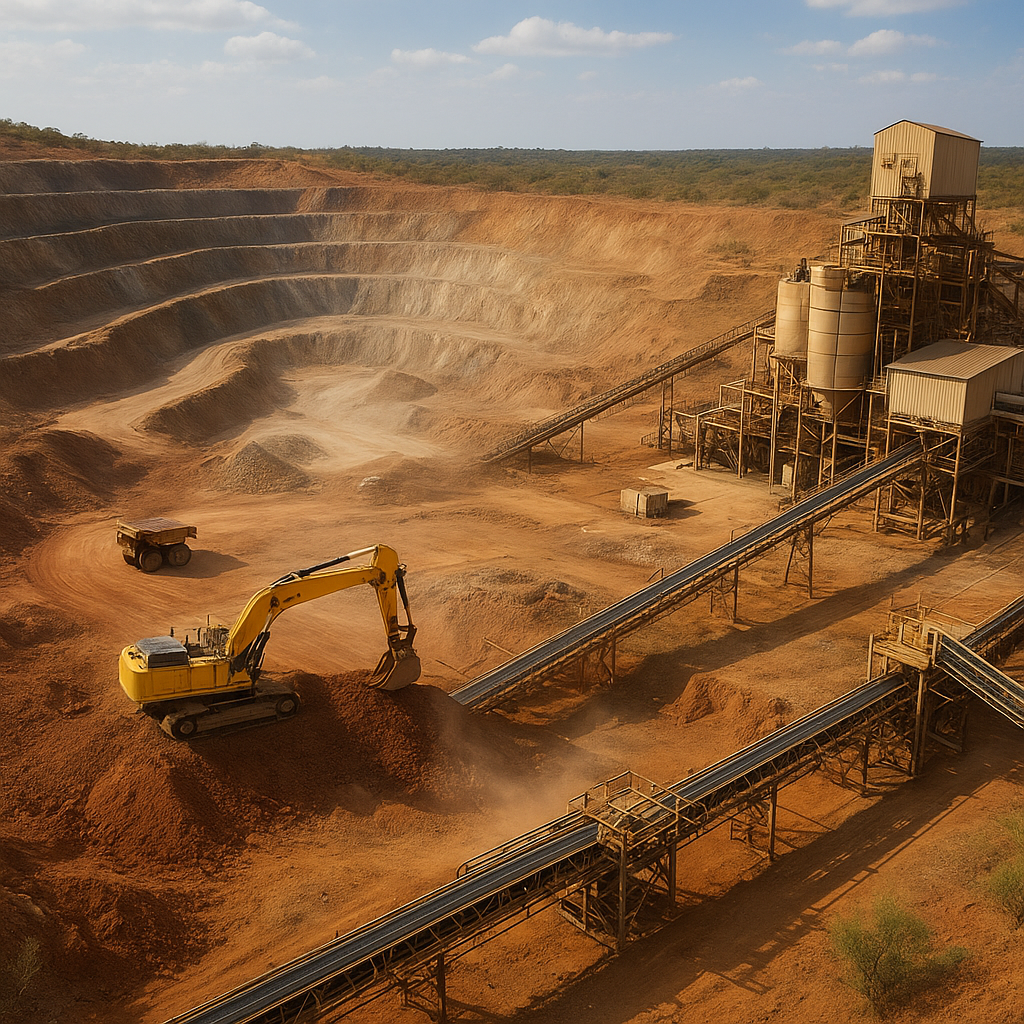
The Foskor Phalaborwa operation is one of South Africa’s best known phosphate-related industrial sites, located in the mineral-rich region of northern Limpopo. This article explores where the mine sits, what commodities it produces, its broader economic significance, and several interesting aspects—from logistics and processing to social and environmental dimensions. The account aims to provide a rounded picture of an integrated mining and chemical complex that plays an important role in regional agriculture and the national mineral value chain.
Location and regional context
The Foskor facilities are situated near the town of Phalaborwa, on the western edge of one of South Africa’s most iconic conservation areas. Phalaborwa lies in the northeastern part of the country in the Limpopo province, a zone known for diverse mineralisation and long-standing mining activity. The area is notable for a juxtaposition of heavy industry and significant biodiversity, with the mine complex occupying land close to transport corridors that link the interior mineral belt to coastal export ports.
The region’s accessibility by road and rail has supported the development of an integrated operation that not only extracts phosphate rock but also processes it into downstream chemical products. Proximity to agricultural markets in South Africa and export terminals on the Indian Ocean makes Phalaborwa a strategically located node for supplying nutrient raw materials to both domestic and international customers.
What is mined and produced at Foskor Phalaborwa
The core raw material extracted at the site is phosphate rock. This rock is the feedstock for a chain of chemical processes that yield phosphoric acid and a range of fertilizer products essential to modern agriculture. The operation is best understood as an integrated mine-and-chemical complex: mining activities produce phosphate ore, which is then beneficiated and chemically processed in on-site facilities.
Mining and beneficiation
- Mining methods: The operation historically relies on open-pit extraction techniques and on-site material handling systems to move ore from the face to processing plants.
- Beneficiation: Crushed phosphate rock undergoes physical separation and washing steps to remove impurities and upgrade the phosphate concentration prior to chemical treatment.
- Quality control: Ore grading and sampling inform the downstream processing stages to ensure stable operation of chemical reactors and consistent product quality.
Chemical processing and product suite
Following beneficiation, the key processing route is the conversion of phosphate rock into phosphoric acid via acidulation—typically using sulfuric acid. The produced phosphoric acid is a precursor to several fertilizer formulations and industrial chemicals:
- Concentrated phosphoric acid for fertilizer manufacture.
- Granulated or blended phosphate fertilizers adapted to local agronomic needs.
- By-products and intermediate chemicals that can be used in industrial applications.
Because the operation integrates mining with chemical manufacture, it captures more value locally than a simple raw material exporter. This vertical integration supports local processing jobs and creates exportable finished or semi-finished products rather than only raw ore.
Economic significance and value chain impacts
The Foskor complex plays multiple roles in the regional and national economy. At the most direct level it provides employment and industrial activity in a part of the country where mining is a major economic driver. Beyond direct jobs, its downstream processing supports technical employment, logistics, and ancillary services.
Employment and regional development
- Job creation: The operation supports a mix of skilled, semi-skilled and unskilled jobs, alongside contractors and suppliers located in and around Phalaborwa.
- Local procurement: Purchasing of goods and services from regional businesses fosters wider economic multipliers, including transport, housing, and retail.
- Community programs: Many mining operations in the region develop community investment programs focused on education, healthcare, and small enterprise development to support long-term socio-economic stability.
Supply to agriculture and markets
Phosphate is a critical nutrient for cropping systems worldwide. By producing phosphate rock-derived products domestically, the Foskor site helps stabilise fertilizer supply chains within South Africa and the neighbouring regions. Supplying phosphoric acid and phosphate-based fertilizer locally reduces reliance on distant imports and retains more value-added processing within the country.
Exports and trade
While meeting domestic demand is a priority, the production profile also enables exports. Finished or semi-finished phosphate products travel by rail and road to ports for shipment abroad, generating foreign exchange and helping maintain South Africa’s position in regional fertilizer markets.
Logistics and infrastructure
Efficient mineral operations depend on robust logistics. The Phalaborwa location benefits from transport linkages that connect inland mineral sites to export harbours. Rail corridors and road networks are used for moving both raw ore and processed products.
- Bulk handling facilities: On-site storage, material handling, and packaging operations accommodate various product forms.
- Port access: Proximity to Indian Ocean ports allows export of products to global markets, while domestic distribution networks supply South African farmers and industrial customers.
- Energy and utilities: Continuous processing plants require reliable power and water supplies; the operation’s planning includes energy management and water-use strategies.
Environmental, social and governance considerations
Mines that combine extraction with chemical processing carry responsibilities across a number of environmental and social domains. The Foskor operation is subject to regulatory oversight and corporate policies addressing waste management, emissions, water use, and community engagement.
Environmental management
- Waste handling and tailings: Chemical processing generates by-products that must be safely neutralised, contained and, where possible, repurposed.
- Water stewardship: Processing plants require significant water inputs; sustainable operations focus on recycling, efficient use and protection of local water resources.
- Air quality and dust control: Mining and beneficiation can generate dust and particulate emissions; mitigation measures and monitoring help reduce impacts on nearby communities and ecosystems.
Community relations and social investment
In mining regions, the social license to operate is as important as regulatory permits. Companies typically invest in local infrastructure, skills training, and health and education programs. Such investments aim to ensure that benefits accrue to nearby communities, reducing the risk of conflict and supporting long-term economic diversification beyond mining.
Rehabilitation and closure planning
Modern mining practice includes planning for eventual site rehabilitation and closure. Progressive rehabilitation during the life of the mine and long-term planning for land restoration are critical components of responsible operation, especially in an area that borders sensitive conservation land.
Interesting features and innovations
Beyond the basic facts of extraction and processing, the Phalaborwa operation holds several points of interest that reflect broader trends in mining and mineral chemistry.
- Integration: The plant’s combination of mining and chemical manufacturing showcases how mineral value chains can be integrated to capture greater economic value locally.
- Proximity to conservation: Close location to major conservation areas presents both challenges and opportunities for collaborative land-use planning and biodiversity offset approaches.
- Resource efficiency: Advances in processing and recycling technologies are increasingly applied to reduce water and energy intensity and to reclaim by-products where feasible.
- Product diversity: Phosphate chemistry supports multiple end-uses—from agriculture to industrial applications—making the operation relevant across sectors.
- Regional importance: The site anchors a local industrial cluster that supports transport, services and agribusiness in the broader region.
Challenges and opportunities
Like many industrial sites, the operation faces a set of converging influences that shape its future trajectory. Commodity price fluctuations affect profitability and investment timing. Environmental regulation and community expectations require adaptive management and transparency. At the same time, opportunities arise from technological improvements in processing efficiency, potential new markets for phosphate-derived products, and partnerships that enhance local benefits.
- Innovation potential: Research into more efficient acidulation processes, lower-emission power solutions, and alternative fertilizer formulations can create competitive advantage.
- Market diversification: Serving both domestic agriculture and export markets can help stabilise revenues against cyclical demand.
- Sustainability leadership: Demonstrating credible progress on environmental and social performance strengthens relationships with regulators, communities and investors.
Technical and operational highlights
Operational excellence in a complex like Phalaborwa depends on technical systems and skilled personnel. Key operational themes include:
- Maintenance regimes that keep continuous processing plants running reliably.
- Quality assurance throughout beneficiation and chemical stages to ensure product specifications are met.
- Safety systems that protect workers from chemical and mining hazards.
- Automation and process control that enhance efficiency and reduce downtime.
Regional and global context
Phosphate is globally important because it is an essential nutrient in fertilizers and cannot be substituted. Operations such as the Phalaborwa complex contribute to the global supply of phosphate-derived products and affect food security considerations. In the regional context, maintaining a domestically based phosphate-processing capacity supports agricultural resilience in southern Africa.
Concluding observations
The Foskor Phalaborwa operation exemplifies a resource-based industrial complex that connects extraction, chemical processing and market distribution. Its role extends beyond mere commodity production: it is a provider of jobs and local economic activity, a supplier to agriculture, and a participant in ongoing debates about responsible mining and industrial sustainability. For observers of mining, agriculture and regional development, the site offers a case study in how mineral resources can be developed to produce both immediate economic gains and longer-term societal impacts.

