
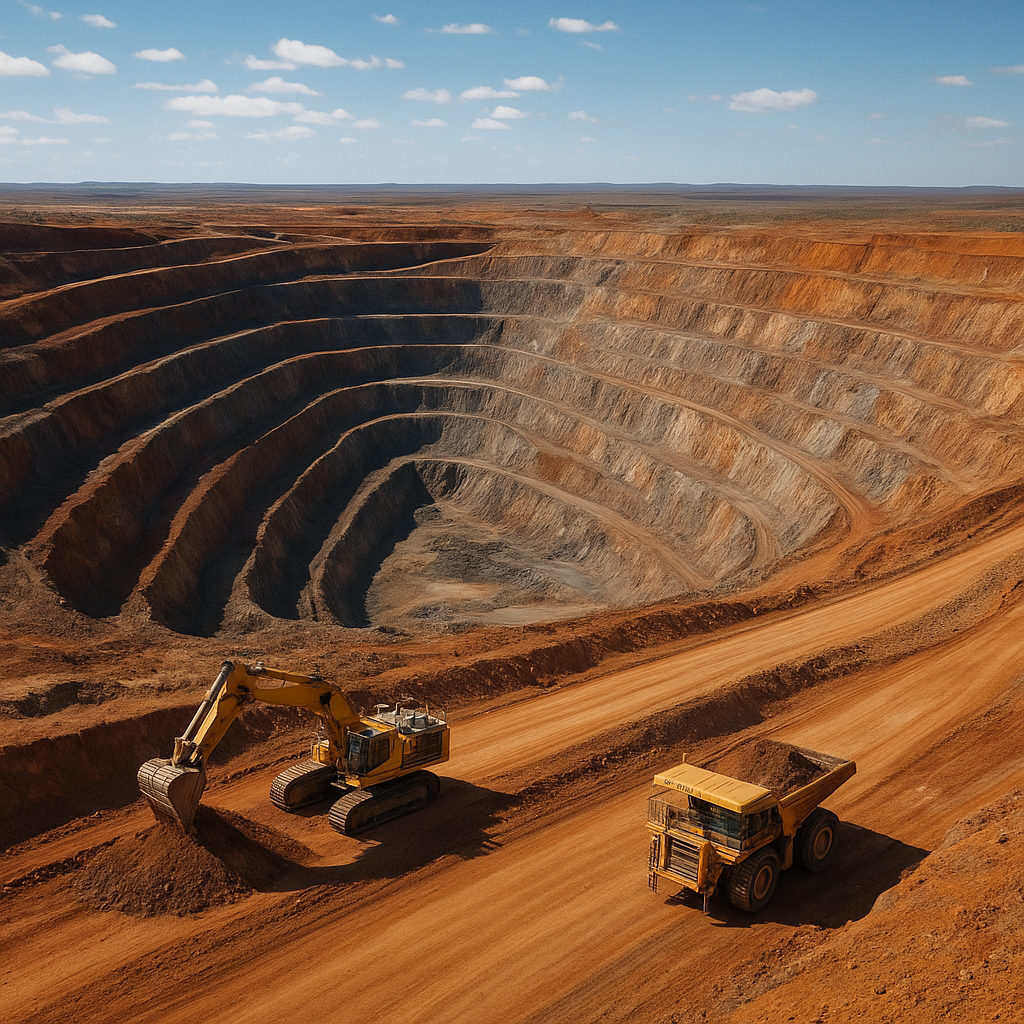
The Telfer mine is a notable and long-running mining operation located in the remote interior of Australia. It combines both gold and copper production in a rugged desert environment and has played an important role in the development of Western Australia’s mining industry. This article outlines where the mine is, what is extracted there, how it is mined and processed, its economic role, and several aspects that make Telfer particularly interesting.
Location and historical background
Telfer is situated in the Great Sandy Desert region of Western Australia, in an isolated area well inland from the state’s northern coast. The mine lies hundreds of kilometres from major ports and regional centres, which has shaped the way it is serviced and operated: most personnel travel on a fly-in fly-out roster and supplies arrive by long-haul road or air. The remote location has required the construction of extensive onsite infrastructure, including an airstrip, accommodation village, power generation and water supply systems.
The discovery and development of the deposit span several decades. Since its identification, the Telfer deposit has been developed into a multi-faceted operation featuring both large open pits and deeper underground workings. Over time the site has been modernised and expanded to maintain production as the near-surface ore was exhausted, and the mine now forms part of a portfolio of assets contributing to Australia’s position as a leading global producer of precious and base metals.
Geology and mineralisation
Telfer hosts a complex mineralised system in which gold and copper occur together, with variable grades and zonation. The mineralisation includes near-surface oxide and transitional zones as well as deeper sulphide-rich domains. These variations require adaptable mining and processing strategies to recover the different metal species efficiently.
Key geological characteristics
- Mixed mineralisation: both gold-rich and copper-rich horizons are present, sometimes overlapping.
- Oxide and sulphide zones: oxide ore is typically amenable to gravity and leach-based recovery, while sulphide ore requires flotation and other metallurgical circuits.
- Stacked deposits: mineralised zones occur at different levels, which has allowed both open-pit and underground extraction methods to be used as the operation matured.
The deposit’s geological setting has attracted significant exploration and technical study because it demonstrates how multi-phase hydrothermal systems can concentrate both precious and base metals within a single district. Ongoing exploration around the established mine has the potential to extend the life of the operation by identifying satellite orebodies and deeper resources.
Mining methods and processing
Telfer is operated as an integrated mining complex combining surface and subsurface mining. The choice of method is dictated by orebody depth, geometry and economics. Early production was dominated by large-scale open-pit operations that exploited near-surface mineralisation, while later phases required development of underground access to reach higher-grade zones at depth.
Surface mining
- Large open pits are used to remove oxide and near-surface transitional ore, employing conventional drill, blast, load and haul techniques.
- Robust earthworks and haul roads are essential due to the arid terrain and the need to transport ore to the processing plant.
Underground mining
- When the orebody extends below economical pit depths, underground mining methods are implemented to exploit deeper high-grade zones.
- Underground development requires ventilation, ground support and a separate materials handling chain to surface processing facilities.
Processing and metallurgy
The mine’s processing plant is tailored to recover both gold and copper. Typical circuits include crushing and grinding, followed by gravity recovery for coarse gold, carbon-in-pulp (CIP) or carbon-in-leach (CIL) processes for gold-rich streams, and flotation to produce a copper-rich concentrate from sulphide ore. Tailings management, water recycling and reagent handling are important components of the processing operation to maximise recoveries and minimise environmental impact.
Economic significance and contribution
Telfer has substantial economic importance at multiple scales: locally for the region, for the state of Western Australia, and nationally as part of Australia’s mining export economy. The combined production of gold and copper contributes to export earnings, government revenues through royalties and taxes, and supports a broad network of contractors and service providers.
Employment and regional development
- The mine provides direct employment and supports hundreds of indirect jobs in transport, equipment maintenance, catering, and other services. These roles are often delivered via regional contractors and service providers.
- Fly-in fly-out arrangements mean workers originate from a wide catchment, bringing spending to regional towns and major cities when rosters allow.
Export and fiscal impact
- Production from Telfer feeds into global commodity markets. Gold contributes to wealth preservation and monetary portfolios globally, while copper is a critical industrial metal used in construction, electrification and electronics.
- Government revenues derived from mining activity include state royalties and corporate taxes, which fund public services and infrastructure in Western Australia and beyond.
The operation’s scale also stimulates investment in logistics and technical services, creating technological and managerial expertise that can be applied across the mining sector. In times of elevated commodity prices, assets like Telfer become especially valuable, prompting reinvestment in exploration and mine-life extension projects.
Environmental stewardship and community engagement
Operating in a fragile desert environment places a strong onus on responsible environmental management. Water is a scarce resource, so efficient water use, recycling and minimising reliance on local aquifers are priorities. Rehabilitation of disturbed land, progressive closure planning and management of tailings facilities are essential components of the mine’s environmental program.
Engagement with traditional owners and communities
The mine exists on the traditional lands of Indigenous communities. Modern operations typically include consultation, heritage management and agreements intended to recognise native title rights where applicable and to provide employment, training and business opportunities for local people. Ongoing engagement is necessary to balance cultural values, land access and economic development opportunities.
- Heritage surveys and avoidance measures are used to protect culturally significant sites.
- Local procurement and training initiatives aim to increase Indigenous participation in the mine’s workforce and supply chain.
Operational challenges and resilience
Running a large mine in such a remote setting presents a range of challenges: logistics chains are long and weather can be extreme; the cost of power and water supply is higher than for more accessible sites; and workforce welfare must be carefully managed to maintain productivity and safety. Despite these constraints, the operation has demonstrated resilience by adapting to changing market conditions, introducing technical improvements to processing and mining, and by maintaining a focus on cost control.
Infrastructure and logistics
- Onsite power generation, often diesel-based with increasing interest in hybrid or renewable options, is required to run processing and camp facilities.
- Long-haul road transport and air services supply fuel, reagents and spare parts while removing concentrate or bullion for export.
Interesting aspects and innovations
Several features make Telfer noteworthy beyond its commodity output. The combination of gold and copper within the same operation requires integrated technical solutions and flexibility in metallurgical processes. The remote location has driven innovation in camp design, workforce management and contractor integration—models that have been emulated across other Australian remote mines. Further points of interest include:
- Operational adaptability: transitioning from large open pits to deeper underground mining showcases the ability to evolve a long-life operation.
- Technical integration: combined gold and copper recovery routes require coordinated metallurgical planning and process optimisation.
- Remote logistics: the need to sustain continuous operations in an isolated desert has driven advances in supply-chain reliability and emergency planning.
- Community programs: partnerships with Indigenous groups and local service providers represent a model of regional engagement that seeks mutual benefit.
- Exploration potential: ongoing exploration in the surrounding terrain keeps open the possibility of discovering satellite deposits that could extend mine life and diversify production.
Future prospects
The future of a complex mine like Telfer depends on a mix of factors: commodity prices, successful exploration, efficient operations and continued social licence to operate. Given the global demand for both gold and copper—gold for financial and jewellery markets, copper for electrification and infrastructure—assets that can produce both metals are strategically valuable. Continued investment in exploration, processing improvements and environmental performance will determine whether Telfer remains a significant contributor to Australia’s mining output in the years to come.
Notable keywords highlighted in this article include: Telfer, Australia, gold, copper, Newcrest, open-pit, underground, export, employment and royalties.

