
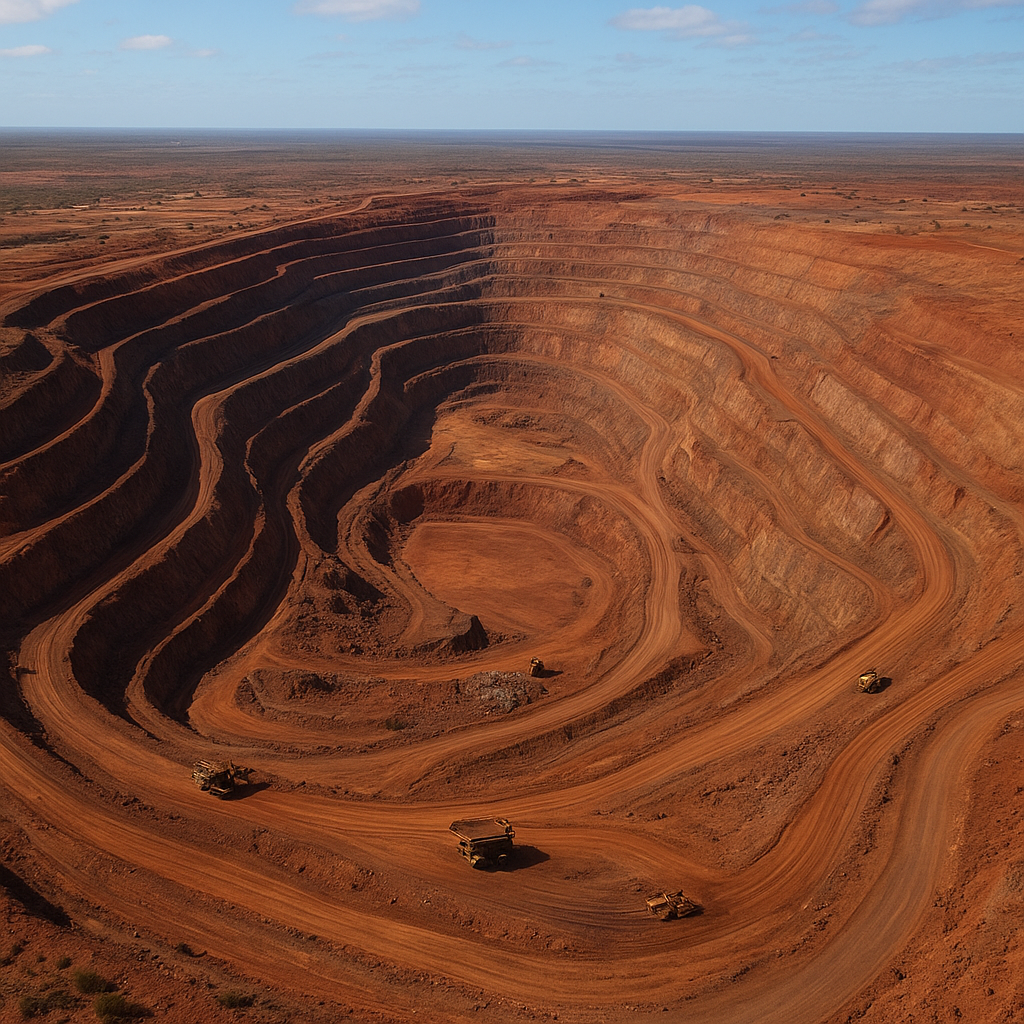
The Koolyanobbing Mine, situated in the heart of Western Australia’s mineral-rich Yilgarn region, is an important source of iron ore that has shaped the economic and industrial life of its surrounding communities. Its operations feed global supply chains, link remote landscapes to port infrastructure and reflect broader trends in mining technology, logistics and environmental management. This article explores the mine’s location and geology, the nature of the ore and mining methods, its economic significance, and a selection of technical and cultural facts that make Koolyanobbing a noteworthy site in Australia’s resource map.
Location and geological setting
Koolyanobbing lies approximately 370 kilometres east of Perth, near the small town of Southern Cross in the Yilgarn Craton — one of the oldest and most geologically complex parts of Australia. The region is recognized for its extensive greenstone belts and ancient banded iron formations (BIF), which are the principal host rocks for the iron deposits mined at Koolyanobbing. The mine site itself is located within the Shire of Yilgarn and sits among low, undulating ranges, scrubland and outcrops typical of the southwestern margin of the Australian continent.
Geologically, the iron resources at Koolyanobbing derive from weathered and oxidized BIF units where primary magnetite and hematite have been enriched or liberated by natural weathering processes. These near-surface ironstones are often associated with lateritic mantles and show textural varieties including massive hematite, pisolitic ironstone and goethite-rich zones. The hematite-dominated character of the ore contributes to its suitability as a direct-shipping-grade material after appropriate processing and screening.
History of discovery and development
The broader Southern Cross–Koolyanobbing corridor has a history of mineral exploration dating back to the 19th and early 20th centuries, with prospectors first recognizing the economic potential of the region’s iron-bearing rocks. Over time, geological mapping, drilling campaigns and metallurgical testwork refined understanding of the deposits, and by the mid-20th century interest in developing commercial-scale iron ore operations had grown.
Development of Koolyanobbing as a formal mining operation followed the pattern of many Australian iron projects: detailed resource evaluation, local infrastructure build-up and integration with rail and port logistics to enable export. The mine’s proximity to the Esperance port — connected by an established rail corridor — made Koolyanobbing a viable candidate for sustained production and export to international markets.
Mineralogy, ore types and processing
Ore characteristics
The iron ores at Koolyanobbing are predominantly hematite and goethite derived from BIF. These ores are typically weathered and occur as soft to moderately hard ironstone that can be mined by conventional open-cut methods. The mineralogical composition commonly yields ores with sufficient iron content to be attractive to international buyers, particularly after simple beneficiation such as screening, crushing and blending.
Processing and product types
Processing at Koolyanobbing is generally focused on removing unwanted material and producing a consistent product specification suitable for steelmakers. Typical processing steps include primary crushing, screening to remove fines or oversize material, and blending of different ore types to achieve target grades. The mine historically produces direct-shipping ore (DSO) and lump/fines products that are loaded onto rail wagons and transported to the port at Esperance for export.
Although the ores are often suitable for export without intensive beneficiation, metallurgical testwork is routinely performed to determine grindability, sintering behaviour and the optimal blend for customers. This technical information is central to maintaining product value and meeting contractual quality requirements.
Mining methods and infrastructure
Koolyanobbing operates as an open-pit iron mine. Conventional drill-and-blast followed by excavator and truck haulage is the typical method employed to extract ore and transport it to onsite processing and stockpiling areas. The scale of operations varies with market conditions, resource lifecycle and rehabilitation schedules, but the essential steps remain focused on safe, efficient removal of ore, control of overburden and progressive rehabilitation of disturbed areas.
- Rail: The mine is connected by rail to the port of Esperance, a key logistical artery for export. Rail haulage enables bulk movement of ore over long distances and integrates with the broader Australian freight network.
- Port: Esperance Port handles loading and shipping of Koolyanobbing ore to international buyers, predominantly in the Asia-Pacific region. Port facilities and loadout systems are configured to manage the lump and fines product categories.
- Onsite facilities: Crushing, screening, stockpiles and maintenance workshops support continuous operations. Water management, fuel supply and worker accommodation are also essential infrastructure elements in this remote environment.
Economic significance
The economic role of Koolyanobbing extends from local employment to contributions to state and national export earnings. Mining operations create direct jobs in extraction, processing and site services, as well as indirect employment in logistics, port services and regional supply chains. For small towns like Southern Cross and surrounding communities, the mine is a significant employer and a driver of local business activity.
At a broader level, iron ore from Koolyanobbing participates in Australia’s position as one of the world’s largest iron ore exporters. Even though Koolyanobbing is not as large as some of the Pilbara operations further north, its products help diversify the national export base and provide feedstock for steelmakers in Asia. The revenue from ore shipments generates government royalties, corporate taxes and investment in infrastructure, reinforcing the mining sector’s strategic economic importance.
Market linkages
Export customers typically include steel producers and traders who value consistent, well-specified iron ore products. The mine’s ability to deliver regular shipments to Esperance and onto ocean carriers allows it to slot into long-term supply chains. Price volatility in the global iron market influences production rates, but steady demand for iron feedstock ensures Koolyanobbing remains commercially relevant.
Environmental management and rehabilitation
Mining in sensitive landscapes inevitably raises environmental considerations. At Koolyanobbing, operators implement water management plans, dust suppression measures and progressive rehabilitation to mitigate impacts on local ecosystems. The region supports native flora and fauna, some of which are adapted to the old-growth and scrubland conditions, and handling biodiversity is a regulatory and ethical priority.
- Progressive rehabilitation: Topsoil management, recontouring of benches and replanting of local species aim to restore post-mining landforms.
- Water and waste: Controlled storage of water, responsible handling of waste rock and monitoring of potential acid-generating material help prevent contamination of surrounding environments.
- Community engagement: Consultation with local stakeholders, including Indigenous communities, helps identify sites of cultural significance and develop mitigation measures.
Regulatory oversight by state authorities requires ongoing reporting and compliance with environmental standards. Advances in rehabilitation techniques and native species re-establishment are gradually improving the post-mining landscape outcomes in the Yilgarn region.
Social and community aspects
The presence of a mining operation in a rural region creates a complex set of social dynamics. Koolyanobbing provides employment opportunities, apprenticeships and business for local contractors and suppliers, strengthening regional economies. Additionally, the mine’s investments in community projects, training and local services can leave a positive legacy.
Conversely, mining also introduces pressures such as increased traffic, changes in housing demand and the need to balance resource development with other land uses like pastoralism and conservation. Responsible operators engage with local councils, community groups and Traditional Owners to align operational practices with community expectations.
Logistics: rail, port and export dynamics
One of the defining logistical features of Koolyanobbing is its reliance on rail haulage to move bulk ore to the coast. The rail corridor to Esperance has historically been a lifeline for the region’s mining and agricultural exports. Trains carrying hopper wagons are assembled at the mine site, travel along the Eastern Goldfields/Esperance lines and arrive at Esperance where ore is transferred to port stockpiles and then onto vessels.
Efficient scheduling, rolling-stock maintenance and coordination with port stevedores are critical to minimizing delays and demurrage costs. The cost and reliability of rail services directly affect the mine’s competitiveness in global markets; consequently, operators work closely with rail infrastructure providers to optimize throughput and address congestion or capacity constraints.
Interesting technical and historical facts
- Koolyanobbing sits within a geologically ancient landscape; the banded iron formations that host the ore record atmospheric and oceanic conditions from billions of years ago and are part of Earth’s deep-time history.
- The mine’s ores often require minimal processing, making them attractive as direct-shipping products that can be loaded and exported without energy-intensive beneficiation.
- Despite its more modest scale relative to mega-operations in the Pilbara, Koolyanobbing demonstrates how regional mines can remain economically viable by integrating efficient logistics and targeted processing.
- Rehabilitation at Koolyanobbing involves reintroduction of local species and experimental trials to re-establish native vegetation on compacted or nutrient-poor substrates, an area where ecological science and mining practice intersect.
- The route to Esperance connects inland mineral wealth with coastal export capacity, illustrating the importance of multimodal infrastructure in Australia’s resource economy.
Challenges and future prospects
Like many mineral projects, Koolyanobbing faces market, environmental and operational challenges. Fluctuations in global demand for iron ore, shifts in steelmaking feedstock preferences and competition from larger, lower-cost mines influence strategic decisions about production volumes and investment. Environmental regulations, community expectations and rehabilitation obligations also shape long-term planning.
On the opportunity side, advances in mining equipment, automation, ore sorting and blending technologies can improve recovery rates, reduce costs and lower environmental footprints. Moreover, maintaining strong relationships with rail and port operators helps ensure that Koolyanobbing can continue to move product competitively to international customers. Mineral Resources and other industry players continually assess how best to extend mine life, enhance product quality and integrate sustainability initiatives into operations.
Why Koolyanobbing matters beyond its tonnage
Beyond the raw volumes of ore shipped, Koolyanobbing exemplifies several broader themes in modern mining: the interplay between ancient geology and contemporary industry; the role of logistical networks in enabling remote operations; and the increasing emphasis on environmental stewardship and community engagement. The mine’s contribution to local employment and regional services highlights how even medium-scale projects are integral to rural economies.
In addition, the scientific value of the site’s banded iron formations gives Koolyanobbing a place in geological research. Studies of these rocks inform our understanding of Earth’s early atmosphere and the processes that concentrated iron into economically extractable deposits. This coupling of scientific interest and industrial activity is a distinctive feature of many Australian mineral provinces.
Additional resources and directions for exploration
Those interested in learning more about Koolyanobbing may consult geological surveys, state mining reports and company disclosures for up-to-date data on resources, production and environmental performance. Technical papers on the mineralogy and metallurgical characteristics of Yilgarn ironstones provide deeper insight into processing challenges, while local histories and community records offer perspectives on the social impact of mining in the Southern Cross region.
Whether viewed as an economic asset, a geological archive or a community cornerstone, Koolyanobbing occupies an important niche in Western Australia’s mining landscape. Its operations continue to link ancient rocks to modern steel production, connecting inland reserves to global industrial demand through an integrated network of rail, port and maritime logistics.

