
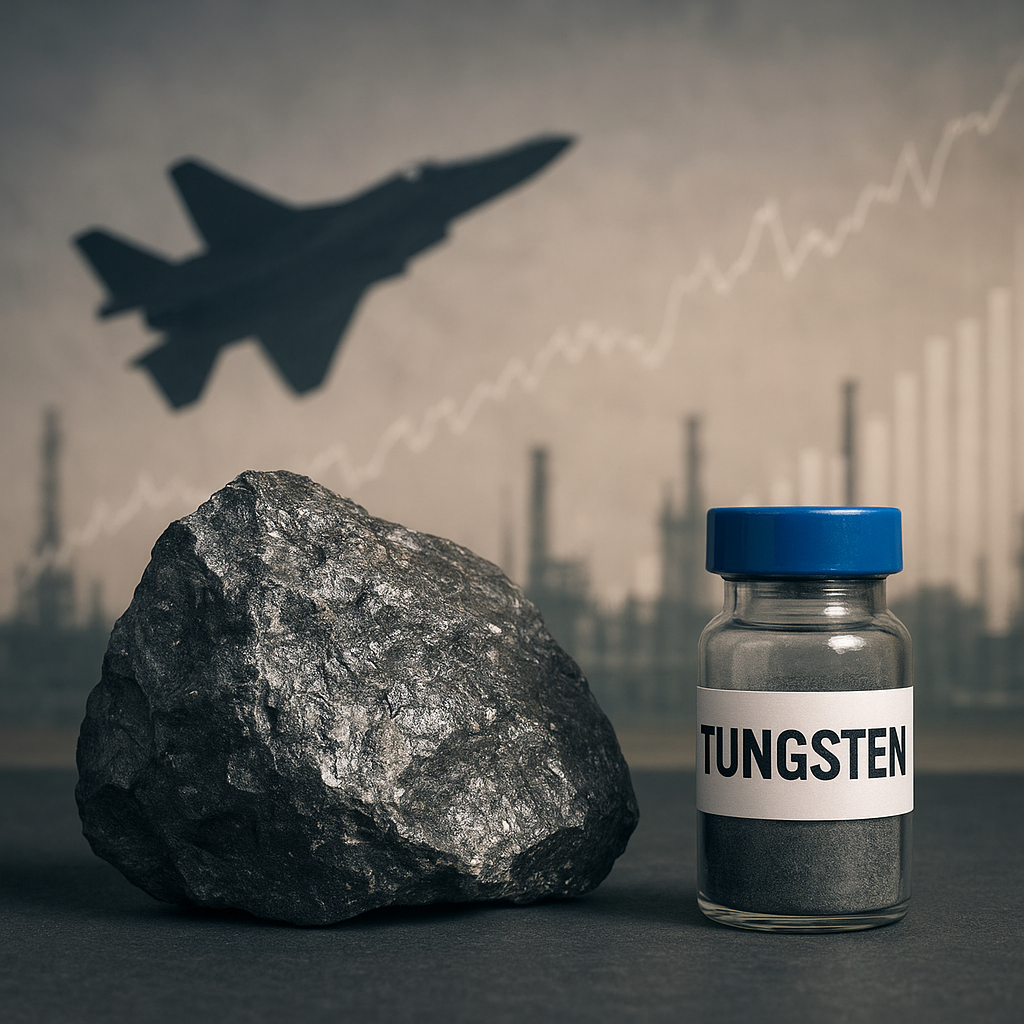
The strategic role of tungsten in modern military technology cannot be overstated. As a high-density, high-performance metal, tungsten underpins a wide range of defense capabilities — from armor-piercing munitions to hardened components in aircraft engines and precision guidance systems. Growing geopolitical friction and concentrated control over extraction and processing create acute supply risks for defense planners and industrial manufacturers. This article examines the nexus between the global tungsten market and the defense sector, explores specific vulnerabilities, and outlines practical mitigation pathways for reducing harmful dependence while maintaining operational readiness and technological superiority.
Geopolitical concentration and supply chain vulnerabilities
Tungsten is a critical mineral because of its unique physical properties: the highest melting point among metals and a density comparable to gold. Despite its global geological distribution, the commercial mining, beneficiation, and refining are heavily skewed toward a small group of countries. China in particular holds a dominant position in both raw output and refined tungsten intermediate materials, which translates into disproportionate influence over global pricing, availability, and downstream manufacturing.
Several structural features amplify the supply risk:
- High concentration of processing capacity: Even when ore deposits exist outside China, the alloy powders, tungsten carbide, and metal forms used in defense manufacturing are frequently processed in Chinese facilities.
- Long lead times and single-source dependencies: Certain specialized tungsten products have only a handful of qualified manufacturers worldwide, compounding the risk that a disruption at a single plant or in one country can ripple across defense supply chains.
- Export controls and trade policy leverage: Geopolitical tensions can, and have, resulted in temporary or permanent export restrictions of materials and precursor chemicals, leaving defense producers with limited alternatives on short notice.
- Environmental and permitting constraints: New mining projects face long environmental review cycles and local opposition, slowing the capacity to scale up non-dominant sources in response to shocks.
Sources and processing bottlenecks
Primary tungsten ores (wolframite and scheelite) are mined in places such as Vietnam, Bolivia, Portugal, Canada, and the United States, but ore concentrate typically requires complex chemical processing to produce ammonium paratungstate (APT) and then tungsten metal powders or carbides. These downstream stages are capital- and technology-intensive. The resulting mismatch between global ore distribution and refining capacity is a structural vulnerability in defense supply chains that rely on just-in-time procurement and high-trust supplier networks.
Importance of tungsten to defense applications
Within the military domain, tungsten serves multiple high-value roles. It is integral to kinetic energy penetrators, penetrator cores, and sub-caliber projectiles due to its high density and hardness. Tungsten carbide and heavy-metal alloys are used in components that require wear resistance and dimensional stability under extreme pressure and temperature — for example, in rocket nozzles, guidance actuators, and helicopter gearbox parts. The munitions and aerospace sectors are particularly sensitive to interruptions in tungsten supply because certification and qualification processes for substitute materials are lengthy and expensive.
Why substitution is difficult
Alternatives such as depleted uranium (DU) bring political and environmental complications, while specialized steels and composites usually cannot match the combination of density, hardness, and thermal stability offered by tungsten. Moreover, shifting to a substitute often requires redesign of munitions and requalification throughout the procurement lifecycle. Consequently, short-term supply shocks cannot be alleviated simply by swapping in another material without degrading performance or raising other strategic concerns.
Lifecycle considerations: from manufacture to demilitarization
Defense systems have long service lives, during which components containing tungsten may require repair or replacement many years after initial procurement. Demilitarization and disposal of spent munitions and hard-metal parts present opportunities for recovery, but also legal, environmental, and logistical challenges. Proper end-of-life management could increase available secondary tungsten, but requires coordination among defense agencies, contractors, and recyclers.
Mitigation strategies: diversification, stockpiles, recycling, and R&D
Reducing vulnerability requires a multipronged approach that reflects the technical complexity and geopolitical sensitivity of tungsten supply chains. No single policy can eliminate risk, but a combination of short-, medium-, and long-term measures can materially improve resilience.
- Strategic stockpiles: Governments and large defense contractors can maintain prioritized reserves of critical tungsten forms (e.g., powder, rods, carbide) to buffer against temporary disruptions while allowing maintenance of production schedules.
- Diversification of supply: Investing in mining, processing, and manufacturing capacity outside dominant countries reduces geopolitical leverage. Public-private partnerships and incentives can accelerate the development of qualified processing facilities in allied countries.
- Recycling and circular economy: Scaling technologies to recover tungsten from scrap — especially from decommissioned munitions and industrial hardmetal waste — can create a secondary supply stream. Recycling reduces dependence on primary mining and mitigates environmental impacts.
- Qualification pathways for substitutes: Investing in research to accelerate testing and certification of alternative materials or new tungsten-containing composites can provide options during prolonged supply constraints.
- Supply chain mapping and near-shoring: Detailed audits of upstream processing steps and supplier concentrations help identify pinch points. Near-shoring critical processing steps reduces exposure to abrupt export controls or trade disruptions.
- Allied cooperation: Multilateral coordination — including shared stockpiles and joint procurement arrangements among allies — spreads risk and enhances leverage in negotiations with dominant suppliers.
Technology and industrial policy levers
To implement these strategies, governments can use tools such as tax credits, guaranteed purchase agreements, direct investment in pilot processing facilities, export-control alignment with allies, and grants for recycling technology development. Encouraging dual-use investment with civil-sector applications (for example, cutting tools, cemented-carbide manufacturing, and electronics) helps create a broader industrial base that can scale in response to defense demand.
Operational and procurement implications for the defense sector
Defense organizations must embed material-risk assessments into acquisition processes. That includes early-stage identification of single-source items containing tungsten, requiring contingency plans such as dual sourcing or mandated inventory buffers. Procurement contracts can include clauses guaranteeing access to essential feedstocks or flexible timelines for substitution where technically feasible.
Additionally, contractors and defense procurement offices should adopt a supply-chain resilience framework that includes:
- Routine supplier stress-testing and scenario analysis for geopolitical shocks;
- Investment in alternative manufacturing techniques such as additive manufacturing for tungsten composites, which may reduce reliance on traditional processing;
- Collaboration with national labs and universities on advanced metallurgical processes that enable partial substitution or more efficient material usage;
- Clear policies for the collection and recycling of tungsten-bearing components at end-of-life.
Balancing security, cost, and performance
Implementing resilience measures often raises unit costs or requires up-front public investment. Policymakers and defense planners must weigh the increased immediate expense against the national-security costs of being unable to field or sustain critical capabilities. In many cases, modest investments in processing capacity and recycling infrastructure can produce outsized reductions in strategic risk.
Practical recommendations and next steps
To translate strategy into action, stakeholders should prioritize a set of coordinated activities:
- Establish a classified and unclassified inventory of tungsten usage across defense platforms to identify highest-risk applications for targeted mitigation.
- Create incentive programs to attract non-dominant producers and refiners, including regulatory fast-tracks for environmentally responsible processing plants in allied jurisdictions.
- Fund R&D on efficient recycling methods and on advanced materials that reduce tungsten intensity without compromising performance.
- Negotiate multilateral agreements to secure alternative trade routes and emergency procurement channels among allied nations.
- Implement compulsory reporting and visibility requirements for contractors on tungsten sourcing and backward traceability to the refining step.
Addressing the strategic challenge posed by tungsten requires sustained attention at the intersection of industrial policy, procurement, and defense planning. The unique properties that make tungsten indispensable for modern weapons systems also make it a focal point for geopolitical leverage. Proactive measures — from expanding processing capacity outside dominant regions to scaling recycling and building targeted stockpiles — can reduce vulnerability. Successful implementation will depend on close collaboration between governments, defense contractors, and the materials industry to ensure that critical capabilities remain available when needed, without unreasonable exposure to single-source risks and geopolitical coercion.
