
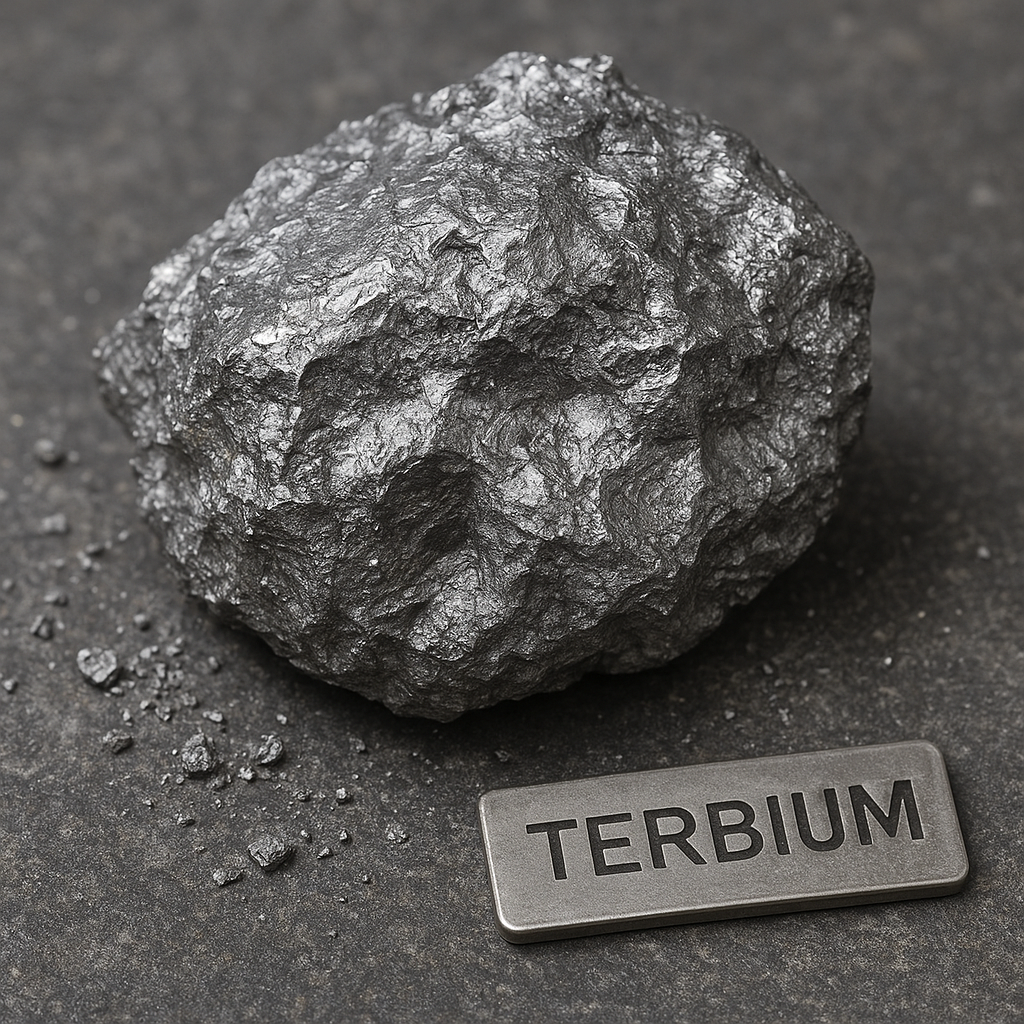
Terbium is a subtle but influential member of the rare-earth family, valued not for mass-market glamour but for a handful of **unique** properties that enable cutting-edge technologies. As a transitional lanthanide element, it often hides in the shadow of its more famous neighbors, yet it plays outsized roles in modern materials science, green light generation, and advanced magnetostrictive devices. This article explores where terbium occurs, how it is extracted and processed, its **chemical** and **physical** traits, practical **applications**, and some of the most intriguing lines of current research involving this metal.
Where Terbium Occurs and How It Is Extracted
Terbium is not found in nature as a free metal but as a minor constituent of a variety of **rare-earth** minerals. It is typically embedded in mixed rare-earth deposits, which makes its separation and isolation a technical challenge. The most important host minerals include:
- Monazite (a phosphate containing several light rare-earth elements)
- Bastnäsite (a carbonate-fluoride rare-earth mineral)
- Xenotime (a yttrium-phosphate mineral that can contain heavy lanthanides)
- Euxenite and allanite (complex minerals that also host rare metals)
Major terrestrial deposits are concentrated in a few locations: China has dominated production for decades, but economically significant deposits are also found in the United States (Mountain Pass), Australia, Brazil, India, and parts of Africa and Russia. Because terbium occurs mixed with many chemically similar lanthanides, commercial separation relies on well-established techniques such as solvent extraction and ion-exchange chromatography. These processes exploit small differences in ionic radii and complexation behavior to isolate **Tb** from neighboring lanthanides like gadolinium and dysprosium. Once separated, terbium is commonly produced as oxides (for example, the mixed-valence oxide often reported as Tb4O7) and then reduced to metal by methods such as metallothermic reduction using calcium or lithium in high-temperature reactors.
Physical and Chemical Properties
The element terbium, with the chemical symbol Tb and atomic number 65, belongs to the lanthanide series. It appears as a soft, silvery-gray metal that is relatively stable in air when freshly prepared, forming a protective oxide layer over time. Some of the key chemical and physical attributes that make terbium useful are:
- Oxidation state: the **+3** oxidation state is dominant in most compounds; mixed-valence oxides and occasional +4 chemistry are known in special environments.
- Electronic configuration: the partially filled 4f shell underpins many of terbium’s **magnetic** and **optical** behaviors.
- Magnetic behavior: terbium exhibits complex magnetic ordering due to interactions among 4f electrons; this yields useful magnetostrictive and magneto-optical properties under specific conditions.
- Optical emissions: the trivalent ion Tb3+ is famous for producing sharp **green** luminescence lines, most notably around 545 nm, which is exploited in lighting and display technologies.
Terbium compounds show strong atomic-like emission lines because the 4f electrons are well shielded by filled outer shells. As a result, **luminescence** from Tb3+ is narrow, intense, and relatively insensitive to the host lattice—features prized by materials scientists.
Applications and Uses
Although usage volumes are small compared with base metals, terbium’s roles are high-value and often critical. Its uses fall into several categories:
Phosphors, Lighting and Displays
One of the most established uses for terbium is in phosphors: materials that convert one form of energy into visible light. The green emission of **Tb3+** is sharp and efficient, making it an important activator in phosphor blends for fluorescent lamps, cathode-ray tubes (historically), and many specialized display technologies. In combination with other rare-earth activators, terbium helps achieve balanced white light or vivid green subpixels in multi-primary systems. In modern solid-state lighting and **OLEDs**, terbium-containing complexes or host lattices are studied for their stability and color purity.
Magnetostrictive Materials and Actuators
Terbium’s most notable industrial application is in magnetostrictive alloys, especially the terbium-dysprosium-iron family of compounds. The alloy commonly known as Terfenol-D (typically Tb-Dy-Fe) exhibits giant **magnetostriction**, meaning it changes shape significantly in response to a magnetic field. This makes it valuable for precision actuators, sonar transducers, vibration control, and energy-harvesting devices. Terfenol-type materials are used in demanding applications such as deep-sea sonar, adaptive optics, and precision valves where compact, high-force actuation is required.
Permanent Magnets and Magnetic Devices
Terbium is sometimes used as an additive in high-performance magnet systems to tailor anisotropy and coercivity, especially for temperature-sensitive applications. Although neodymium-iron-boron (NdFeB) magnets dominate many markets, terbium and dysprosium are used to improve high-temperature performance and resistance to demagnetization in certain grades of magnets.
Advanced Electronics and Spintronics
In research contexts, thin films and heterostructures containing terbium are important for magneto-optical devices, spintronic experiments, and studies of exotic electronic phases. Terbium compounds can be used to create strong spin-orbit coupling environments and to study coupling between magnetic and electric order parameters.
Medicine and Isotope Applications
Beyond stable-element uses, terbium’s isotopes are becoming attractive in nuclear medicine. A family of terbium radioisotopes offers complementary diagnostics and therapeutic possibilities—some isotopes are suitable for positron emission tomography (PET), others for single-photon emission computed tomography (SPECT), and certain alpha- or beta-emitting terbium isotopes are under study for targeted radiotherapy. This “one-element, multiple-modes” potential is sometimes called a theranostic approach, because a single chemical element can provide both diagnostic imaging and therapy when different isotopes are used.
Processing Challenges and Recycling
Because terbium is a minor constituent of mixed rare-earth ores, its commercial availability is closely tied to the economics of the larger rare-earth extraction and refining industry. Separation processes are chemically intensive, often using large volumes of acids, solvents, and ion-exchange materials. Environmental concerns and supply-chain security have encouraged investment into:
- More selective separation methods, including modern solvent-extraction protocols and chromatography.
- Recycling of terbium from end-of-life products such as phosphor powders, magnets, and electronic components.
- Substitution research to reduce demand for critical terbium in certain applications where alternatives can be engineered.
Recycling is technically feasible but commercially challenging because terbium concentrations in many devices are low and recovery requires complex chemical processing. Nevertheless, the strategic importance of rare-earth elements has accelerated funding and innovation in recycling technologies worldwide.
Interesting Research Topics and Compounds
Terbium’s electron configuration and intermediate position in the lanthanide series lead to several fascinating research areas:
Multiferroics and Correlated Electron Systems
Compounds such as terbium manganite (e.g., TbMnO3) are studied for their coupled magnetic and ferroelectric orders. In these materials, magnetic ordering can induce electric polarization, enabling control of electric properties by magnetic fields and vice versa. This coupling could underpin future low-energy information storage and sensor technologies.
Nano- and Bio-applications
Terbium-doped nanoparticles are explored for bioimaging due to sharp luminescent signatures and long decay lifetimes that allow time-gated imaging to suppress background fluorescence. Functionalized terbium complexes are also investigated as luminescent probes in assays and as components in responsive sensors.
Quantum Materials and Fundamental Physics
Thin films and intermetallics containing terbium contribute to the study of low-temperature magnetism, topological textures (such as skyrmions in certain rare-earth-containing lattices), and magneto-optical phenomena. These fundamental studies can ultimately translate into technologies for information processing and secure communications.
Safety, Toxicity and Environmental Considerations
Terbium metal and most stable terbium compounds are not acutely toxic in the way heavy metals such as lead or mercury are, but they should still be handled with care. Fine powders and dusts can be respiratory irritants; soluble salts can pose other hazards if ingested or inhaled. Proper industrial hygiene practices—ventilation, protective equipment, and appropriate waste handling—are standard. Radioactive isotopes of terbium obviously carry radiological risks and are handled only in controlled medical or research settings with regulatory oversight.
From an environmental standpoint, the chemical processes used to extract and separate rare-earths, including terbium, can generate acidic and radioactive waste streams (monazite often contains thorium). Responsible sourcing, improved processing methods, and recycling are therefore key to minimizing ecological impact and ensuring a reliable supply of this strategic element.
Supply, Economics and Strategic Importance
Terbium’s market is small by tonnage but significant by economic and strategic value. Global production is influenced by geopolitical factors, regulatory frameworks in producing countries, and demand from technologies such as green lighting, high-precision actuators, and specialized magnets. Because a few countries dominate different stages of the rare-earth supply chain, securing diversified sources and establishing efficient recycling loops are priorities for many governments and industries.
Investment in substitution research—finding ways to reduce the terbium content in certain devices or to replace it with more abundant elements—runs in parallel with efforts to improve extraction and separation. Both approaches aim to reduce price volatility and dependence on a narrow supplier base.
Concluding Observations
Terbium illustrates how an element present in tiny amounts in the Earth’s crust can have outsized influence through unique **optical** and **magnetic** properties. Whether in the vivid green of a phosphor, the forceful motion of a magnetostrictive actuator, or the specialized isotopes under study for medicine, terbium contributes to technologies where precision and performance outweigh bulk. Continued advances in materials processing, recycling, and targeted application development mean that terbium will remain a focus of both applied industrial effort and basic scientific inquiry for years to come.