
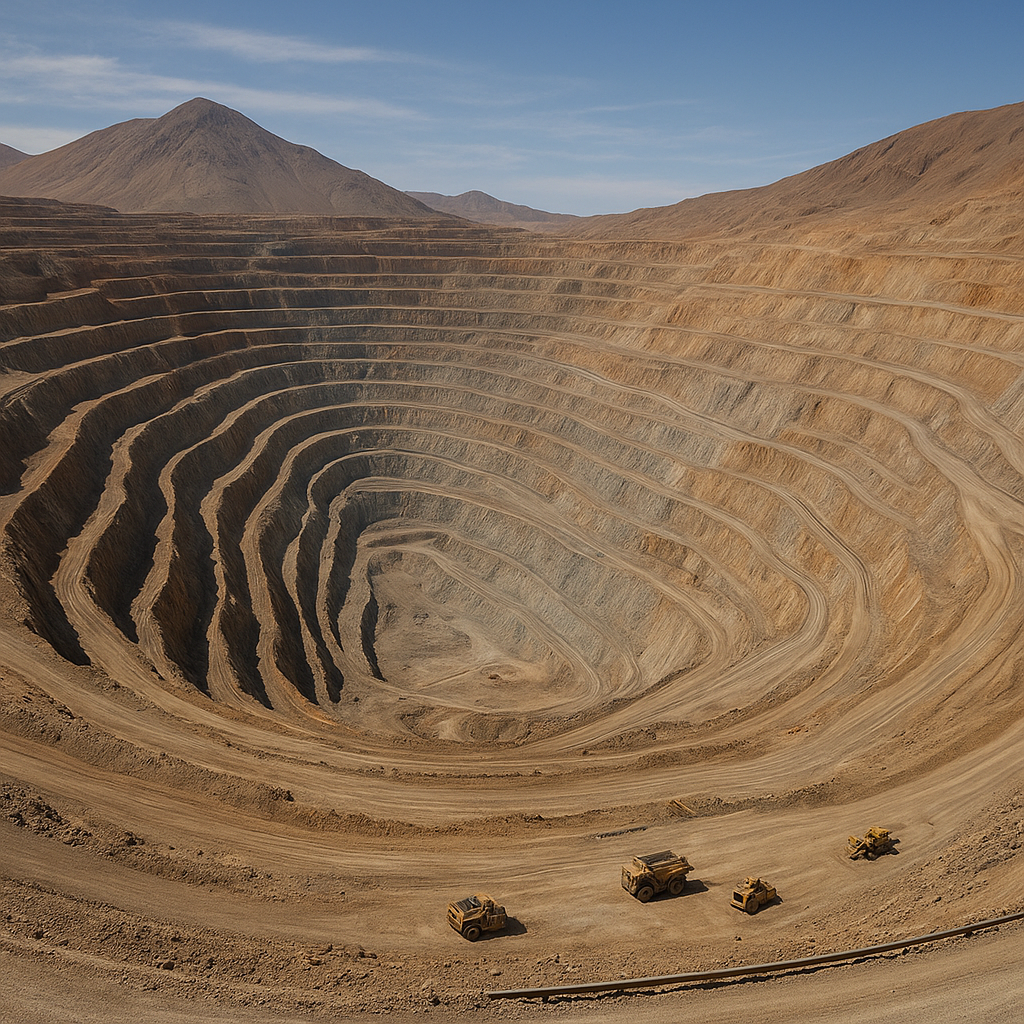
The name Chuquicamata evokes both the scale of modern mining and the long history of human interaction with the Earth’s resources. Located high in the Andes, this mine has shaped regional economies, national policy and global copper markets for more than a century. The following text examines where the mine is located, what is extracted, why it matters economically and socially, and which features make Chuquicamata especially remarkable.
Where Chuquicamata is located and its geological setting
Chuquicamata sits in northern Chile, within the Antofagasta Region, not far from the city of Calama. The mine is positioned at high altitude on the Altiplano plateau, typically above 2,700 meters (8,860 feet) above sea level. That elevated, arid setting shapes everything about how the mine operates, from logistics and water use to worker housing and transport links.
Geological character
The deposit at Chuquicamata is a classic example of a porphyry copper system — a large, disseminated body of copper-bearing rock associated with felsic to intermediate intrusions. Porphyry systems are prized because they form huge, relatively low-grade ores that are economically viable when mined at scale. The ore at Chuquicamata contains copper together with by-product metals such as molybdenum and trace amounts of gold and silver. The combination of size and continuity of mineralization is what turned this site into one of the world’s most important copper sources.
Landscape and climate implications
The mine’s location in an arid highland basin means scarce surface water and extreme diurnal temperature swings. These conditions demand engineered solutions for water supply, tailings management and equipment maintenance. Furthermore, the high altitude affects human physiology and operational safety, so mining schedules and worker accommodations are designed to mitigate altitude-related risks.
What is extracted and how: mining methods and technologies
Chuquicamata has historically been synonymous with large-scale, mechanized extraction of copper. For most of the 20th century it was best known as one of the world’s largest open-pit mines, with a pit that became famous for its sheer size and depth. In recent decades, as the pit reached ever greater depths and the economics of mining changed, operators began a staged transition toward underground extraction to access deeper ore safely and economically.
Open-pit era
During the open-pit phase, massive benches and haul roads were carved into the rock, and giant trucks and shovels moved tens of thousands of tonnes of material daily. Material handling, primary crushing, grinding and flotation circuits produced copper concentrates that were transported by rail and road to smelters and ports. The visual scale of the pit — with terraced walls and a vast void at its center — made Chuquicamata symbolic of modern extractive capacity.
Transition to underground mining
As the open pit deepened, the cost and difficulty of removing overburden made it less economical to continue surface mining at greater depths. The modern project emphasizes systematic underground mining using block caving and other mass-mining techniques suitable for large, low-cost extraction. Underground operations reduce the surface footprint and can reach ore bodies that would be prohibitively expensive to mine by open pit.
Processing and product
Ore extracted at Chuquicamata is processed to produce copper concentrates and refined copper cathode. Processing includes comminution (crushing and grinding), flotation to concentrate sulfide ores, and subsequent metallurgical steps including smelting and refining. Over its life, the mine has supplied raw material to both domestic and international smelters, linking Chuquicamata to the global supply chain for electrical wiring, electronics, renewable energy systems and industrial applications.
Economic significance: local, national and global impacts
Chuquicamata has been central to the economic development of northern Chile and to the country’s stature as the world’s leading copper producer. The mine helped catalyze infrastructure investments — railways, roads, power lines and water conveyance projects — that enabled broader economic activity in the region.
National revenue and ownership
Since nationalization in the early 1970s, the mine has been operated by the state-owned copper company Codelco (Corporación Nacional del Cobre de Chile). Codelco’s revenues from Chuquicamata and other assets have been a major source of government income, financing public expenditures and contributing to Chile’s fiscal stability. The economic model in Chile links mineral rents to national budgets, social programs and reinvestment in public goods.
Employment and local economies
At its peak, Chuquicamata employed thousands directly and supported many more through secondary services — suppliers, transporters, maintenance firms and local commerce. While mechanization and automation reduce labor intensity over time, the mine remains a significant employer and an anchor for the Calama metropolitan area and adjacent communities.
Contribution to global copper supply
On the world stage, Chuquicamata’s long-term output has been part of the foundation of the modern copper market. Large mines such as this influence global supply dynamics, pricing, and investment flows into mining technology. The presence of such a major asset in Chile helps sustain the country’s leadership in copper exports, which are pivotal for international trade balances and industrial supply chains.
Environmental, social and technical challenges
Large-scale mining inevitably raises environmental and social questions. Chuquicamata’s scale, longevity and arid setting accentuate those challenges, prompting continuous efforts to manage their impacts.
Water and tailings management
Water scarcity in the region requires careful management: processing demands significant volumes of water, and tailings — the finely ground waste from mineral processing — must be stored securely. In recent decades, investments in water recycling, tailings thickening and engineered repositories have become priorities. The mine’s operations are increasingly subject to stricter environmental regulations and community expectations concerning water stewardship.
Air quality and community health
Smelting and processing can generate emissions, and dust from mining activities affects air quality around the site. Mitigation measures include dust suppression, emission control systems and continuous monitoring. Health programs for workers and local communities aim to reduce exposure risks and improve overall public health outcomes.
Social displacement and urban planning
Chuquicamata’s expansion and changes over time led to unique social dynamics, including the relocation of residential areas that once clustered close to the mine. Entire company towns and amenity structures have been reconfigured as operations evolve. Managing the social consequences of relocation, securing long-term livelihoods for affected families, and maintaining cultural ties are ongoing challenges.
History and cultural dimensions
The history of Chuquicamata stretches from pre-Hispanic times through colonial and modern industrial eras. Indigenous peoples were the first to notice and exploit surface mineralization, and the site later attracted prospectors and international mining companies in the 19th and 20th centuries. The mine’s modern industrialization accelerated in the early 1900s, and throughout the 20th century it became a focal point for technological innovation, labor organization and national policy debates.
Labor and community identity
Labor history at Chuquicamata is rich: unions, strikes and negotiations at the mine influenced labor law and social policy across Chile. The company towns and mining culture fostered a distinct identity among residents, with traditions, institutions and social networks built around the rhythm of mining work.
Architecture and heritage
Remnants of the mine’s industrial past and community life — including older processing plants, rail lines and residential neighborhoods — form part of the cultural heritage of the area. Museums and interpretive centers document not only the technical achievements but also the human stories of generations who worked there.
Interesting facts and noteworthy features
- Chuquicamata has been known simply as “Chuqui” among miners and locals — a nickname that underscores its iconic status in Chilean mining culture.
- The mine’s open pit, during its peak, was one of the largest man-made excavations on Earth, visible from space and recognizable by satellite imagery.
- Technological shifts at the site exemplify industry trends: from giant open-pit shovels and trucks to modern, mechanized underground systems focused on cost-efficiency and safety.
- Because of its scale and longevity, Chuquicamata has been a testing ground for innovations in mine planning, ore processing and worker safety protocols.
- The mine’s evolution reflects larger global transitions: rising demand for copper driven by electrification and renewable energy, coupled with the need for improved environmental performance and community engagement.
Future prospects
The future of Chuquicamata will be shaped by resource economics, technological innovation and policy choices. The global push for decarbonization increases demand for copper, essential for electrical infrastructure, electric vehicles and renewable energy systems. At the same time, sustainability pressures require operators to lower environmental impacts, enhance social licensing and pursue circular economy measures like recycling and efficient processing.
Continuous investment in underground mining, automation, digital monitoring and water-conserving technologies will determine how effectively the mine can extend its productive life while reducing per-unit environmental impacts. As a large, long-lived asset, Chuquicamata will likely remain central to Chile’s mining portfolio and to conversations about how to balance resource development with social and ecological stewardship.
Technical and human stories worth noting
Beyond tonnages and revenues, Chuquicamata’s narrative includes human ingenuity and adaptation. Mining engineers developed novel excavation sequences and ventilation systems for high-altitude underground operations. Safety programs evolved to manage risks specific to deep mining. Workforce training programs and technological upskilling have helped local labor forces adapt to increasingly mechanized and digital workplaces.
On a cultural level, songs, literature and local festivals reflect the mine’s imprint on community life. The transition of neighborhoods, the relocation of families and the shifting economic base around Calama illustrate how industrial megaprojects reconfigure landscapes not just physically but socially.
Legacy and the global context
Chuquicamata’s historical role as a major copper source makes it an instructive case study for other resource-rich regions. Its long operational history offers lessons about the importance of adaptive management, transparent governance (given the role of Codelco), and investment in human capital to manage transitions — whether technological, environmental or economic.
Finally, Chuquicamata remains a powerful symbol: of the possibilities and challenges of extracting vital minerals at scale, of the capacity of nations to harness natural wealth for development, and of the ongoing need to reconcile industrial ambition with the imperatives of community well-being and environmental protection. The mine’s story is thus both local and global, technical and human — a complex legacy that will continue to unfold as the world’s appetite for copper evolves.

