
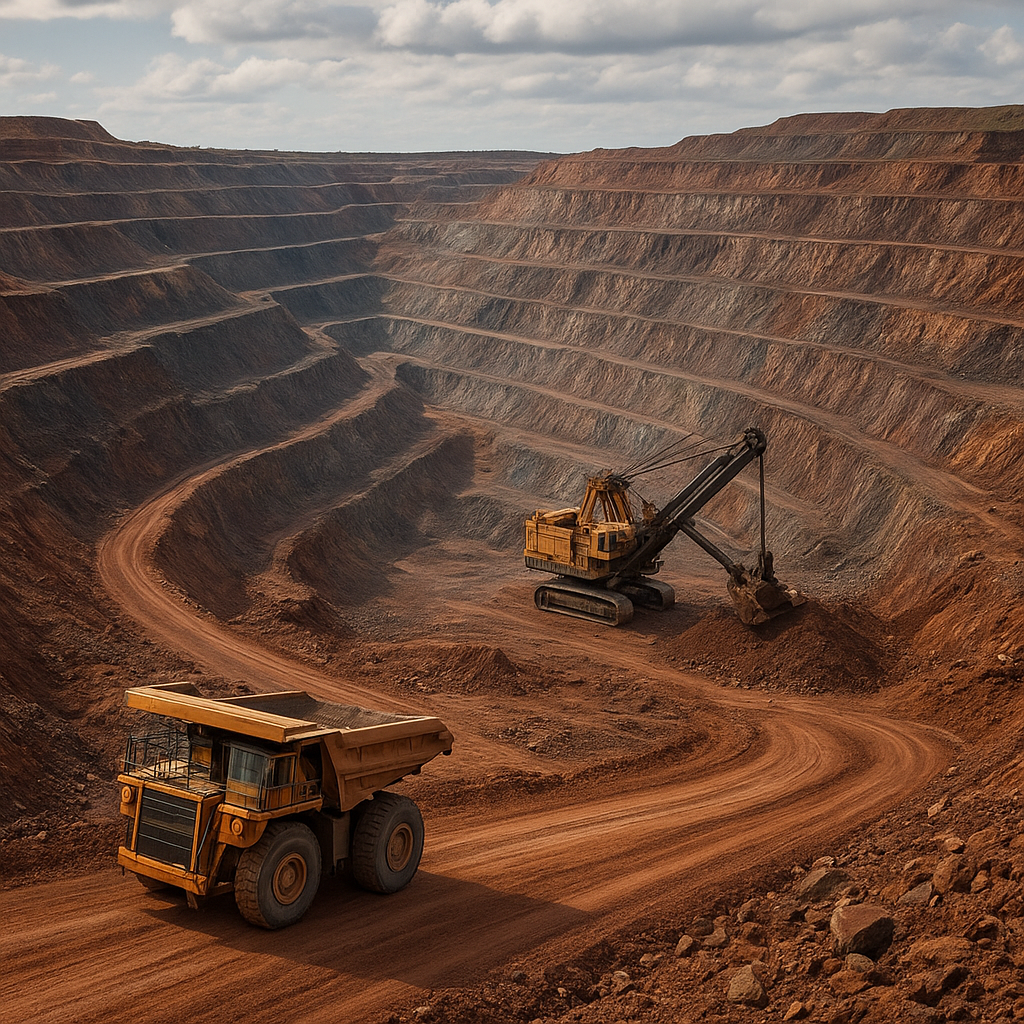
The Kiruna Mine in northern Sweden is one of the world’s most remarkable industrial sites: a giant Kiruna iron-ore deposit that has shaped local life, national industry and global steel markets for more than a century. Located well above the Arctic Circle, this mine combines extreme geography, advanced mining technology and ambitious social and environmental programs. The story of Kiruna is not only about iron extraction but also about how a community and a company manage the consequences of deep‑level production and prepare for a low‑carbon future.
Location, geology and the nature of the deposit
The mine lies in the municipality of Kiruna in Norrbotten County, in the far north of Sweden. The town sits within the Scandinavian mountain region, surrounded by forests, tundra and the characteristic long winters and short summers of the Arctic. The ore body discovered near Kiruna represents a particular type of mineralization often referred to as Kiruna‑type or iron oxide‑apatite deposits. It is exceptionally rich in magnetite and also contains apatite and trace elements.
The ore body is large, elongate and steeply dipping, running for several kilometers underground. While the precise geometry varies, it is sufficiently extensive to justify very large‑scale, long‑lived operations. Mining has progressed downward and outward over decades, so the extraction front is often hundreds of meters below the surface. The location and character of the deposit have dictated the use of mass‑mining methods capable of producing very large volumes at competitive cost.
Mining methods and production
Mining at Kiruna is conducted entirely underground. Historically, the operation has used variations of sublevel and block caving methods that allow the rock mass to break under its own weight and be collected through a network of drawpoints and ramps. These methods are chosen to economically exploit the large, relatively homogenous ore body and to maximize extraction while maintaining safety and cost efficiency.
Over the past decades the mine has become highly mechanized and has progressively adopted advanced equipment and automation. The workforce operates remotely and the fleet includes high‑capacity loaders, crushers and conveyance systems to move ore to processing plants where it is concentrated and pelletized. The concentrated product is then transported by rail to ports on Sweden’s Atlantic coast for export. Production volumes at Kiruna have made Sweden one of the world’s leading iron ore exporters, with the mine contributing a substantial share of national output.
Economic importance and industrial links
The mine is owned and operated by the Swedish state company LKAB, which is central to Sweden’s mining and metallurgy sector. The economic impact of the Kiruna operation extends beyond direct employment in the pit and processing plants: it supports local suppliers, rail and port operations, and downstream steelmakers that depend on high‑quality iron feedstock. Revenue from iron ore exports has been an important source of foreign exchange and industrial income for Sweden for more than a century.
Locally, the mine has been the main employer and economic driver. Entire neighborhoods, service industries and municipal finances have been structured around mining. Nationally, the ore supplies steel industries across Europe and the world, making Kiruna an essential node in global metal supply chains. The mine’s output is prized for its relatively high iron content and suitability for pelletizing, which improves efficiency in blast furnaces and direct reduction plants.
Social dimension: town relocation and community impact
One of the most striking social consequences of deep mining at Kiruna has been the decision to relocate parts of the town to safer ground. As underground extraction progressed, ground deformation and subsidence risk made large areas of the original town center unsafe. This led to a major, long‑term urban planning project involving the movement of tens of thousands of residents, the careful relocation of historically significant buildings and the construction of new residential and municipal infrastructure.
The relocation is unique in scale for a modern European town and has required intricate planning between the company, local government and residents. Some buildings have been moved intact, including important cultural landmarks, while other structures have been newly built in the designated relocation area. The effort illustrates how modern mining can force nonlinear interactions between industry and community and how adaptive strategies can preserve cultural heritage while addressing safety and economic continuity.
Environmental challenges and sustainability initiatives
Mining inevitably brings environmental challenges — landscape disturbance, energy consumption, tailings management and emissions connected with ore processing and transportation. At Kiruna, these issues are addressed through a combination of technology, regulation and long‑term planning. LKAB and Swedish authorities emphasize environmental monitoring, rigorous water and waste management, and progressive restoration of disturbed areas.
In recent years, the company has placed strong emphasis on sustainability and low‑carbon transformation. Initiatives include electrification of the mining fleet, more energy‑efficient processing, and research into hydrogen‑based direct reduction methods that could drastically reduce CO2 emissions from pellet production. Pilot projects aim to eliminate fossil fuel use in key parts of the value chain, aligning with Sweden’s broader climate goals and the global push for greener steelmaking.
New technologies tested at Kiruna — such as electric heavy machinery, remote operation, and potential carbon capture and utilization — could set benchmarks for the mining industry. These innovations are not only technical but also organizational, affecting labor skills, supply chains and the economics of iron production in a decarbonizing world.
Interesting facts, history and cultural context
The history of mining in the Kiruna area spans well over a century. The development of the mine accelerated in the late 19th and early 20th centuries, turning a remote Arctic community into an industrial hub. Kiruna’s growth was intertwined with the expansion of the Swedish rail network and with global industrialization, when demand for iron surged.
- Kiruna town is located above the Arctic Circle, so it experiences the phenomena of the midnight sun in summer and polar night in winter — features that shape local life and tourism.
- The mine has attracted visitors and researchers fascinated by its size and the engineering solutions used to exploit such a deep deposit. Guided tours and a visitor center offer perspectives on modern mining and geology.
- The relocation of parts of the town included moving historic structures; the project has become a case study in urban transformation driven by industrial activity.
- Because the deposit is particularly rich in magnetite, the material is amenable to magnetic separation and pelletizing, processes that improve transport efficiency and furnace performance.
Technological innovation and research directions
Kiruna has often served as a testbed for new solutions in large‑scale underground extraction. Innovations include automation of haulage and loading, using data analytics for resource planning and predictive maintenance, and experimenting with electrified and battery‑driven fleets to reduce local emissions and improve energy efficiency.
Beyond equipment, research at Kiruna touches on metallurgy and the decarbonization of steel production. Collaborations among industry, academia and government are exploring how to integrate renewable energy and hydrogen into mineral processing. If successful, such approaches could convert high‑grade iron concentrates and pellets into steel with a much smaller carbon footprint, thereby increasing the long‑term value of the ore mined at Kiruna.
Logistics, export markets and global significance
After concentration and pelletizing, the product leaves Kiruna by rail on specialized ore trains. These trains travel hundreds of kilometers to ports that can handle bulk carriers for export. The mine’s output supplies steel mills across Europe and beyond, meaning that developments at Kiruna have ripple effects on steel availability, prices and technological choices in downstream industries.
Access to high‑quality pellet feedstock is strategically important for countries aiming to decarbonize steel production. Thus, Kiruna’s role is not only economic in the narrow sense but also strategic in broader discussions about secure, low‑carbon material supply chains.
Future outlook and ongoing challenges
Looking ahead, the Kiruna Mine will continue to balance resource extraction with social and environmental responsibilities. The relocation project will proceed for years, the technical challenges of deep mining will require ongoing innovation, and climate policy will push the operation toward lower emissions. At the same time, the world’s need for raw materials to build infrastructure and renewable energy systems ensures that high‑quality iron ore will remain in demand.
How the operation adapts — through innovation, changing workforce skills and investment in green technologies — will determine its role in the coming decades. The combination of a massive resource base, institutional support and a willingness to experiment positions Kiruna to remain a focal point for the future of global iron supply and the transformation of heavy industry.

