Fluorite is a widely admired and scientifically important mineral composed of calcium fluoride. Its variable colors, perfect cleavage, and striking crystals make it a favorite among collectors, while its chemical properties secure an essential role in numerous industrial processes. This article explores where fluorite forms, how it is identified, its applications from metallurgy to optics, and several intriguing facets of its natural history and cultural significance.
Occurrence and geological settings
Fluorite most commonly occurs in hydrothermal veins, often associated with minerals such as galena, sphalerite, barite and calcite. These veins form when hot, mineral-laden fluids migrate through fractures and cavities in the host rock, precipitating minerals as temperature and chemistry change. Fluorite also appears in sedimentary deposits as a product of diagenetic processes and in cavities within igneous rocks where late-stage fluids crystallize.
Major geological environments for fluorite include:
- Hydrothermal vein systems — particularly in carbonate rocks where fluids can dissolve and later precipitate carbonate and fluoride minerals.
- Replacement deposits — where fluorite replaces limestone or dolostone, creating thick, mineable bodies.
- Pegmatitic and greisen zones in some granitic systems where residual fluorine-rich fluids concentrate late in the crystallization sequence.
- Metasomatic zones adjacent to igneous intrusions, with chemical interaction producing fluorite and associated mineral assemblages.
Notable localities historically and currently producing world-class specimens include:
- Derbyshire, England — home of the famous purple and banded „Blue John” fluorite.
- Weardale, County Durham, England — renowned for green and purple crystals.
- Elmwood Mine, Tennessee, USA — known for sharp cubic crystals with unusual habits and fluorite associated with barite and calcite.
- Cave-in-Rock, Illinois, and other Midwestern U.S. deposits — classic localities for colorful fluorite.
- China (especially Hunan and Inner Mongolia) — major modern source with large, vividly colored crystals.
- Mexico (Durango, Chihuahua) — producing attractive transparent and strongly colored specimens.
- Spain (Asturias) — long history of fine fluorite mining and display specimens.
- Namibia and Morocco — newer sources yielding gemmy and unusual pieces.
Physical and optical properties
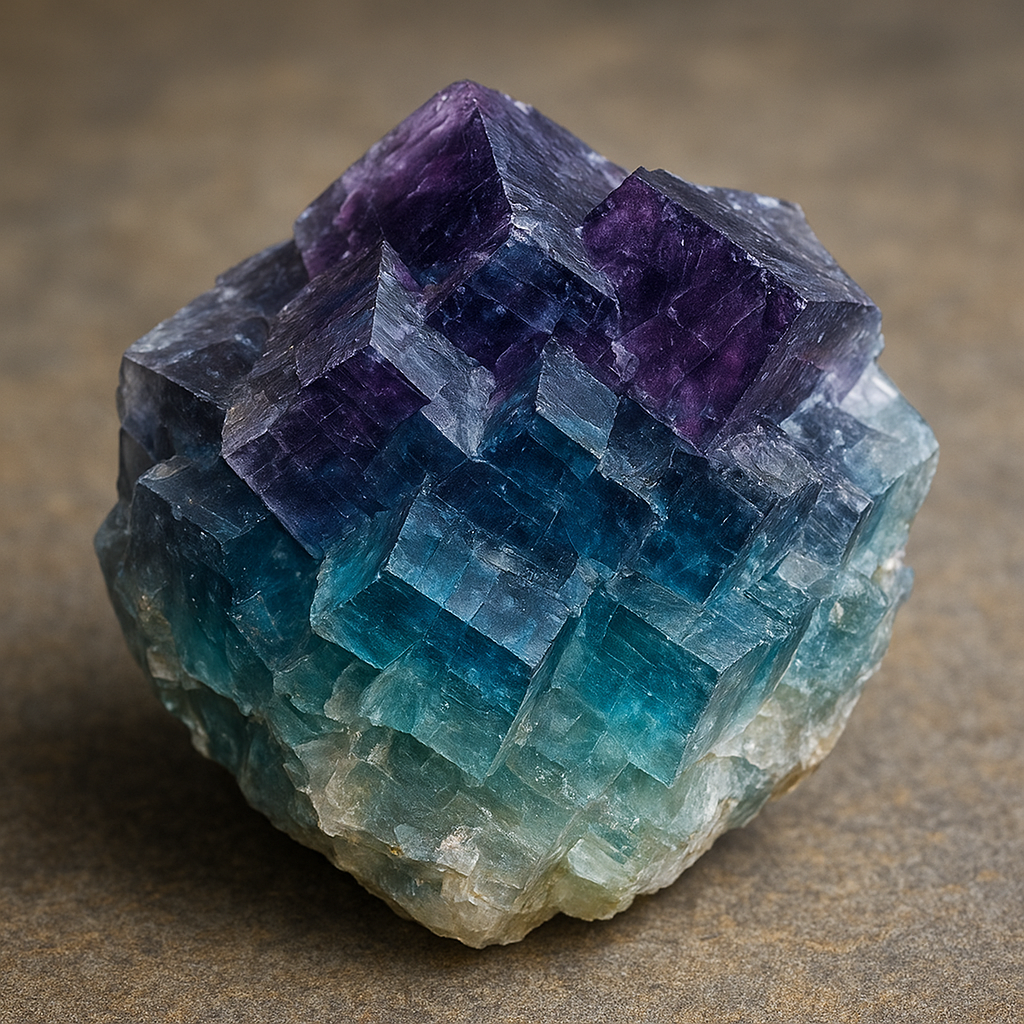
Fluorite crystallizes in the isometric system, typically forming well-developed cubes and octahedra, and sometimes more complex combinations. Its most diagnostic physical attributes include perfect cleavage in four directions (producing octahedral fragments when broken), a Mohs hardness of about 4, and a relatively low specific gravity (~3.0 – 3.3).
Color in fluorite is extremely variable — purple, blue, green, yellow, pink, red, colorless, and even black occur. The causes of color are diverse: trace impurities of rare-earth elements or metals, structural defects, and irradiation effects can all produce or change color. Zoning and banding of color are common and add aesthetic appeal to lapidary work and specimens.
One of the most famous optical attributes of fluorite is its fluorescence under ultraviolet light, a phenomenon first noted and named after specimens of this mineral. The fluorescence can be a diagnostic property and varies among localities: some specimens glow bright blue, others green, red, or white. Separately, fluorite may show thermoluminescence and phosphorescence, reflecting its ability to trap and release energy in different ways.
Optically, natural fluorite is valued for its low dispersion and high transparency in certain wavelengths. Synthetic calcium fluoride (CaF2) is widely used in high-performance optics because of these properties, especially in ultraviolet and infrared systems where ordinary glass is unsuitable.
Uses and industrial applications
Fluorite’s value extends from industry to artistry. The mineral is the principal source of element fluorine for industrial chemistry, and its behavior as a flux in metal production is centuries old.
Chemical industry and fluorochemicals
When processed, fluorite yields hydrogen fluoride (hydrofluoric acid), which is a primary precursor for many fluorine-containing compounds. These include:
- Fluoropolymers — materials such as PTFE (Teflon) used in high-performance coatings and tubing.
- Fluorinated refrigerants and solvents — historically important and now more regulated for environmental reasons.
- Fluoroaromatic and inorganic fluorides — used in pharmaceuticals, agrochemistry, and specialty materials.
Metallurgy and ceramic industries
Fluorite acts as a flux in iron and steel smelting and in the production of certain non-ferrous metals, lowering the melting point of raw materials and improving slag fluidity. It is also used in ceramic glazes and enamels to modify melting behavior and produce certain surface effects.
Optics and high-technology uses
High-purity synthetic CaF2 crystals are used to make lenses, prisms and windows for ultraviolet, vacuum ultraviolet, and infrared applications due to their exceptional transmission and low refractive index variation. Fluorite optics are found in specialized photographic lenses, telescope objectives, lithography tools for semiconductor manufacturing, and military-grade sensor systems.
Gemstone and decorative uses
Fluorite is a favorite for ornamental carvings, inlays, and cabochons. While its softness (Mohs 4) limits use in jewelry subject to wear, collectors prize translucent and vividly colored stones for polished spheres, carvings, and faceted pieces. The term gemstone is applied to the higher-quality pieces that are carefully cut for display rather than daily wear.
Collecting, lapidary work and handling
Collectors prize fluorite for its crystal forms, color zoning and luminescent properties. Because of its ease of cleavage and relatively low hardness, collectors and lapidaries must exercise care when extracting and working the mineral.
Practical collecting and working tips:
- Use padded tools and gentle extraction techniques to avoid cleavage breakage.
- Store specimens away from strong direct sunlight if color fading is suspected; some fluorite varieties may fade with prolonged exposure to light or heat.
- For lapidary work, make use of light cutting and gentle polishing — water or appropriate coolants prevent heat-induced damage.
- When displaying, consider UV sources to highlight fluorescent specimens under controlled conditions.
The lapidary community values fluorite for its vibrant color and polishability. The term lapidary refers to stone cutting and polishing skills applied to produce cabochons, beads and ornamental objects out of this delicate mineral.
Scientific and cultural interest
Fluorite occupies a special niche in both scientific study and human culture. In mineralogy, it serves as a classic example of an isometric halide mineral, and its fluorescence played a key role in developing early photoluminescence research. Fluorite crystals are often used to study crystal growth, zoning and trace element partitioning in hydrothermal systems.
Culturally, several localities have given fluorite special names and lore. „Blue John” from Derbyshire is prized for its purple banding and has been carved into ornamental objects for centuries. Specimens from certain mines have been associated with local legends and have become tourist attractions, further entwining natural history with regional identity.
Educational and museum displays
Museums and educational institutions use fluorite to demonstrate crystallography, cleavage and fluorescence. Display specimens often include UV-exhibit cabinets to show how the mineral responds to long-wave or short-wave ultraviolet light, providing immediate and memorable teaching moments.
Notable scientific properties and research uses
Beyond industrial and decorative uses, fluorite and synthetic CaF2 crystals have roles in advanced research applications. Doped fluorite can act as a host for luminescent activators and rare-earth ions, enabling scintillation detectors and other optoelectronic devices. Research into radiation damage, defect centers, and color center formation in fluorite contributes to material science and solid-state physics.
Because natural fluorite readily records changes in the chemistry of the fluids that formed it, geochemists analyze trace-element zoning patterns and stable isotope signatures in fluorite to reconstruct thermal histories and fluid evolution in ore-forming environments. These studies inform exploration strategies and enhance understanding of how valuable ore deposits form.
Safety and environmental considerations
While handling intact fluorite specimens poses little risk, industrial processing to make hydrogen fluoride and other fluorine compounds involves hazardous chemistry. Hydrofluoric acid is highly corrosive and toxic; adequate industrial controls, personal protective equipment, and regulated procedures are essential where fluorite is chemically processed. Dust created during mining and cutting should be managed to minimize inhalation hazards. Environmental considerations include managing mine tailings, water quality impacts, and reclamation of worked sites to reduce long-term ecological effects.
Interesting facts and curiosities
Several tidbits underscore the mineral’s appeal:
- Fluorite’s name derives from the Latin fluere, meaning „to flow”, a reference to its use as a flux in smelting.
- The phenomenon of fluorescence was named after fluorite because certain specimens glow impressively under ultraviolet light.
- Some fluorite crystals exhibit exceptional clarity and are sought after as small optical elements in historical scientific instruments.
- Collectors prize rare habits such as skeletal cubes, highly lustrous cleaved faces, and large single crystals, some of which have reached museum-quality status and fetched high prices at auction.
- Advanced synthetic CaF2 is produced to extremely high purity for specialized optics and electronics, demonstrating the mineral’s industrial evolution from a natural ore to a precision material.
Practical advice for enthusiasts and researchers
For those interested in collecting or studying fluorite, useful approaches include networking with local mineral clubs, visiting museum exhibits and mineral shows, and reading locality reports and mining histories. Fieldwork in classic districts is a rewarding way to appreciate the geological contexts that produce fluorite, while laboratory techniques such as X-ray diffraction, electron microprobe analysis, and spectroscopy reveal the mineral’s internal story.
Whether admired for its color, sought for industrial chemistry, or used in cutting-edge optics, fluorite remains a mineral of multifaceted significance. Its combination of aesthetic variety and practical utility ensures continued interest from collectors, scientists and industry alike. The study and appreciation of fluorite touch on geology, chemistry, craftsmanship and technology — a mineral that truly bridges natural beauty with human ingenuity.