Agate is a fascinating and widely collected variety of microcrystalline quartz known for its striking banding, wide range of colors and patterns, and durable nature. It has inspired artisans, geologists and jewelers for centuries and appears in contexts from volcanic rock cavities to ancient trade routes. This article explores the geological formation of agate, its global occurrences, its many uses, and the cultural and scientific roles this versatile stone has played over time.
Formation and Geological Characteristics
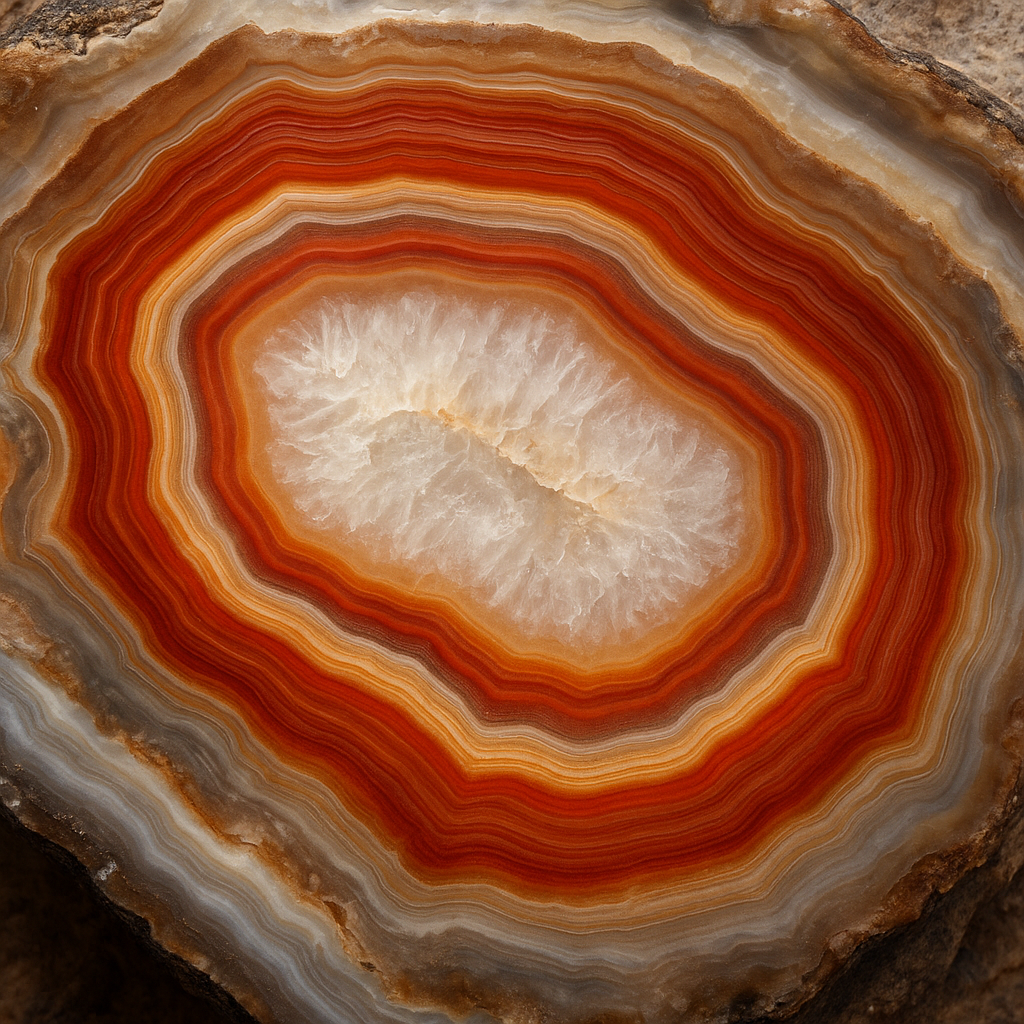
At its core, agate is a form of chalcedony, itself a cryptocrystalline variety of silica (SiO2). The stone forms when silica-rich fluids percolate into cavities and voids within host rocks, commonly volcanic rocks such as basalt or in sedimentary environments where silica can precipitate. Over long periods of time, silica is deposited in layers along the walls of cavities, producing the concentric banding that makes agate so visually distinctive. These layers can differ in composition, trace minerals and microscopic texture, creating subtle variations in refractive index and color.
Typical formation settings
- Vesicles in volcanic flows (most common) where gas bubbles left pockets for mineral deposition.
- Geodes and nodules in sedimentary formations where silica-rich groundwater precipitates micrometric crystals.
- Replacement of organic material such as fossil wood, producing agatized wood (petrified wood).
Variations in temperature, pH, and the availability of trace elements like iron, manganese, titanium and chromium influence color and pattern. Inclusions of iron oxides create red and brown hues, manganese produces black dendritic patterns, and other impurities can yield blues, greens and yellows. In some agates, microscopic structures or thin layers cause optical phenomena—fire agate shows iridescent flashes due to the diffraction and interference of light through thin layers of silica and oxide films.
Where Agates Occur: Notable Localities
Agates are truly global in distribution, but certain regions are especially famous either for quantity, unique varieties, or historical lapidary industries.
Major producing regions
- Brazil (Rio Grande do Sul, Minas Gerais) — one of the largest modern sources of colorful agates and large geodes.
- Uruguay — complementary deposits with Brazil, especially noted for dark, richly colored agates.
- Botswana — famous for banded grey and pink “Botswana agate” prized in fine jewelry for its fine lines.
- Mexico (Chihuahua) — home to striking „crazy lace” and fire agates with vivid patterns and play-of-color.
- United States — notable occurrences include Lake Superior agates (Minnesota, Michigan), Montana agates, and agates from Oregon and Idaho.
- India — abundant, historically significant material especially for bead-making and carving.
- Germany (Idar-Oberstein) — historically central to the agate cutting and trade industry; many agates were imported, cut and re-exported from here.
- Madagascar, Indonesia and Australia — important sources for modern collectors and lapidaries.
In many cases, the best agates are found by prospecting near old volcanic flows, in stream gravels that concentrate resistant agate nodules, or in quarries where geodes and nodules can be opened and examined.
Varieties and Decorative Patterns
Agate exhibits a remarkable diversity of names and descriptive categories tied to its appearance:
- Plume agate — contains feather-like or plume-shaped inclusions, often from manganese oxides (dendritic patterns).
- Fortification agate — concentric patterns resembling the ramparts of a fortress; prominent in many classic agates.
- Eye agate — banding forms circular „eye” shapes.
- Crazy lace agate — complex, swirling lace-like bands, famously from Mexico.
- Blue lace agate — delicate blue and white banding, popular in jewelry and beads.
- Fire agate — shows iridescence or „fire” from layered structures or oxide films.
- Agatized wood — wood replaced by chalcedony, preserving growth rings and cellular structure.
Collectors prize certain patterns and color contrasts, while lapidaries value material that polishes to a high shine and reveals internal beauty when sliced and polished.
Historical and Cultural Significance
Agate has been used since prehistoric times. Archaeological discoveries show beads, pendants and small carved objects made of agate and other chalcedonies in Neolithic and Bronze Age sites. The stone’s durability, ready polishability and aesthetic appeal made it ideal for personal ornament and small tools.
- Ancient civilizations — Egyptians, Greeks and Romans carved intaglios, seals and amulets from agate. The banding was often used decoratively or to highlight carved scenes.
- Idar-Oberstein — from the 15th century onward this German town became central to agate cutting; artisans developed sophisticated tumbling, sawing and polishing techniques and built a global trade network.
- Traditional beliefs — across cultures agate was credited with protective, healing and stabilizing properties; it was worn as a talisman to ward off danger and to strengthen perseverance.
Beyond personal ornament, large polished agate slices and slabs are used in luxury interiors and religious objects. Museums and collectors prize historical agate cameos and intaglios for both artistry and the rarity of certain patterns.
Uses: Jewelry, Lapidary Work, Industry and Science
Agate’s hardness (about 6.5–7 on the Mohs scale) and the ability to take an excellent polish make it a favorite for many uses.
Jewelry and Decorative Objects
- Cabochons, beads and inlays in rings, pendants and bracelets.
- Bookends, coasters, tabletops and ornamental bowls cut from large agate slabs.
- Intaglio and cameo carving where contrast between bands enhances the relief.
Lapidary and Artistic Uses
- Agate is prized by lapidaries because fine banding yields spectacular visual results when sliced and polished.
- It is used for mosaics and inlay work where small pieces are assembled into detailed patterns.
Scientific and Industrial Applications
- Agate mortar and pestles — used in laboratories for grinding chemicals where a hard, virtually non-contaminating surface is needed.
- Precision bearings and pivots — historically, agate was used for jewel bearings in measuring instruments and watches because of its hardness and low friction characteristics.
- Optical uses — historically, finely polished agate lenses and components were sometimes used in early optical instruments.
These practical roles leverage agate’s combination of hardness, chemical resistance and fine-grained structure. In jewelry, agate’s stability and affordability make it a go-to material for both mass-produced and bespoke designs.
Identification, Treatments and Imitations
Because agate is common and attractive, it is often dyed, heat-treated or otherwise enhanced to produce vivid colors and uniform appearance. Simple identification techniques and awareness of treatments help buyers and collectors make informed choices.
- Natural agates typically show banding and gradual color transitions; bright uniform colors often indicate dyeing.
- Polish a cut surface and inspect under a loupe — dye may concentrate along fractures or pores.
- Heat treatment is sometimes used to intensify color; this is generally stable but should be disclosed.
- Synthetic chalcedony or glass can mimic agate; look for air bubbles (glass) and unnatural uniformity.
Reputable sellers will disclose treatments. For collectors, provenance and cut quality are as important as color—certain localities and patterns command premium prices.
Care, Cutting and Lapidary Techniques
Caring for agate is straightforward due to its hardness and toughness, but gentle handling preserves polish and prevents damage to delicate inlays.
- Cleaning — warm soapy water and a soft brush are usually sufficient; avoid prolonged exposure to harsh acids or strong alkaline solutions.
- Avoid sudden temperature shocks which could produce thermal stress fractures, especially in stones with internal inclusions.
- Dyed agates may fade if exposed to prolonged sunlight; keep such pieces shaded or stored away from direct light.
Lapidaries cut agate with diamond saws and lap wheels, using progressively finer abrasives to reveal internal patterns and achieve a high-gloss polish. Cabochons are the most common form for jewelry, while thin slices are prized for display and for making decorative items.
Collecting and Valuing Agates
Value in agate collecting is guided by several factors beyond basic rarity. A specimen with exceptionally fine, tight banding or a rare color combination can fetch high prices. Conversely, heavily fractured or poorly banded material is far less valuable even if large.
- Factors influencing value: clarity of pattern, color contrast, size, provenance and workmanship.
- Unique specimens — such as particularly vivid fire agates or unusual dendritic plumes — are especially sought after.
- Historical provenance (e.g., carved objects from classical antiquity or pieces that passed through Idar-Oberstein workshops) adds significant premium.
For hobbyists, collecting agates can be as simple as beachcombing or searching streambeds; for serious collectors, field trips to classic localities or purchasing from reputable dealers yields the most prized specimens.
Interesting Facts and Lesser-Known Uses
A few intriguing notes highlight agate’s versatility and cultural reach:
- Agate beads are among the earliest forms of personal adornment, with some examples dating back several thousand years.
- Because of its hardness and resistance to chemical attack, agate has been used historically in tools and implements like knife handles and small grinding implements.
- Agate slices with dramatic banding are often used in contemporary interior design as backlit features, showcasing translucence and color when illuminated.
- Certain agates display photonic-like structures creating iridescence; fire agate’s shimmering effect continues to fascinate gemologists and collectors.
From ancient amulets to modern laboratory mortars, from polished jewelry to grand decorative installations, agate remains a stone that blends natural history, human craft and scientific utility. Its enduring appeal lies in the combination of beauty, durability and an almost infinite capacity for visual variety.