Obsidian is a fascinating natural material that bridges the worlds of geology, archaeology, craft, and art. Formed when molten rock cools so rapidly that crystals do not have time to grow, this glassy substance has been prized for its utility and beauty for tens of thousands of years. In the paragraphs that follow you will find an exploration of its origins, global distribution, physical characteristics, historical and modern uses, cultural meanings, and a few surprising facts that highlight why obsidian continues to capture human imagination.
Formation and Geological Characteristics
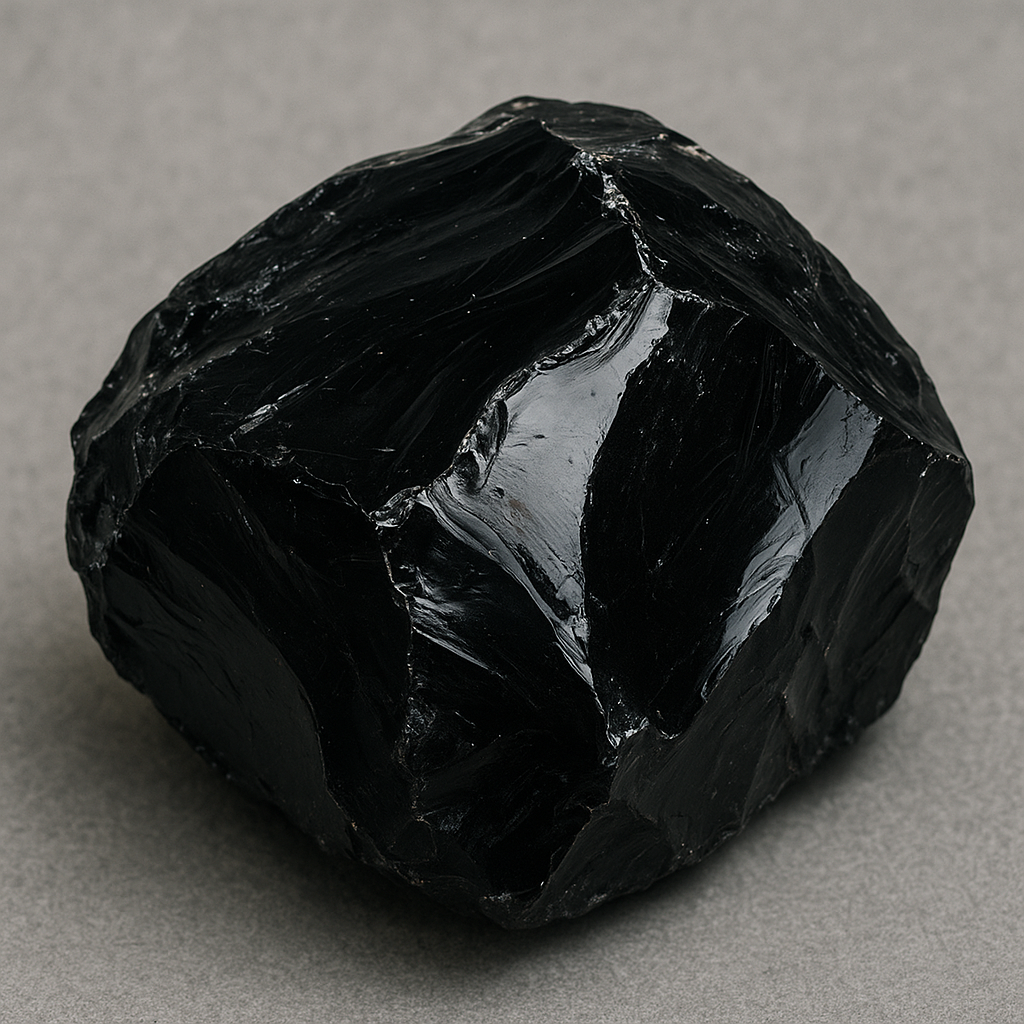
Obsidian is a type of volcanic glass composed primarily of silica (SiO2). It forms when high-silica lava extruded from a volcano cools extremely quickly, preventing the formation of a crystalline structure. Because of this rapid quenching, the resulting material is amorphous rather than mineralogically crystalline, which gives obsidian its characteristic smooth, glass-like texture.
Typical geological settings for obsidian formation include the margins of rhyolitic lava domes, the edges of flows, or in the chilled surfaces of high-silica volcanic flows. The chemistry of the parent magma—rich in silica and relatively poor in dissolved gases—favors glass formation. Within such environments, cooling rates, volatile content, and local temperature gradients determine whether a flow will become crystalline rock such as rhyolite or remain glassy as obsidian.
Despite its glassy appearance, obsidian can display a variety of internal textures and inclusions. Small crystalline spherulites composed of cristobalite or other silica polymorphs can grow inside obsidian over time, forming the familiar white “snowflake” patterns. Tiny gas bubbles or layers of microscopic impurities may produce iridescent sheens or rainbow effects in so-called “rainbow obsidian.” The color range—black, brown, green, gray, or even translucent hues—depends on trace elements such as iron and magnesium, as well as microscopic inclusions of magnetite or other phases.
Where Obsidian Occurs — Global Distribution
Obsidian has been documented on nearly every continent where recent (geologically speaking) volcanic activity occurred. Some well-known occurrences include:
- North America: Obsidian Cliffs in Yellowstone National Park, Glass Buttes in Oregon, and deposits near Newberry Volcano in Oregon, as well as Mount St. Helens and areas of California and Arizona.
- Mesoamerica: Numerous high-quality obsidian sources in central Mexico (Pachuca, Otumba), Guatemala, and the Maya lowlands were exploited intensively in pre-Columbian times.
- Europe: The Italian island of Lipari, the Greek island of Milos, and certain localities in Turkey and Armenia produced classical obsidian used since antiquity.
- Asia: Regions of Japan and the Caucasus produced deposits that were central to prehistoric tool industries and later crafts.
- South America and the Pacific: Scattered deposits served island communities and Andean cultures.
Ongoing volcanic activity and post-eruptive processes mean that new obsidian can form whenever the right chemical and cooling conditions arise. Because obsidian sources are often geographically restricted and geochemically distinctive, archaeologists can use obsidian composition to trace ancient trade and exchange networks across vast distances.
Physical Properties and Identification
Obsidian’s most striking physical attribute is its smooth, glassy fracture. It breaks with a conchoidal fracture, producing curved surfaces and extremely sharp edges. This property made obsidian an ideal raw material for producing cutting implements in prehistory and even in specialized modern contexts.
- Hardness: On the Mohs scale obsidian ranks around 5 to 5.5—softer than many crystalline silicates, but hard enough to hold a fine edge.
- Brittleness: It is brittle and shatters under impact, so while the edges are razor-sharp, the material is prone to chipping.
- Fracture: The conchoidal pattern enables skilled knappers to produce very fine flakes and blades with predictable geometry.
- Density: Typical densities range around 2.3 to 2.6 g/cm³.
Field identification is usually straightforward: obsidian’s glossy luster, conchoidal break, and often dark color are distinctive. However, some natural glasses such as pitchstone or perlite can be confused with obsidian, and human-made glasses obviously share characteristics. Geochemical analysis with portable XRF or petrographic microscopy can confirm provenance and composition.
Ancient and Archaeological Uses
For tens of thousands of years human societies exploited obsidian for its exceptional sharpness and predictable fracture mechanics. From Paleolithic bladelets to complex projectile points, obsidian artifacts appear in archaeological sites worldwide.
- Stone tools: Obsidian was knapped into blades, scrapers, and points that rivaled later metal implements in cutting ability. Archaeological pieces such as Clovis points in North America and Levallois-like flakes in Eurasia show advanced flaking techniques.
- Trade and exchange: Because obsidian sources are limited and individually distinctive, obsidian pieces found far from their source reveal extensive prehistoric trade routes. Geochemical sourcing has mapped movement of goods across continents and helped reconstruct social networks.
- Ritual: Many cultures used obsidian in ritual contexts—mirror-polished pieces, sacrificial blades in Mesoamerica, and symbolic ornaments in Neolithic Europe.
- Tools for medicine: Some ancient cultures used obsidian blades in trepanations or surgical procedures; the fine edge allowed precise incisions.
Archaeologists often employ techniques such as obsidian hydration dating—measuring the thickness of a hydration rim that forms over time—to estimate when an object was made or modified. While environmental variables complicate absolute dating, the method can provide useful relative chronologies.
Modern Applications and Craft
Obsidian remains valued today in both practical and aesthetic applications. Artisans and jewelers work with it to create cabochons, beads, carvings, and inlay work. Its glassy black or variegated surfaces make it popular for contemporary jewelry and decorative objects.
- Jewelry: Polished obsidian is fashioned into necklaces, rings, and ornamental stones. Varieties like snowflake obsidian and sheen obsidian are prized for their visual patterns.
- Surgical scalpels: Surprisingly, obsidian blades are still used in specialized surgical contexts. When sharpened to a molecular edge, obsidian can produce cuts with less tissue trauma than steel, making it the subject of medical research into microsurgery and research nicking blades.
- Lapidary and carving: Carvers value obsidian for its workability with abrasive tools and its ability to take a high polish.
- Collecting and education: Geological collections, museums, and educational displays frequently include obsidian specimens because they tell a clear story about rapid cooling and glass formation.
Varieties and Visual Characteristics
Obsidian appears in several visually distinct types, each with names that reflect their appearance or origin:
- Black obsidian: The most common, typically opaque and jet-black due to tiny inclusions of magnetite.
- Mahogany obsidian: Brownish-black with streaks and swirls from iron impurities.
- Snowflake obsidian: Contains white cristobalite spherulites that create striking snowflake-like patterns.
- Rainbow or sheen obsidian: Displays iridescent colors or metallic sheens caused by microscopic layers and inclusions that diffract light.
- Apache tears: Rounded nodules of obsidian, typically found in volcanic tuff or perlite, often translucent at the edges when held to light.
These varieties influence both the material’s value in craft and the approaches used by knappers and carvers. For example, snowflake obsidian may be preferred for ornamental work, while uniformly dense black obsidian is often selected for fine flaking and tool replication.
Cultural Significance and Mythology
Across cultures, obsidian has accrued symbolic and spiritual meanings. Because of its mirror-like potential when polished, several civilizations used obsidian for divination and ritual purposes.
- In Mesoamerica, the Aztecs used polished obsidian mirrors for ritual and possibly scrying; the god Tezcatlipoca’s name even translates to something like “Smoking Mirror.”
- In various indigenous traditions, obsidian was attributed protective qualities and used as amulets against negative forces.
- Scholars of folklore note obsidian’s association with thresholds—sharpness, clarity, and the boundary between inner sight and outer world.
These cultural roles gel with obsidian’s physical realities: a dark, reflective surface that reveals and conceals simultaneously, and an edge that can sever or heal.
Techniques: Knapping, Cutting, and Conservation
The art of shaping obsidian—often called knapping—requires skill and understanding of its conchoidal fracture. Techniques include pressure flaking, percussion flaking, and bipolar reduction. Modern practitioners and experimental archaeologists recreate tools to understand ancient technologies and performance characteristics.
Conservation of obsidian artifacts demands care. Because it is glassy and brittle, obsidian can develop chips, cracks, or weathering effects such as the slow devitrification that produces a dull rind. Museums often control humidity and handle obsidian with soft supports to prevent scratching. When exhibited, labels should avoid direct contact; when stored, pieces are cushioned to prevent impacts.
Scientific and Analytical Applications
Obsidian plays a role in multiple scientific fields:
- Archaeometry: Geochemical fingerprinting (XRF, INAA, ICP-MS) traces obsidian artifacts to their geological sources, mapping trade, migration, and social interaction patterns in prehistory.
- Geochronology: Obsidian hydration dating, though complex, is a tool in establishing relative timelines at archaeological sites.
- Materials science: Study of glass formation and devitrification in obsidian informs broader understanding of amorphous materials and volcanic processes.
- Environmental monitoring: Fresh obsidian deposits and their weathering products help geologists interpret past volcanic events and surface processes.
Care, Identification Tips, and Ethical Sourcing
If you possess or intend to acquire obsidian, a few practical recommendations are useful:
- Handle obsidian gently; avoid dropping it onto hard surfaces to prevent chipping.
- Clean with a soft cloth and mild soap; avoid harsh chemicals or ultrasonic cleaners that might stress the material.
- When buying, ask for provenance. Ethically sourced obsidian—especially artifacts—should come with documentation to avoid illicit trade in cultural property.
- For hobbyists interested in knapping, wear eye protection and appropriate gloves; flakes can be razor-sharp and dangerous.
Compelling Facts and Lesser-Known Details
A few intriguing points that often surprise readers:
- At a microscopic level, an obsidian edge can be far sharper than a steel scalpel—this explains why experimental surgical teams still investigate obsidian blades for some precise incisions.
- Obsidian trade served as one of the earliest examples of long-distance exchange networks. In certain regions, pieces moved hundreds of kilometers from source, linking distant communities.
- Because each source has a unique trace-element signature, modern portable analytical tools enable archaeologists to run non-destructive sourcing in the field.
- Obsidian is not immortal: over geological time it can slowly crystallize, forming spherulites or becoming perlitic, altering its appearance and mechanical behavior.
Final Notes on Value and Continued Relevance
Today obsidian continues to be valued for both practical properties and aesthetic allure. Whether considered as a window into volcanic processes, a key to unlocking ancient trade routes through geochemical fingerprinting, or a material for contemporary design and surgical innovation, obsidian stands at the intersection of science, history, and art. Its capacity to form ultra-sharp edges, its distinctive visual varieties, and its deep cultural resonances ensure that obsidian remains a subject of study and admiration across many disciplines.