
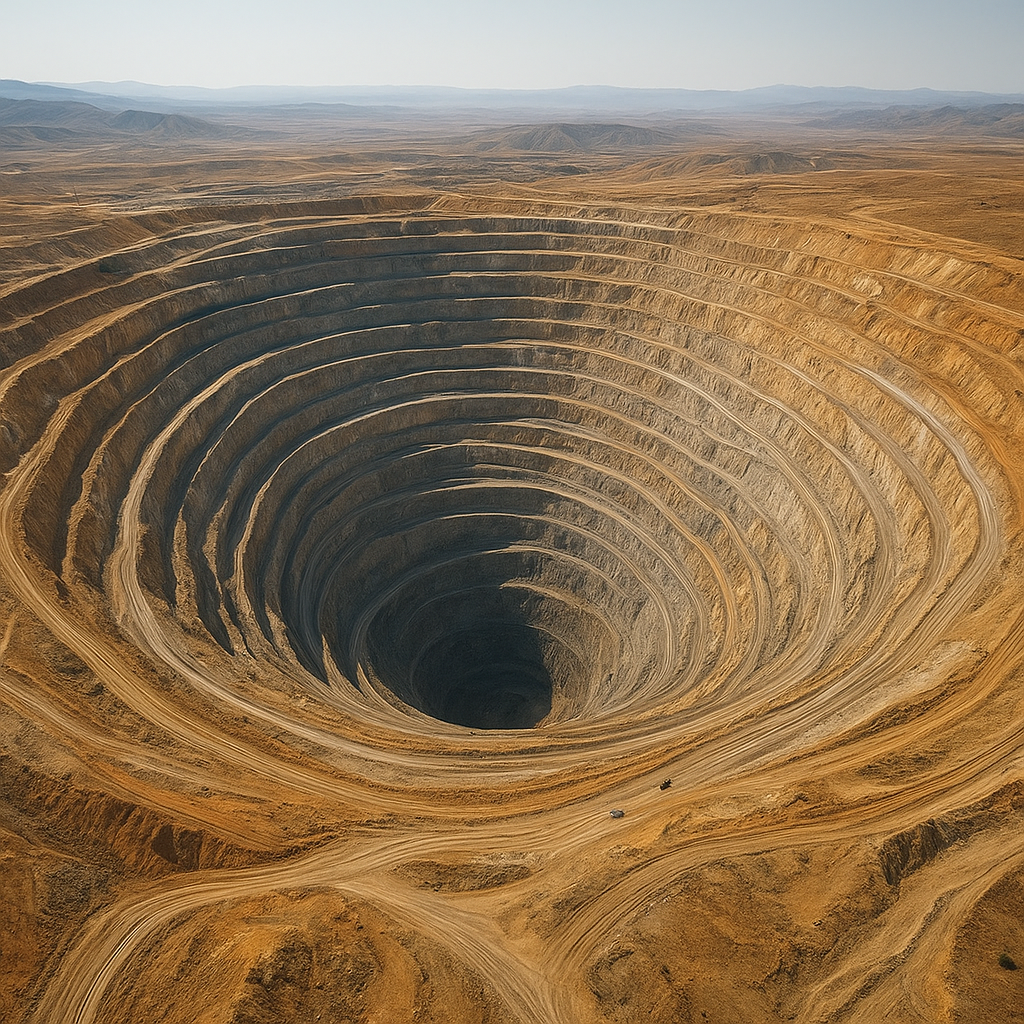
The Muruntau mine is one of the most remarkable mining complexes on Earth, located in the heart of Central Asia. Its story combines geology, industrial scale, and national economics: a vast open-pit operation that has shaped the modern mining identity of Uzbekistan. This article outlines where Muruntau sits on the map, what is extracted there, how it is mined and processed, and why it matters economically and socially. In addition, several less-known and intriguing aspects of the site are presented for readers who want to understand the mine beyond statistics.
Location and geological setting
The Muruntau mine lies within the Kyzylkum Desert in central Uzbekistan, in the administrative region near the city of Navoi. Positioned in an arid, sparsely populated landscape, the mine occupies an area where the visible surface hides a very large, low-grade gold system. The deposit type is characterized by a large, bulk-tonnage body rather than a small, high-grade vein — geology that makes the deposit well suited to large-scale open-pit mining techniques.
From a geological perspective, Muruntau represents a classic example of a huge hydrothermal gold system where mineralizing fluids percolated through host rocks and precipitated gold and associated sulfide minerals. The ore is generally low grade by grade-per-ton standards but enormous in volume, which is the primary reason the site became economically viable. Geological exploration over decades has delineated a resource that allowed continuous operations on a vast scale.
Regional context
The mine sits within a broader mining district that hosts several other deposits and mining operations. Historically explored during the Soviet period, Muruntau was developed into a major industrial asset and retained strategic importance after Uzbekistan’s independence. Its remote desert setting poses logistical challenges and has influenced the development of supporting infrastructure — roads, camps, power lines, and water supply systems — necessary for a continuous mining operation.
What is mined and how it is processed
The primary commodity extracted at Muruntau is gold. Although other metals and by-products (such as silver traces in concentrates) can occur, the mine is overwhelmingly focused on gold production. The overall model is based on exploiting vast volumes of rock that contain relatively low concentrations of gold but, when processed in bulk, yield significant quantities of the metal.
Mining methods
As an expansive open-pit operation, Muruntau uses large-scale pit benches, drilling, blasting, and heavy mobile equipment — power shovels, hydraulic excavators, and enormous haul trucks — to move rock and ore. The mining philosophy prioritizes maximum extraction with continuous removal of overburden and ore to maintain a productive pit life. Because the ore is low-grade, economies of scale and cost-efficient mass mining are essential for profitability.
Ore processing
Processing typically involves a sequence of crushing, grinding, and metallurgical treatment tailored to extract gold economically from low-grade material. One widely used method for similar deposits is heap leaching, where crushed ore is placed on large pads and irrigated with a leaching solution to dissolve gold. The solution is collected and processed to recover gold through adsorption, elution, and smelting into doré bars. At facilities of Muruntau’s scale, a combination of heap-leach and more conventional carbon-in-pulp or carbon-in-leach techniques can be found, adapted to the specific mineralogy of the ore. Overall, the operation integrates large crushing circuits, agitation leach tanks, solvent extraction or carbon systems, and refining elements.
Processing infrastructure and logistics
Maintaining continuous production requires extensive supporting infrastructure: crushing plants, conveyors, leach pads, cyanide recovery systems, water treatment plants, and facilities for tailings management. The desert environment makes water a critical constraint; therefore, water recycling and efficient use are priorities. Power supply and transport corridors are likewise essential to move ore, consumables, and refined product to domestic or export channels. For security and regulatory reasons, access to certain parts of the complex is restricted and closely managed by the operating company.
Economic significance
Muruntau is a cornerstone of Uzbekistan’s mining industry and a major contributor to the national economy. Operated by the state-controlled mining enterprise (commonly known by its Russian abbreviation), the mine has long provided a steady stream of export revenue, hard currency earnings, and employment. Revenue from gold production supports public finances, funds investments in regional infrastructure, and underpins the balance of payments for the country.
Contribution to state revenue and exports
Gold from Muruntau bolsters the national treasury through direct sales, taxes, and dividends from the state enterprise. Given gold’s status as a high-value, exportable commodity, Muruntau helps diversify Uzbekistan’s export base — lessening dependence on a narrow range of raw materials and contributing to the country’s resilience to external economic shocks. The mine’s output has been used both for export and for strengthening national gold reserves.
Employment and regional development
At the local level, Muruntau supports thousands of jobs directly and indirectly: miners, plant operators, engineers, maintenance crews, contractors, and service providers. Its presence has stimulated the development of nearby towns and logistic hubs, improved local roads, and provided opportunities for businesses that supply goods and services to the operation. Training programs and technical education tied to the mine have also increased skill levels in the region.
Strategic industrial role
Beyond immediate revenue and jobs, the Muruntau complex has catalyzed additional industrial activity, such as refining, metallurgy, and engineering services. The technical knowledge developed at the site has been a foundation for other mining projects in Uzbekistan and the wider region, elevating the country’s profile as a producer and manager of large mining operations.
Environmental and social challenges
Large-scale mining in a fragile desert environment inevitably brings environmental and social responsibilities. Key issues include water consumption, management of tailings and waste rock, dust and air quality impacts, and the visual footprint of a massive open pit on the landscape. The mine’s operators must balance production goals with the need for responsible environmental stewardship and mitigation measures.
Water management and desert constraints
Because Muruntau is located in an arid region, water use is a major operational concern. The mine employs water-saving technologies and recycling schemes to reduce fresh water consumption. Desalination, groundwater management, and water recycling systems are commonly implemented in desert mining operations to ensure sustainable use of scarce resources and to limit impacts on local water tables.
Tailings, waste, and reclamation
Handling tailings and waste rock safely is paramount. Tailings facilities must be properly engineered and monitored to prevent contamination and ensure long-term stability. Contemporary practice increasingly emphasizes progressive reclamation — reshaping and revegetating mined areas as operations permit — although the scale of Muruntau means full reclamation will be a long-term, multi-decade task.
Community and social programs
Mining operations of Muruntau’s size typically support community development initiatives: housing, medical facilities, schools, and local infrastructure improvements. Companies and authorities are required to engage with local populations to address impacts and to distribute benefits in a sustainable manner. Worker safety, occupational health, and labor standards remain central to social license to operate.
Interesting facts and historical notes
- Muruntau is often cited among the largest open-pit gold mines in the world, not because the ore is exceptionally rich, but because of the enormous volume of rock processed.
- The site was intensively explored and developed during the Soviet era; after Uzbekistan gained independence, Muruntau remained a strategic asset and continued to expand under national management.
- Because of the mine’s scale and the nature of the surrounding desert, it is frequently referenced in discussions about the limits of single-asset dependence in a national economy.
- Operating in the desert has required considerable investment in logistics, from road networks to energy and water systems designed to support an industrial community in a remote area.
- Muruntau’s output has been an important source of foreign exchange, helping Uzbekistan to finance imports and development projects.
Technological and managerial aspects
Managing an operation like Muruntau requires a broad suite of technologies and a large organizational structure. Fleet management systems, modern drilling and blasting techniques, geotechnical monitoring, and metallurgical optimization are all critical to safe, efficient, and environmentally responsible production. The operational knowledge captured at Muruntau has been disseminated across Uzbekistan’s mining sector and applied to other projects and deposits.
Geopolitical and market influences
Gold prices and global market conditions directly influence the economic return from large mines. When gold prices rise, even lower-grade ore becomes more profitable, which reinforces the strategic importance of a high-volume producer like Muruntau. Conversely, operational costs, currency fluctuations, and export policies can affect the net benefit to national revenue. Consequently, the mine’s fortunes are intertwined with both global commodity cycles and domestic policy decisions.
Future outlook and ongoing developments
Looking ahead, the Muruntau complex is likely to remain an important mining center for Uzbekistan for many years. Ongoing exploration in the district may expand the resource base or identify satellite deposits that can be integrated into the existing infrastructure. Technological improvements in processing efficiency, water use reduction, and environmental management are expected to play a role in extending the mine’s life while reducing ecological footprint.
Strategic planning at the national level can also influence the mine’s trajectory: investment in downstream processing, diversification of the mining sector, and policies encouraging private sector participation or foreign partnerships may all change how Muruntau contributes to the economy. Regardless of the precise path, the site stands as a major example of how geology, engineering, and public policy intersect in the extraction of mineral wealth.
For anyone interested in the scale and impact of modern mining, Muruntau offers a compelling case study: a vast, desert-based, state-operated complex centered on gold extraction that has shaped regional development, contributed significantly to national finances, and presented long-term challenges in environmental stewardship and resource management.

