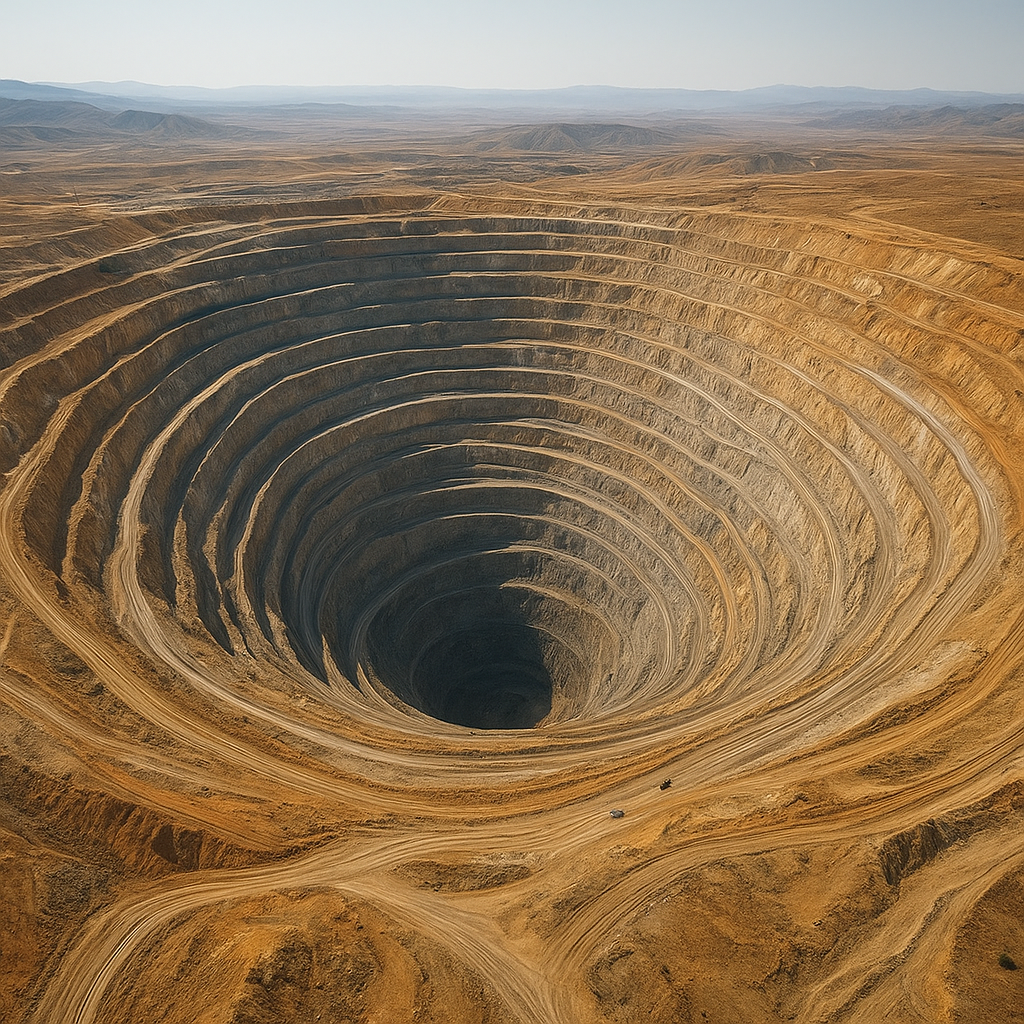
The Bingham Canyon Mine, often called the Kennecott Copper Mine, stands as one of the most remarkable industrial landscapes on Earth. Located in the western United States, it is an emblem of large-scale mineral extraction and technological evolution in mining. This article examines where the mine is, what is extracted there, its economic importance, and several notable and sometimes surprising aspects of its history and operation.
Location and geology
The Bingham Canyon Mine lies on the western slope of the Oquirrh Mountains in Utah, roughly 30 kilometers (about 20 miles) southwest of downtown Salt Lake City. The mining complex sits near the small communities of Copperton and Bingham, with frontage on Interstate 80 and visible from many vantage points in the Salt Lake Valley. Its geographic coordinates are commonly reported near 40.53°N, 112.18°W, placing it in a semi-arid highland zone with rugged mountain scenery.
Geologically, Bingham Canyon is a classic example of a porphyry copper deposit. Porphyry systems form when large volumes of hydrothermal fluids circulate through crystalline host rocks, precipitating disseminated sulfide minerals over a broad area. The deposit at Bingham is hosted in Precambrian to Tertiary-age rocks of the Oquirrh range and contains copper-bearing minerals such as chalcopyrite along with significant quantities of gold, silver, and other byproducts such as molybdenum. The distribution of mineralization in large, low-grade disseminations is what made the site suitable for large-scale open-pit mining, rather than underground methods.
History and development
People have known about copper in the Bingham Canyon area since the mid-19th century. Small-scale mining and prospecting began in the 1860s and 1870s, but the transformation into a modern, industrial-scale operation took place in the early 20th century. The key development was the adoption of large-scale open-pit mining techniques, driven by technological innovation and capital investment.
At the turn of the 20th century, entrepreneurs and mining engineers recognized the potential of the low-grade, but extensive, copper mineralization. Companies consolidated claims and introduced mechanized extraction; notable figures such as Daniel C. Jackling played roles in making large-scale open-pit copper mining commercially viable. Over the following decades the site expanded into a vast pit with terraced benches, haul roads, and extensive processing infrastructure.
Throughout the 20th and into the 21st century, the mine changed owners and corporate structures but continued continuous operation. For much of its modern history the site has been operated by Kennecott Utah Copper, a major mining division. The mine has weathered price cycles, technological shifts, and environmental regulation changes while remaining one of the largest mining operations in the United States.
Production, minerals and methods
Primary production at Bingham Canyon is centered on copper, but the operation yields several important byproducts that significantly enhance its economic return. Processing recovers substantial quantities of gold and silver and smaller but valuable amounts of molybdenum and other elements. Over more than a century of operation the mine has produced tens of millions of tonnes of copper and large volumes of precious metals, making it one of the most productive single-source mining sites in history.
Mining method
- Open-pit mining: The mine uses a large-scale open-pit (or open-cast) approach, removing overburden and ore in bench layers. Massive haul trucks and shovels carry crushed rock from the benches to primary crushers and conveyors.
- Comminution and concentration: Crushed ore is ground and subjected to flotation processes to produce copper concentrates, which are further refined. Concentration increases the copper content before smelting and refining.
- Processing byproducts: During concentration and subsequent processing, recoverable amounts of gold, silver, and other metals are separated and sold.
Scale and engineering
The pit has grown to enormous proportions through successive expansions. The terraced slopes form iconic concentric rings etched into the mountain, creating a layered, amphitheater-like profile. The scale of equipment used—shovels, haul trucks, crushers, and conveyors—is among the largest in industrial mining, and the logistical coordination of material handling, blasting, and processing is a major engineering task.
Economic significance
Bingham Canyon Mine plays an outsized role in regional and national mineral production. Its long-term output of copper and precious metals has supported manufacturing, construction, electronics, and national defense supply chains. Copper itself is a critical industrial metal used in electrical wiring, motors, plumbing, telecommunications, renewable energy systems, and electric vehicles—applications that have only increased copper’s strategic importance in recent decades.
- Employment: The mine and its supporting operations provide hundreds to thousands of jobs directly and support many more in the supply chain, including contractors, transporters, parts suppliers, and professional services.
- Tax and royalty revenue: State and local governments have benefitted from taxes, royalties, and other payments tied to production and property, contributing to public budgets and infrastructure.
- Export and trade: Concentrates and refined metals have been a component of U.S. mineral exports. Large producers such as Bingham influence market supply and can affect prices and investment decisions.
- Downstream industry: Copper from the mine feeds manufacturing sectors that produce wires, cables, electronic components, and industrial machinery—linking an exposed Utah slope to global supply chains.
Beyond raw economics, the mine’s presence has shaped local communities. Company towns and neighborhoods grew around operations, and local identity and history are intertwined with the mine’s cycles of boom and adjustment. Philanthropic and civic investments by mining companies have also influenced education, recreation, and museum projects in the region.
Environmental management, safety and reclamation
Large-scale mining inevitably raises environmental concerns, and Bingham Canyon has been no exception. Over the decades, regulatory standards and company practices evolved in response to spills, emissions, tailings management challenges, and community expectations. Contemporary operations emphasize environmental controls, monitoring, and progressive reclamation.
- Water management: Because mining interacts with runoff and groundwater, modern facilities implement water treatment plants, containment systems, and monitoring networks to limit impacts on downstream water quality.
- Tailings and waste rock: Tailings basins and engineered storage facilities are used to contain processed residues. Long-term stability and closure plans are essential elements of permit requirements.
- Air quality and dust control: Dust suppression, fugitive emissions controls, and particulate monitoring help mitigate air-quality impacts affecting nearby communities.
- Reclamation: Progressive reclamation—filling and shaping disturbed areas, replanting native vegetation, and restoring drainage—is integrated into modern mine life-cycle planning. Reclamation funding and bonding ensure costs are accounted for after mine closure.
Safety is also central. Mining at this scale requires rigorous procedures for blasting, slope stability, heavy equipment operation, and emergency response. One notable safety-related event in the mine’s recent history was the massive landslide in April 2013. A colossal slump of rock and debris descended into the pit; while it was one of the largest non-volcanic landslides in modern mining history, there were no reported injuries because operations had been paused and monitoring had provided advance warning. The event prompted reviews of geotechnical monitoring systems and reinforced the importance of real-time slope and seismic monitoring in large pits.
Interesting facts and cultural impact
Bingham Canyon Mine is not only important economically and geologically—it has also attracted attention for several intriguing reasons.
- Visible from space: The mine is large enough to be seen from orbit. Astronauts aboard the International Space Station and satellite imagery regularly capture the glazed terraced rings of the pit.
- One of the largest excavations: It is often cited among the largest man-made excavations in the world by both volume and surface area. The scale of the pit makes it a landmark and a subject of photographs, documentaries, and study.
- Historic technological development: The mine was a proving ground for new large-scale mining techniques that later spread to other porphyry deposits worldwide. Innovations in blasting, hauling, and processing at Bingham helped shape modern metallurgical practices.
- Economic lifeline and cycles: The mine demonstrates how a single large resource deposit can influence local economies, public infrastructure, and labor markets over many decades—through periods of high commodity prices and through downturns.
- Mining heritage: Museums and interpretive centers near the mine chronicle the human story—miners, families, and communities—linking industrial heritage with regional culture.
From a scientific standpoint, the site is a natural laboratory for geologists and mining engineers who study ore-forming processes, slope stability, and mine reclamation practices. For policymakers and environmental scientists, Bingham is an example of how long-lived industrial operations intersect with regulatory frameworks, community expectations, and evolving standards for environmental stewardship.
Current trends and future outlook
The future of the Bingham Canyon Mine is shaped by several converging trends. Global demand for copper is expected to grow as electrification, renewable energy deployment, and the expansion of electric vehicles increase demand for conductive materials. That demand supports continued investment in efficient extraction and processing at established sites.
Operationally, mines like Bingham must adapt through automation, improved energy efficiency, and more effective waste and water management. Advances in processing can improve recovery rates and reduce environmental footprints. In addition, social license to operate—community trust and regulatory compliance—remains critical for long-term viability.
Finally, when the mine reaches the end of its economically recoverable resources, careful closure and reclamation will shape the legacy of the site. Planning for a post-mining landscape that is stable, ecologically functional, and safe for future generations is an increasingly central element of modern mining practice.
Conclusion
At the intersection of geology, engineering, economics, and community life, the Bingham Canyon Mine exemplifies the scale and complexity of modern mineral production. Its vast open pit encapsulates more than a century of technological change and economic influence while highlighting the environmental responsibilities that accompany large industrial operations. For many the mine is a symbol of industrial achievement; for others it is a reminder of the trade-offs inherent in extracting the raw materials that power modern life.